Zoom
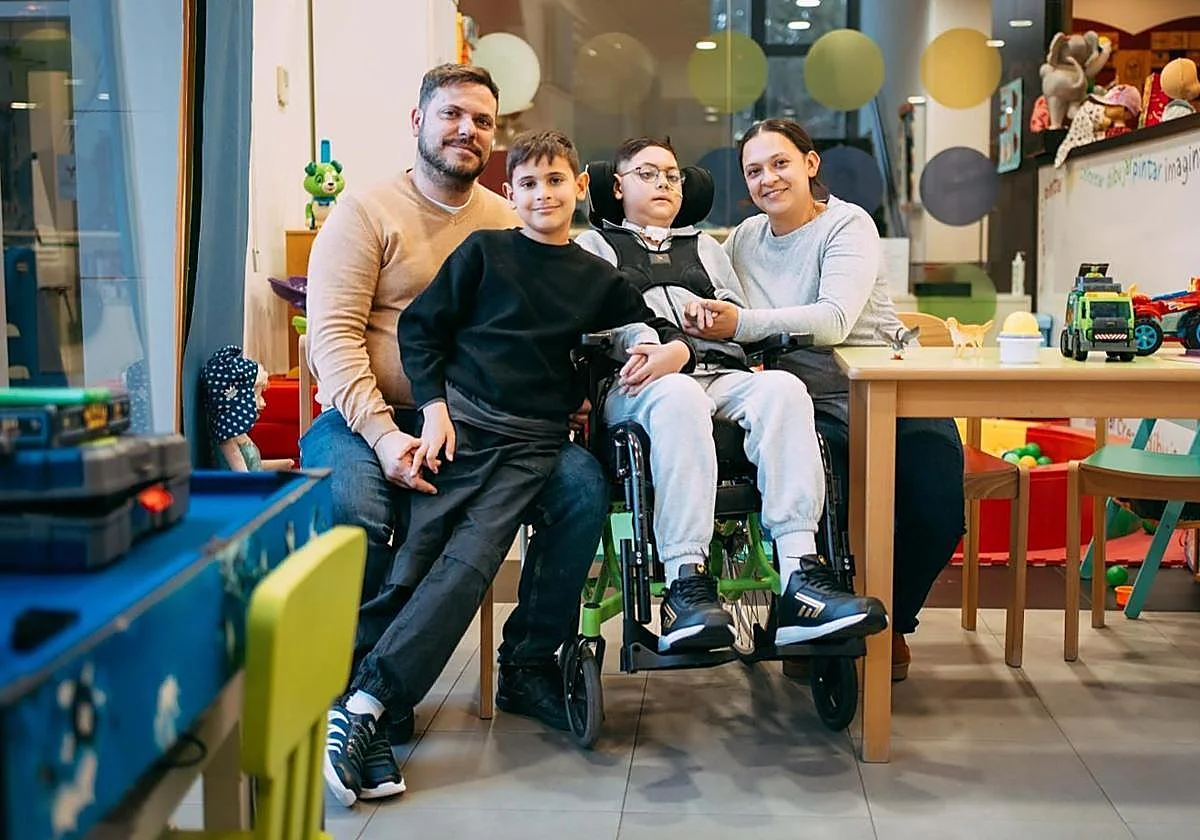
Nico, with his brother and parents at the Ronald McDonald House. Dani Maldonado Appeal Nico, the boy with cancer who needs an adapted carThe family of this eleven-year-old boy from San Pedro, who is in a wheelchair due to a brain tumour, needs a specific vehicle to attend his daily therapy sessions
Alberto Gómez
Friday, 27 February 2026, 10:32
Nico likes to paint and play Minecraft with his brother. He also likes to dance. "He is very theatrical," says Julieta, his mother: "He loves dressing up, anything that involves a party."
He is eleven years old and lives in San Pedro Alcántara. In 2024 he began to get headaches. At first they were intermittent, apparently mild, then they became more frequent. There was a succession of visits to the emergency department, the fear of his parents in the pit of their stomachs.
In October of that year the blow came in the form of a diagnosis: he was suffering from medulloblastoma, a type of malignant brain tumour that is more common in children and grows rapidly.
The first operation to remove the tumour and the subsequent months in intensive care left him with serious consequences: he entered the hospital on his own two feet, like any other child, and left in a wheelchair, without mobility from the neck down and unable to speak or swallow.
Zoom
Nico, with his brother Tiago. D. MaldonadoHis parents' world fell apart. Damián worked as a plumber. Julieta worked in an embroidery company. "Normal people," they sum up. A humble and united family, a hole in the chest. They tell their story in the playroom of the Ronald McDonald House, next to Malaga's children's hospital, their refuge for the first year: some comfort in the middle of the storm. They speak with fortitude, until Juliet's voice starts to tremble.
"It has changed our lives. Without expecting it, in a second," says Julieta with emotion. "It's hard to take in. Even today. Everything is new, we have to get used to it.
"We can't afford to think of the future. We are where we have to be. We are going to try to give him the best quality of life he can have. And go as far as we can go. We don't know what's going to happen, but we're going to be with him. We will always be with him."
The future
The prognosis, as they know, is complicated. Nico has many neurological and respiratory physiotherapy sessions ahead of him to try to gain some mobility and autonomy. And, although slow, progress is being made.
Recovering his speech is far from being a lost battle, but now words have been replaced by small gestures, by looks. If he wants to say yes, he blinks twice. To say no, he shakes his head from side to side.
They have fitted out the family home with the help of companies such as GC Studio, Tecnoclima, Muñoz Lanzas, Arka Gestión and Able Wood, but now they have another challenge ahead of them: to get an adapted vehicle.
They have fitted out the family home, but now they have another challenge ahead of them: getting an adapted car
Nico's recovery process means that he has to travel almost every day. In addition to the sessions with the physiotherapist, there are other therapies such as craniosacral therapy (aimed at relaxing the nervous system and improving circulation), neuropsychological therapy, music therapy and speech therapy for swallowing and communication. Not to mention treatment with bevacizumab, an anti-cancer antibody that prevents the formation of new blood vessels that tumours need to grow and spread, administered every fortnight at the Materno hospital in Malaga.
Zoom
Nico's parents Damián and Julieta. D. MaldonadoAll this involves many hours on the road for which the old family car is not prepared, especially because Nico cannot get in with his wheelchair. Now Damián has to pick him up in his arms to lift him in and out, a practice that is not advisable.
"He has no postural control," his parents explain: "If we put him in the front passenger seat, it's dangerous, but he shouldn't be in the back either." A vehicle with a ramp but not adapted, where the wheelchair can be anchored behind the seats, would not work either, because Nico must remain seated next to an adult.
After his tracheotomy, he breathes through a cannula and any jolt could ruin the small but hard-won progress of the last few months. The type of car the family needs must be prepared to fit the wheelchair in the middle of the back, with specific anchorages and a ramp, an investment of tens of thousands of euros. That is why they have opened an Instagram profile (Nico Corazón Fuerte) and have set up an account for certified donations.
Nico is not an only child, even if any child's illness has something of an emotional monopoly at home. At his side throughout the interview, sits Tiago, sometimes stroking his hand, sometimes even intervening in the conversation like an adult.
"I want Nico to come with us for walks like normal families," he says at one point with a maturity unbefitting his eight years. Normal families. Because a diagnosis like this dynamites everything. Even routine. It is then, in the midst of uncertainty, that the Ronald McDonald Foundation, like a flash in the dark, reaches out: it offers accommodation and company a few steps away from the Materno hospital.
Damián was hesitant at first: "I wasn't convinced by the idea." Until, on one of the trips back to San Pedro, when Nico was hospitalised, he realised that driving in that state of nerves was foolhardy. They ended up moving into one of the rooms at the McDonald House, which also has a kitchen, games room, cinema, gardens... and the feeling of being understood.
"It was the best thing we could do," he explains now they have returned to Marbella after eleven months at the foundation, which is celebrating its 14th anniversary.
Maintenance
"Sometimes," says Belén Collantes, manager of Ronald McDonald in Malaga, "people think that we only help families who live outside the province." But the doors of this house are open to anyone who needs it, "wherever they are from". The effort to get the project off the ground is titanic; with the capacity to house around 15 families, its maintenance depends on the generosity of the collaborating companies, and even more are needed, and on its volunteers.
"For me, they are my family," says Julieta. We've been at home here. You feel like you've been taken care of. Now we call each other often, they ask us about Nico, we ask about their children... I don't consider them acquaintances: they are my family."
Zoom
Nico with his brother Tiago. D. MaldonadoThey know that there are still stages to go through, but their confidence in the treatments and therapies is unshakeable: "We will go wherever we have to."
Every advance, every new gesture is now a small miracle to cling to. And they have not stopped finding allies: the Cesare Scariolo Foundation, the Materno Children's Oncology Volunteers Association (Avoi), the Jubert Figueras Foundation, the Casa dels Xuclis, the Xana Foundation, the Global Gift Foundation, the Enriqueta Villavecchia Children's Oncology Foundation, the Olivares Foundation are among the associations to have smoothed these months of admissions and operations.
Now that Nico is stabilised, although he still has a tracheotomy, the family's challenge is to recover some routine and stimulate his mobility. If possible, in a car that guarantees his safety: "That's all we ask for."