3 min read
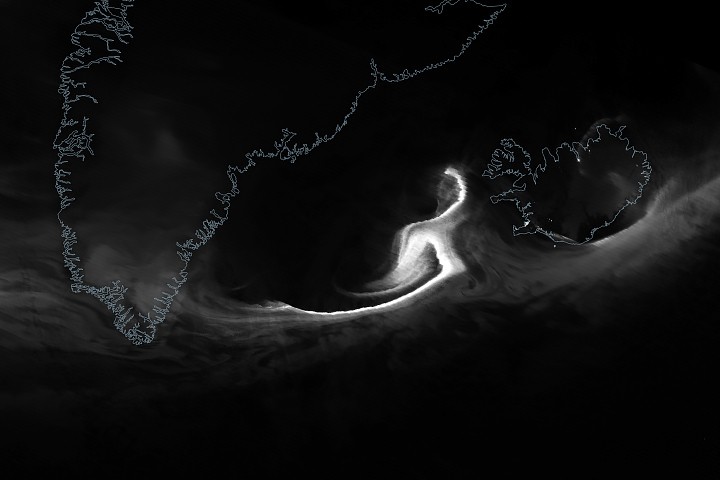
Northern Glow Spans Iceland and CanadaImage of the Day for February 19, 2026A vivid display of the aurora lit up skies over the Denmark Strait and eastern Canada during a minor geomagnetic storm in February 2026.
NASA Earth Observatory
Feb 19, 2026 ArticleAlthough the aurora borealis, or northern lights, is most often observed in March and September, it can appear at other times of the year if conditions are right. For instance, in February 2026, a minor geomagnetic storm produced a striking display of light swirling across northern skies.
The VIIRS (Visible Infrared Imaging Radiometer Suite) on the Suomi NPP satellite acquired these images in the early morning hours of February 16. The VIIRS day-night band detects nighttime light in a range of wavelengths from green to near-infrared and uses filtering techniques to observe signals such as city lights, reflected moonlight, and auroras. While these satellite data are displayed in grayscale, auroras appear in various colors to observers on the ground, from green (the most common) to purple to red.
The first image (top) shows ribbons of light that shimmered over the Denmark Strait and Iceland at 04:45 Universal Time (4:45 a.m. local time in Reykjavík). The second image shows the view farther west, where the lights danced above the Canadian provinces of Québec and Newfoundland and Labrador at about 06:30 Universal Time (1:30 a.m. local time in Montreal).
February 16, 2026According to the NOAA Space Weather Prediction Center, a minor geomagnetic storm was in progress during this period. Classified as a G1—the lowest level on a scale that goes up to G5—such storms typically make the aurora visible at high latitudes. G1 storms can also cause slight disruptions, including weak fluctuations in power grids and minor impacts on satellite operations.
Later that day, conditions intensified to a G2 storm, likely associated with a coronal hole and a high-speed stream of solar wind. G2 storms are considered moderate in strength and can occasionally push auroral displays as far south as New York and Idaho.
About a week earlier, on February 10, a NASA rocket mission launched from the Poker Flat Research Range near Fairbanks, Alaska, to study the electrical environment of an aurora. The GNEISS (Geophysical Non-Equilibrium Ionospheric System Science) mission’s two sounding rockets gathered data that will help scientists create a 3D reconstruction of the electrical currents flowing from the northern lights. Combined with observations from the ground and space, this information can help researchers better understand the system that drives space weather near Earth.
NASA Earth Observatory images by Michala Garrison, using VIIRS day-night band data from the Suomi National Polar-Orbiting Partnership.Story by Kathryn Hansen.
Downloads
Iceland, February 16, 2026
JPEG (654.50 KB)
Canada, February 16, 2026
JPEG (1.79 MB)
References & Resources
- NASA Science (2025, February 27) Electrojet Zeeman Imaging Explorer. Accessed February 18, 2026.
- NASA Science (2025, January 23) Aurorasaurus. Accessed February 18, 2026.
- NASA’s Wallops Flight Facility (2026, February 10) NASA Rocket to Conduct ‘CT Scan’ of Auroral Electricity. Accessed February 18, 2026.
- NOAA Space Weather Prediction Center via X (2026, February 16) EXTENDED WARNING: Geomagnetic K-index of 5 expected. Accessed February 18, 2026.
- University of Alaska Fairbanks (2026, February) Launches x4: Multiple missions kept everyone busy at Poker Flat. Accessed February 18, 2026.
You may also be interested in:
Stay up-to-date with the latest content from NASA as we explore the universe and discover more about our home planet.
A Northwest Night Awash in Light 3 min readThe glow of city lights, the aurora, and a rising Moon illuminate the night along the northwest coast of North…
Article The Galaxy Next Door 3 min readThe Large Magellanic Cloud—one of our closest neighboring galaxies—is a hotbed of star formation that is visible to both astronauts…
Article Five Minutes in Orbit 3 min readAn astronaut captured a moonrise—and much more—in a series of photos taken from the International Space Station.
Article Keep ExploringDiscover More from NASA Earth Science
Subscribe to Earth Observatory Newsletters
Subscribe to the Earth Observatory and get the Earth in your inbox.
Earth Observatory Image of the Day
NASA's Earth Observatory brings you the Earth, every day, with in-depth stories and stunning imagery.
Explore Earth Science
Earth Science Data