3 min read
Photophoretic tracers for near-space remote sensing at 30-100 km altitudesLoura Hall
Jul 21, 2026 ArticleBenjamin Schafer
Rarified Technologies, Inc.
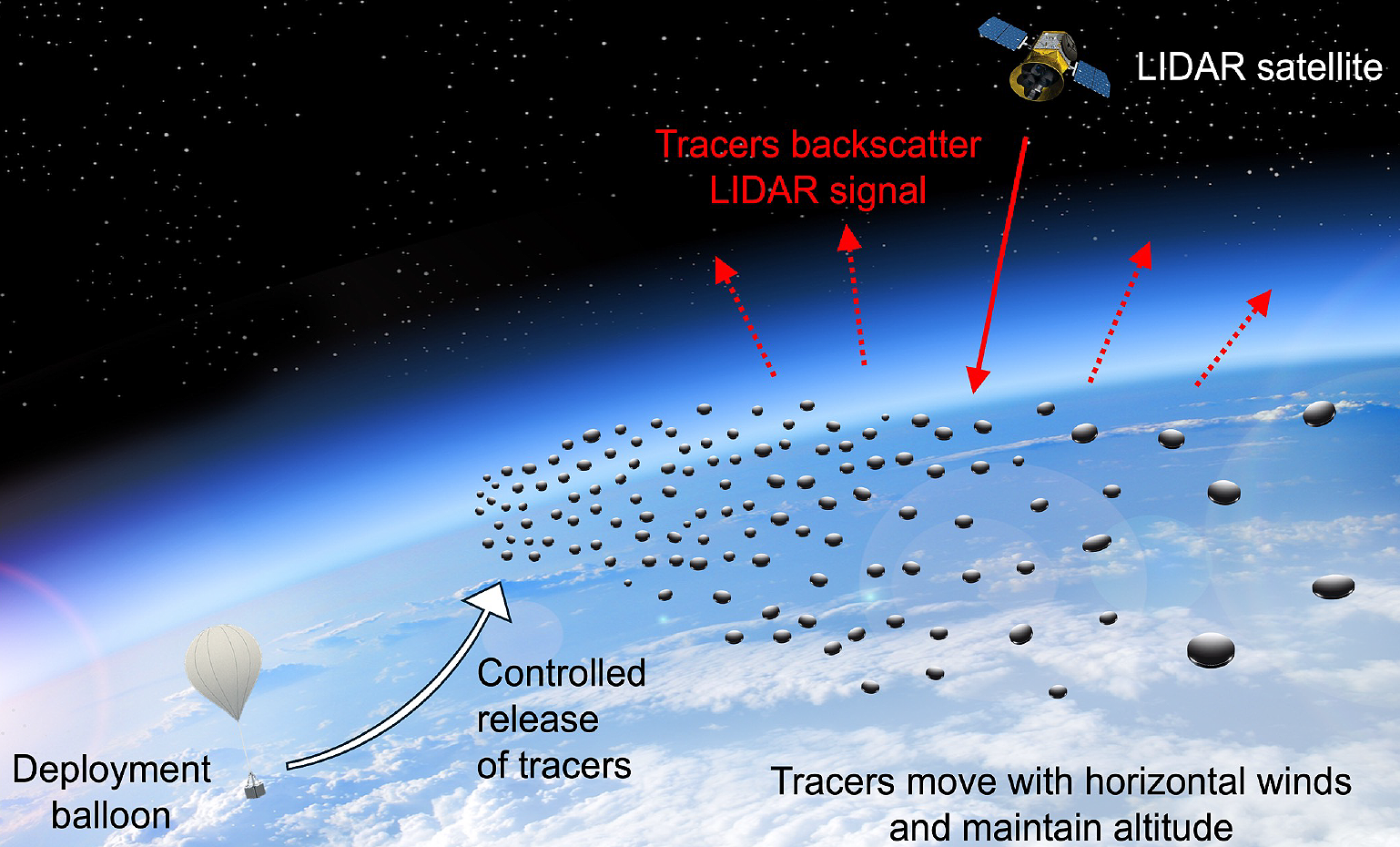
We propose a new approach to atmospheric sensing at 30-100 km altitudes using photophoretically levitating tracers. These lightweight structures harness sunlight to remain suspended for up to months at controlled altitudes and can be remotely tracked by satellite-based lidar or radar. Unlike natural aerosols, these tracers are designed to provide strong andtunable backscatter at standard remote sensing wavelengths, enabling passive, persistent, and altitude-selective measurements of wind, temperature, and pressure in a region that is critically under-measured by existing systems.
This concept addresses a major gap in current sensing capabilities. The mesosphere and upper stratosphere play a key role in atmospheric dynamics, space-domain awareness, space weather, and high-altitude platform navigation. Despite the importance of this region, data collection remains a challenge. Near-space is too high for sustained balloon flight and too low for satellites to orbit. Concentrations of extant atmospheric species are also too low for remote sensing techniques such as lidar and radar. Photophoretic tracers offer a new solution: a persistent, stratified sensor layer of non-toxic, inert backscattering points that require no onboard power, propulsion, or control. These tracers can be deployed via high-altitude balloons or rockets and autonomously reach their target altitudes based on their geometry and coatings.
In a representative mission, thousands of tracers are released from a lightweight balloon at around 30 km. The tracers rise to their target altitude of 90-100 km, the lower ionosphere. Satellite-based lidar tracks their motion over their month-long lifetimes. Tracer trajectories enable continuous mapping of wind shear, thermal gradients, and pressure profiles at sub-kilometer resolution and hourly cadence. The collected real-time data are used to calibrate boundary conditions of ionospheric space weather models. As more data is collected, the predictive capabilities of these models improve, leading to enhanced situational awareness and communications resilience in near-space and LEO. Other early deployments could, for example, support weather model improvements in the tropics and monitor atmospheric conditions over spaceports.
This work builds on emerging experimental results in photophoretic flight, with laboratory validation of levitation in near-space conditions and initial simulations of tracer dispersion and visibility. Backscatter models confirm feasibility for orbital detection using commercially available lidar systems. The tracers are designed to safely disintegrate at end-of-life and are compatible with scalable fabrication techniques. By engineering the scattering medium itself, this concept inverts traditional atmospheric remote sensing. It enables lower-SWaP-C satellite sensing systems and a fundamentally new class of persistent measurement tools for national security, meteorology, heliophysics, and planetary exploration.
2026 Selections
Facebook logo @NASATechnology@NASA_TechnologyShare
Details
Last Updated Jul 21, 2026 EditorLoura HallRelated Terms
- Space Technology Mission Directorate
- NASA Innovative Advanced Concepts (NIAC) Program
- NIAC Studies
- Research and Technology Mission Directorate
Discover More NIAC Topics
Space Technology Mission Directorate
NASA Innovative Advanced Concepts
NIAC Funded Studies
About NIAC