2 min read
Plasmon-Enhanced Radioisotope Thermophotovoltaic (PRTPV) Power Generation for Interstellar MissionsLoura Hall
Jul 21, 2026 ArticleKeunhanPark
University of Utah
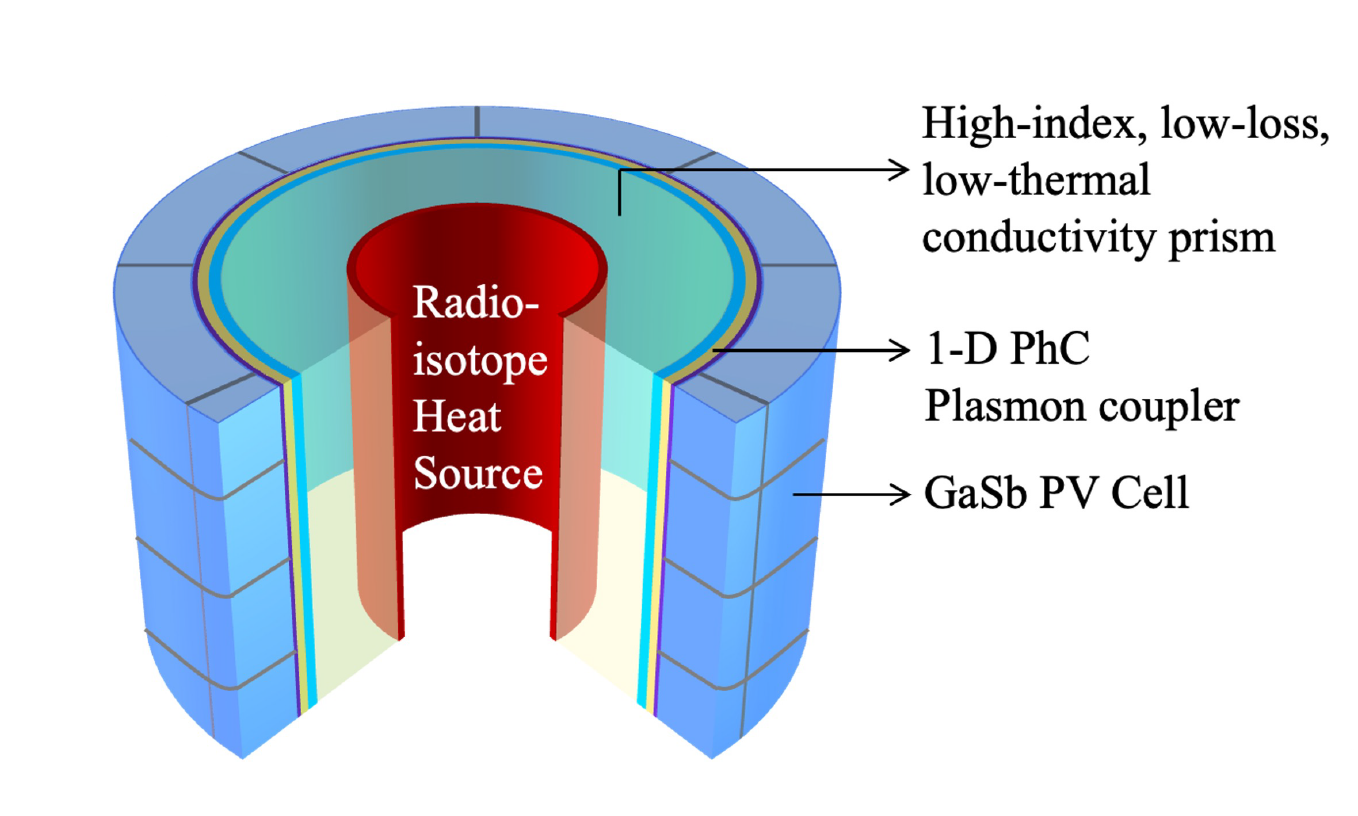
This proposal seeks to develop a transformative energy system — the plasmon-enhanced radioisotope Thermophotovoltaic (PRTPV) generator — that significantly surpasses the performance of current radioisotope thermoelectric generators (RTGs) in both specific power and efficiency. Designed to achieve a specific power of 17 W/kg and a thermal-to-electric conversion efficiency greater than 40%, the PRTPV offers a sevenfold improvement in efficiency and nearly an order-of-magnitude increase in specific power compared to state-of-the-art RTGs. The system combines two novel innovations: the use of a high-refractive-index, low infrared loss, low-thermal-conductivity, and high-melting point material (e.g., Al2O3) to replace the traditional vacuum gap between the heat source and photovoltaic (PV) cell, enhancing thermal radiation power density proportional to the square of the refractive index, and the integration of a multilayered photonic crystal plasmon coupler to spectrally tune the thermal radiation by exciting surface plasmons at the coupler-PV cell interface matching with the PV cell’s bandgap, further improving conversion efficiency. Together, these advances overcome the low power density that limits current TPV systems. The resulting technology is compact, efficient, and scalable, opening the door to new classes of NASA missions, including long-duration surface operations in permanently shadowed lunar regions and interstellar missions where solar power is impractical. The proposed work directly supports NASA’s long-term goals in space exploration and energy innovation.
2026 Selections
Facebook logo @NASATechnology@NASA_TechnologyShare
Details
Last Updated Jul 21, 2026 EditorLoura HallRelated Terms
- NIAC Studies
- NASA Innovative Advanced Concepts (NIAC) Program
- Research and Technology Mission Directorate
Discover More NIAC Topics
Space Technology Mission Directorate
NASA Innovative Advanced Concepts
NIAC Funded Studies
About NIAC