3 min read
PRAXIS: Planetary Rings Autonomous EXploration with In-situ SamplingLoura Hall
Jul 21, 2026 ArticleMarco Quadrelli
NASA Jet Propulsion Laboratory
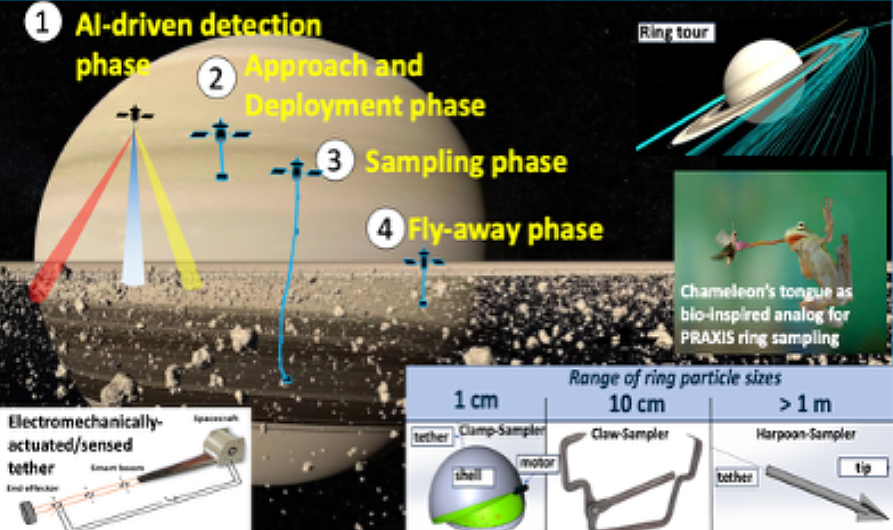
Humanity has never touched the particles of a planetary ring, but if we were able to get close enough and sample them, it will transform understanding of ring structure and origins for Saturn (dense), Uranus and Neptune (tenuous), rings of other objects such as Centaurs Chariklo and Chiron, and even early protoplanetary and circumstellar disks. Despite Cassini’s groundbreaking discoveries, fundamental questions about the formation, dynamics, and evolution of planetary rings remain unanswered. After Cassini, there is a very strong scientific case to learn more about the microphysical interactions of Saturn’s rings, and this necessitates sampling them. Many ring structures and features such as self-gravity wakes, “propellers”, density waves and gap edges remain to be explored at high resolution. Saturn’s rings are micron-size grains to house-size boulders, always in motion. They are made mostly of water ice, piles of rubble coming together and breaking apart. PRAXIS addresses a key Decadal priority by delivering the first direct observations of mm- to cm-scale ring particles, a capability Cassini lacked. Planetary rings are highly dynamic environments where constant particle motion demands advanced robotic autonomy for collision avoidance, precision sampling, and in situ analysis. Our system adapts innovations from sport casting to capture free-floating particles, and instrument miniaturization for real-time analysis. AI integration enables the first-ever autonomous collection of ring particles, directly measuring science priorities like particle size, porosity, and composition. PRAXIS develops and tests a novel AI-driven, bio-inspired robotic explorer to perform in situ ring sampling, a capability never before attempted. This effort directly supports Decadal Survey priorities in planetary ring science while spearheading the next generation of planetary robotic exploration and delivering transformative insights into the origins and evolution of ring systems. Feasibility of PRAXIS is already on firm ground because it leverages key element of the Saturn Ring Observer Mission Study, which considered an orbit grazing the rings and hovering above them to directly image the ring particles in motion. After an initial imaging and characterization phase to select the ring particle, the spacecraft conducts a touch-and-go sampling event of the particle surface with a long and soft deployable boom. Since the particles are always in motion within the ring, there is a compelling case for the spacecraft staying away to avoid collision, hence the agile sampling with the long boom is justified. Once the sample is retrieved, the PRAXIS exploration system moves to another section (or gap) of the rings, thus sampling many diverse regions. Feasibility of PRAXIS will be demonstrated Phase I with simulation and sound system design, motivating solid system design and development of a physical prototype in Phase II. The system’s versatility makes it valuable across planetary formation missions, positioning it for infusion into the upcoming Uranus Probe mission.
2026 Selections
Facebook logo @NASATechnology@NASA_TechnologyShare
Details
Last Updated Jul 21, 2026 EditorLoura HallRelated Terms
- NASA Innovative Advanced Concepts (NIAC) Program
- NIAC Studies
- Research and Technology Mission Directorate
Discover More NIAC Topics
Space Technology Mission Directorate
NASA Innovative Advanced Concepts
NIAC Funded Studies
About NIAC