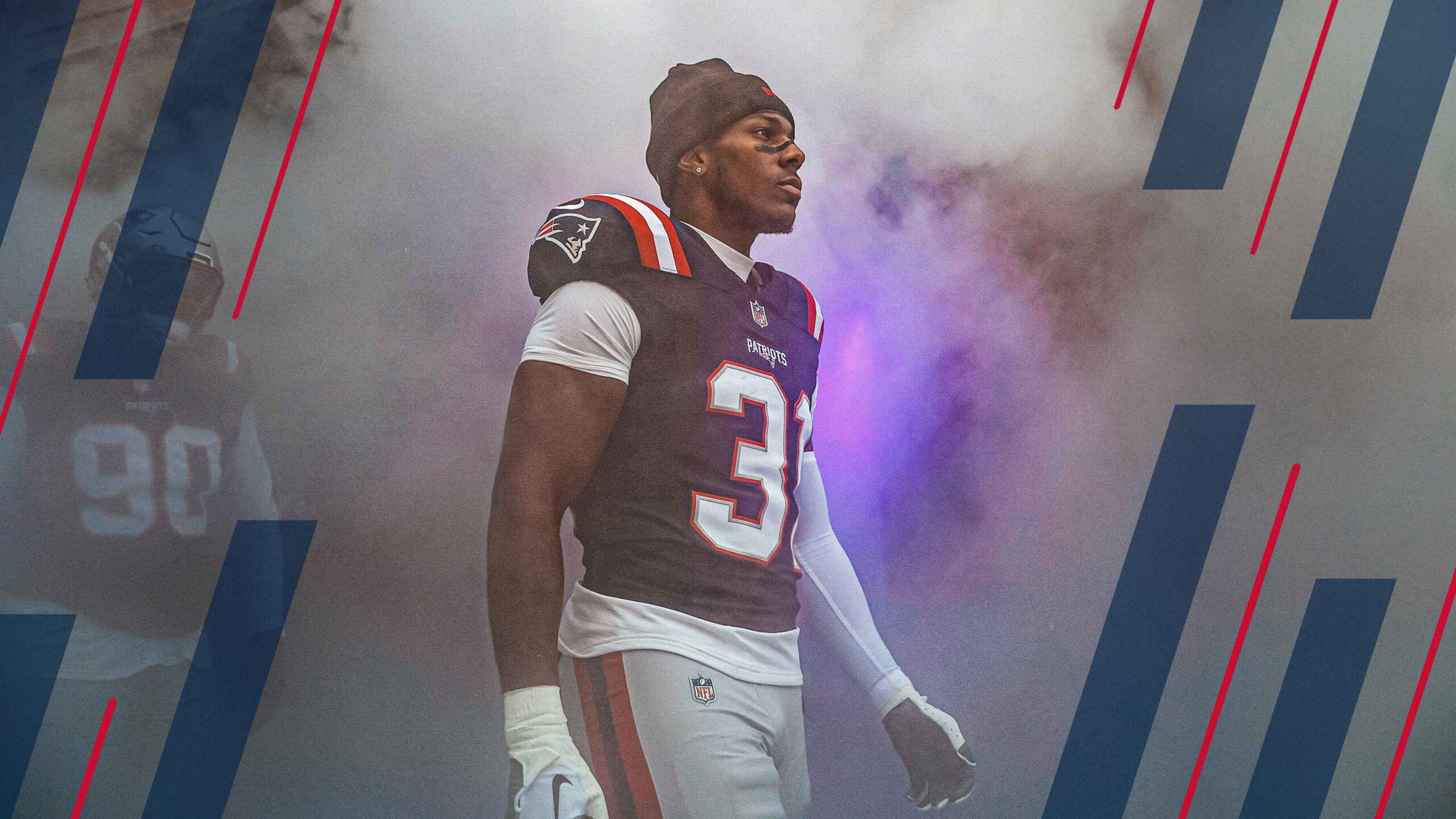
- Grey Zabel is heating up at the right time: He is the ninth-highest-graded guard since Week 14 (80.6 PFF overall grade), powered by the fourth-best PFF run-blocking grade in that span (82.8).
- 2026 NFL Draft season is here: Try the best-in-class PFF Mock Draft Simulator and learn about 2026's top prospects while trading and drafting for your favorite NFL team.
Estimated Reading Time: 11minutes
We're diving into the top rookies by PFF overall grade from the divisional round. To qualify, players needed to have logged at least 25 snaps.
🏈 Draft Season 2026Prepare for the 2026 NFL Draft with PFF+
Your complete draft preparation toolkit
Mock Draft Simulator 2026 NFL Draft Big Board Big Board Builder NCAA Premium Stats Subscribe1. S Craig Woodson, New England Patriots (90.3)
Woodson was sticky in coverage against the Texans, breaking up two passes across three targets and also picking off a second-quarter throw that bounced off Xavier Hutchinson’s hands. Woodson earned the third-best PFF coverage grade among the position in the divisional round (85.1). He also recorded a quarterback hit as a pass rusher and two tackles in run defense, leading him to grade out as the third-best safety this weekend (90.3).
The fourth-round pick from California enters the AFC title game against the Broncos as the second-highest-graded safety this postseason (90.1). Woodson leads all safeties in PFF run-defense grade (87.6), having recorded four tackles with five assists and a run stop. His 15.2% positively graded play rate is second best at the position, while his 3.0% negative play rate ranks third.
Meanwhile, Woodson has been the second-best coverage safety during New England's playoff run (81.2), holding receivers to 16 yards — the second fewest among qualifying safeties — on two catches across seven targets. He is also limiting quarterbacks to a league-best 0.0 NFL passer rating when targeted.
Explore PFF Premium Stats
Game grades, positional splits and high-level metrics for Woodson's 2025 season.
Open Woodson's Profile2. G Grey Zabel, Seattle Seahawks (80.4)
San Francisco had no answer for Zabel’s run blocking. The first-rounder recorded a position-best 30.3% impact-block rate in the divisional round, mostly in zone blocking schemes (23 snaps), where he earned the third-best PFF run-blocking grade (77.6). He was equally strong in gap schemes, finishing with a 74.6 PFF run-blocking grade (fourth best). Overall, Zabel logged the fourth-highest PFF run-blocking grade among guards in the divisional round, in addition to the fourth-lowest defeated rate (21.2%).
Zabel did surrender a quarterback pressure in pass protection, leading to a 62.6 PFF pass-blocking grade, but he still graded out as the second-best guard over the weekend in his postseason debut.
Zabel enters the NFC Championship game against the rival Rams having played the most snaps among rookie guards this season (1,055). He endured an up-and-down regular season (59.5 PFF overall grade), as he was beaten 23 times in pass protection (tied for sixth most among starting guards) and earned 58.8 PFF grades in both facets.
Things have been trending upward for the 18th overall pick from North Dakota State, though. He is the ninth-highest-graded guard since Week 14 (80.6 PFF overall grade), powered by the fourth-best PFF run-blocking grade in that span (82.8). His surrendered pressure against the 49ers in the divisional round is the only one he’s allowed in his past three games.
3. RB RJ Harvey, Denver Broncos (71.0)
Harvey rushed six times for 20 yards against the Bills, with a long of 12 yards in the second quarter. He also secured each of his five targets for 46 receiving yards. His biggest play came in overtime as he broke multiple tackles for a 24-yard reception to move Denver near midfield on what became the game-winning drive. He forced seven total missed tackles and logged the fifth-best PFF receiving grade among running backs (74.9) in the divisional round.
The second-round pick from Central Florida has racked up 400-plus yards as a rusher and receiver this season. Harvey, who took over as the starting back after J.K. Dobbins suffered a season-ending foot injury in November, has 152 carries for 560 yards and seven touchdowns this season. He logged the third-most rushing touchdowns (tied) among rookie running backs, in addition to 28 first downs, 407 yards after contact and 27 forced missed tackles.
Harvey has made a big impact in the passing game, where he’s caught 52 passes for 402 yards to lead the draft class. He also paces the class in receiving touchdowns (five), first downs (19) and catches of 15-plus yards (six) while ranking second in missed tackles forced (15) and passer rating when targeted (120.6). His 70.4 PFF receiving grade ranks fourth among first-year backs.
4. G Jared Wilson, New England Patriots (69.1)
Wilson had one of his best games of the season, grading out as the fifth-best guard this weekend after his performance against the Texans. Wilson surrendered two hurries in pass protection but still garnered a 76.9 PFF pass-blocking grade (fifth best). He also generated the sixth-best impact-block rate as a run blocker (22.6%) on his way to a 64.1 PFF run-blocking grade.
The third-round pick from Georgia has gone through growing pains in his first season, as he enters the AFC Championship game with a 52.9 PFF overall grade — the lowest mark among New England’s starting offensive linemen.
Wilson has surrendered 36 pressures at a 6.8% clip, with 13 combined sacks and hits. Despite his high impact-block rate in the run game against the Texans, Wilson still holds a 9.6% clip and a 16.6% defeated rate for the season.
5. RB Kyle Monangai, Chicago Bears (68.9)
Chicago’s season came to an end after an overtime loss to the Rams. Monangai ripped off a 15-yard run late in the first quarter to move the Bears to the Rams' nine-yard line, but he finished the game with only 36 rushing yards on 13 carries. He gained three first downs and forced four missed tackles (tied for second most), but his 30.8% stuff rate was his second-highest clip in a game this season.
Monangai earned a 77.2 PFF receiving grade (third best among running backs), catching each of his four targets for 28 yards and two first downs. His longest reception, 16 yards, came midway through the second quarter on an underneath pass.
The Rutgers product ended his rookie campaign with a 67.7 PFF overall grade. He carried the ball 190 times for 846 yards, ranking third among rookie rushers in rushing yards and PFF rushing grade (75.6). He picked up 46 first downs (tied for second most among rookies) and rushed for five touchdowns, generating a 24.2% first down-plus-touchdown rate (third in the class). He also recorded the lowest stuff rate in the class (14.7%), forced 30 missed tackles, and tallied 16 runs of 10-plus yards.
Most of Monangai’s rushes came in zone schemes, where he handled 126 carries for 536 yards. The seventh-round pick also flashed his receiving ability, securing 23 passes for 222 yards. Although he had four drops, he forced eight missed tackles and picked up 10 first downs and five catches of 15-plus yards.
Explore PFF Premium Stats
Game grades, positional splits and high-level metrics for Monangai's 2025 season.
Open Monangai's Profile6. T Aireontae Ersery, Houston Texans (67.4)
Miscues plagued the Texans all day against the Patriots, few of which were Ersery's fault. He earned a 76.5 PFF pass-blocking grade after surrendering just three hurries across 54 pass-blocking snaps. He struggled more in the run game (63.3 PFF run-blocking grade), as his 15.0% defeated rate was the sixth-worst clip among all tackles in the divisional round.
Ersery is another rookie offensive lineman who took his lumps throughout the season. His 60.2 PFF overall grade was the lowest mark among Houston’s starting linemen, and he allowed a team-high 7.0% pressure rate, surrendering 49 pressures with 11 hits and eight sacks (all team-high marks). He also finished with the second-worst PFF run-blocking grade among the group.
However, the second-round pick from Minnesota found his footing late in the season. Ersery did not allow a single sack over his last five games, boosting his PFF pass-blocking grade to 73.0 in that time. Since Week 15, his impact-block rate in the run game increased to 10.1% from 8.9% and his defeated rate fell from 17.3% to 10.1%.
7. TE Colston Loveland, Chicago Bears (65.6)
After leading all rookies with an elite 90.6 PFF overall grade in the wild-card round, Loveland fell to a 65.6 mark against the Rams in the divisional round. He saw double-digit targets (10) for the third straight game but came down with only four catches for 56 yards. That didn’t stop him from picking up three first downs, with two explosive gains, as he was able to separate from Emmanuel Forbes for a 23-yard gain late in the first quarter and pick up 18 yards across the middle with less than two minutes remaining in the fourth quarter.
Loveland had a monster rookie season, ranking in the top five among all tight ends in receiving yards (906) and first downs (44). He caught 70 passes (ninth most) with six touchdowns and only two drops across 106 targets. He also led the position with 15 catches of 20-plus yards while recording a 70.0 PFF run-blocking grade (13th best).
The 10th overall pick from Michigan caught 12 passes for 193 yards in his first playoff run. He moved the chains nine times, with seven explosive gains, earning an 83.0 PFF receiving grade.
Loveland opened up the field all season with his vertical ability, seeing 41 targets of 10-plus yards downfield. He caught 13 of 28 passes between 10 and 19 yards out for 219 yards and two touchdowns. Meanwhile, he brought down seven of 13 targets 20-plus yards out for 231 yards and two more scores, recording a perfect 99.9 PFF receiving grade on those plays (tied for first).
Explore PFF Premium Stats
Game grades, positional splits and high-level metrics for Loveland's 2025 season.
Open Loveland's Profile8. WR Jayden Higgins, Houston Texans (64.6)
Higgins hauled in six of 10 targets for 59 yards, with two catches of 10-plus yards, in the Texans' divisional-round defeat. His longest gain came on a 16-yard grab late in the second quarter to move Houston into Patriots territory while trailing by double digits. He gained two first downs, secured two contested catches and earned a 63.0 PFF receiving grade in the game.
The second-round pick from Iowa State ended his rookie season with 50 catches for 623 yards and six touchdowns. He ranked fourth among rookie receivers in catches and receiving yards while tying for second with Emeka Egbuka in touchdown catches. Higgins also recorded 11 explosive gains, including five catches of 20-plus yards. His 69.3 PFF receiving grade in the playoffs was the third-best mark among rookie receivers.
The future is bright for the 23-year-old receiver, who garnered elite 90.0-plus PFF receiving grades at every level of the field beyond the line of scrimmage.
Higgins caught 29 short targets for 242 yards and 13 first downs. His 105.0 passer rating when targeted from that area ranked second among rookie receivers. He also earned the third-best PFF receiving grade among the class at the intermediate level (95.5), with 17 catches for 236 yards and three touchdowns. Finally, Higgins brought down four deep passes for 145 yards and two touchdowns, earning a 94.4 PFF receiving grade on those plays.
9. DI Deone Walker, Buffalo Bills (64.1)
Walker struggled in run defense against the Broncos, recording a 28.6% negatively graded play rate on 14 snaps — albeit with one run stop on a third down in the third quarter — en route to a 34.9 PFF run-defense grade.
But he fared much better as a pass rusher, logging two pressures and an 11.1% pass-rush win rate across 27 snaps on his way to an elite 90.0 PFF pass-rushing grade in the loss.
That variance sums up Walker’s rookie season. The fourth-round pick from Kentucky led all rookie interior defensive linemen, as well as Buffalo’s interior group, with a 78.3 PFF pass-rushing grade. The 6-foot-6, 345-pound player recorded 20 pressures at a 7.4% rate and batted down five passes.
However, Walker faced more of an uphill battle in run defense, where he finished with 21 stops, including 13 for a loss or no gain, but also recorded a 22.7% negatively graded play rate, leading to a 45.4 PFF run-defense grade.
Walker ended his postseason run with a 65.3 PFF overall grade, tied for first among rookie linemen, and an 88.3 PFF pass-rushing grade (third best at the position).
Read More
2026 NFL Mock Draft: Jets pivot to David Bailey at No. 2
Read More →10. S Jaylen Reed, Houston Texans (64.1)
Reed found himself on the wrong end of a touchdown pass to Stefon Diggs late in the second quarter of the Texans' duel with the Patriots. He was right on the star receiver’s hip but could not prevent him from bringing down the seven-yard catch. Reed was targeted twice on the day, and he allowed both to be caught for just six yards. He also recorded a tackle and an assist in run defense, earning a 70.6 PFF run-defense grade for the game.
The sixth-round pick from Penn State‘s rookie season was filled with adversity, as injuries not only limited him to two games in the regular season but also threatened his playoff run after he suffered a knee injury in the wild-card round against the Steelers.
Reed produced a 59.8 PFF overall grade across four games. He looked best in run defense, where he recorded three tackles and four assists for a 71.3 PFF grade (third best among rookie safeties). He allowed all 12 of the targets into his coverage to be caught for 143 yards, leading to a 144.1 NFL passer rating in that span (second highest). His tackling was also inconsistent, as he made 10 tackles with three stops but also had four misses (42.9% missed tackle rate) in the playoffs.