Zoom
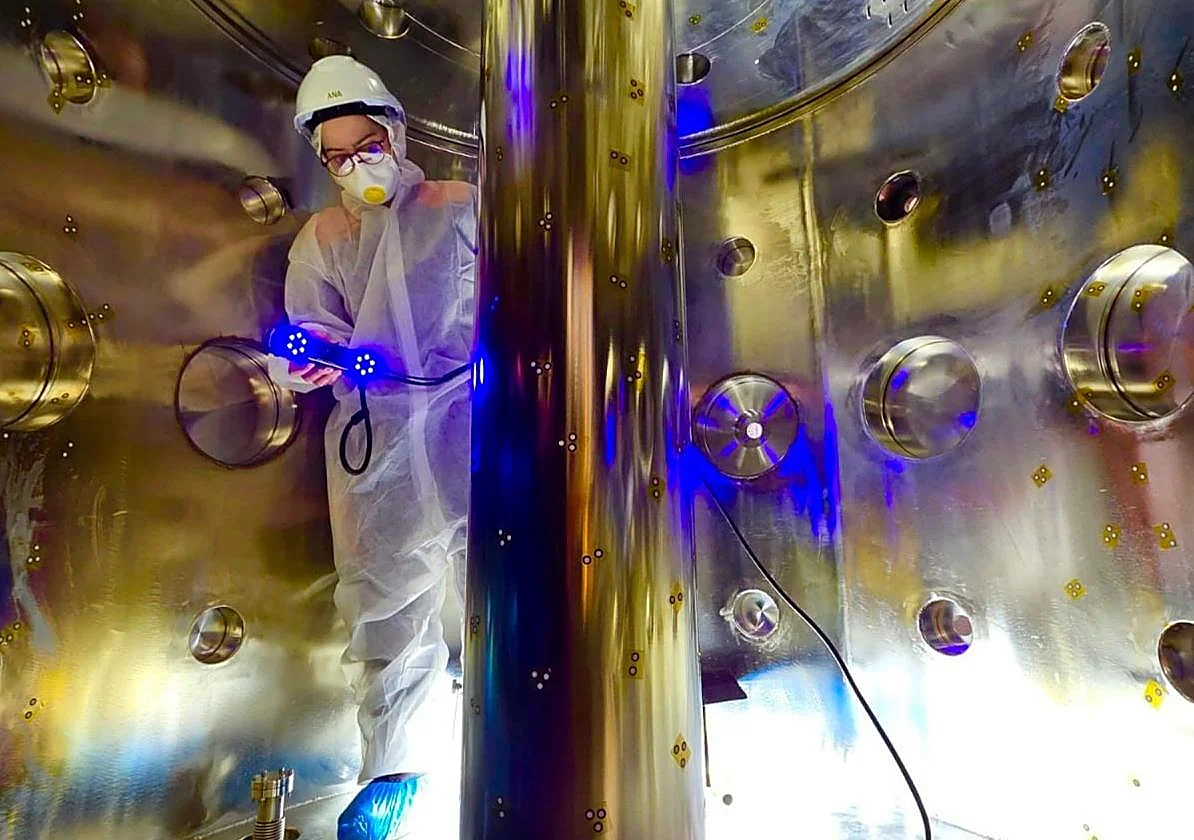
Installation of the Tokamak reactor promoted by the University of Seville with the support of the Andalusian regional government. SUR Innovation Regional government aims to make Andalucía world reference in nuclear fusionThe regional ministry of university invests almost 220 million in the Escúzar particle accelerator and the University of Seville reactor
Wednesday, 7 January 2026, 16:10
The regional government (Junta) is aiming to make Andalucía an international benchmark for nuclear fusion with two scientific facilities it is promoting in Granada and Seville.
These projects are seeking to find clean and unlimited sources of energy and to generate knowledge, employment and technological opportunities with high added value.
The infrastructure in question are the Ifmif-Dones particle accelerator, planned for the Granada municipality of Escúzar, and the Tokamak Smart reactor, which is being built by the University of Seville.
The regional ministry of university, research and innovation has earmarked 219.95 million euros to promote these two 'world-class' research facilities that it hopes will make Andalucía an international hub for nuclear fusion.
The Junta's contribution to the two centres comes mainly from the Feder Andalucía 2021-2027 programme. Ifmif-Dones also has self-financing resources. The particle accelerator accounts for the vast bulk of the funds (211.95 million).
These funds will be transferred to the project in tranches up to 2033 and represent 50% of the investment committed by Spain, with the other half to be provided by the Ministry of Science, Innovation and Universities.
The accelerator's main mission is to test, validate and qualify materials to be used in future nuclear fusion power plants. The project will be developed over an estimated period of 30 years, with the construction and commissioning phase lasting about ten years. Once completed, the operational phase will begin, running from 2035 to 2055.
According to the Junta, it will be a unique facility that will be essential in validating the components that will operate under extreme conditions inside fusion reactors, which is key to move towards commercial fusion power generation.
Its construction and operation will be carried out with the participation of numerous countries and scientific institutions, with Spain and Andalucía playing a central role by hosting the accelerator, constructing the building and housing the international team responsible for its start-up.
Its impact on the Andalusian economy and society will be exceptional, as its development will generate tens of thousands of direct and indirect jobs throughout its life cycle and will boost high value-added industrial sectors such as advanced engineering, materials manufacturing, vacuum technologies, scientific instrumentation and industrial control. It will also attract top-level research talent to the region's universities and technology centres.
The University of Seville project, which will receive eight million euros in funding from the Junta de Andalucía, will build the first spherical Tokamak, which will be an experimental device for controlled nuclear fusion. It will use a vacuum chamber and very powerful magnetic fields to confine and heat a plasma to extreme temperatures in order to fuse atoms and generate clean energy which, in the first phase, will produce enough to supply the city of Seville.