Mental health
Renowned Spanish psychiatrist Enrique Rojas teaches Malaga how to lead a truly happy and balanced lifeRojas measures the benefits of aspiring for happiness against those of aspiring for balance and how to achieve it
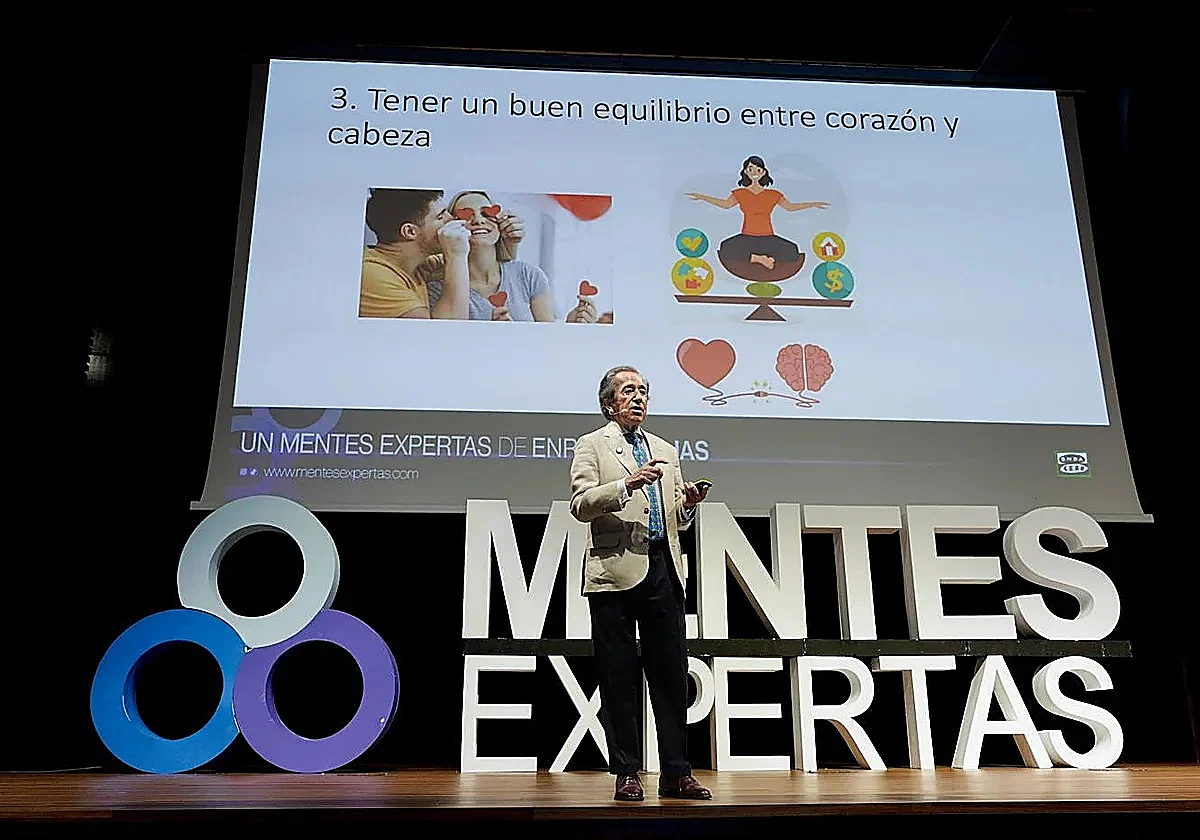
Añádenos en Google Psychiatrist Enrique Rojas talking at the fair and trade centre (Fycma) in Malaga. (Marilú Báez)Matías Stuber
12/06/2026 a las 15:06h.Absolute happiness doesn't exist. Sometimes, it seems as if everything is perfect. Friends are seated around the table, the food is delicious and the wine is good. Then, precisely when everything seems to fall into place to achieve that state everyone longs for, it doesn't quite arrive.
Sometimes, even the opposite happens: the conversation doesn't flow, the evening is disjointed and one realises that things aren't progressing as they would like.
Then comes the realisation: the best nights are the unplanned ones, those that ended with everyone dancing in the kitchen and no one quite able to explain why afterwards.
What, after all, is happiness? Renowned psychiatrist Enrique Rojas offered some insights during the Mentes Expertas lecture series at the fair and trade centre (Fycma) in Malaga on Thursday.
There are many ideas about what true happiness is. Striving for it is one of the driving forces of existence. A pessimist might claim that happiness is the mere absence of suffering. Hedonists might find it in consumption. A neurobiologist would say it is pure chemistry and Aristotle wrote that it consists of self-sufficiency.
The pursuit of happiness is booming. Psychology, neurology, sociology, economics… there is hardly a discipline that hasn't attempted to answer the age-old question of how to achieve it and whether each individual possesses the tools to attain it.
Ultimately, everyone knows people who have overcome great hardships, as well as others who walk through life with a heavy heart despite favourable circumstances.
Is happiness a destiny, predetermined by our genetics, or based on the experiences of our earliest childhood? Or can happiness be learnt? Underlying all of this is a much broader question: does humankind have the capacity to create its own happiness?
Rojas would answer with a "yes". At least, in part. In Malaga, he addressed this universal concept and talked about his latest book: Siete consejos para la felicidad (Seven Tips for Happiness).
Eternal longing
To begin, Rojas introduced the classical definitions of happiness by Seneca, Plato, Pythagoras. The list of thinkers who have explored the topic is extensive. Rojas suggested that happiness is a kind of leafy tree and called for a distinction between momentary and structural happiness.
While the first is fleeting, the second is the state truly worth striving for, based on a proper balance between love, friendship, work and access to culture. "When seeking happiness, we must be very clear that absolute happiness does not exist," he stated.
Rojas then outlined the seven pieces of advice from his book that, for him, are key to achieving that relative happiness, which is indeed attainable.
A good balance between heart and head means achieving emotional maturity: Rojas believes that a balanced person is neither one who suppresses their feelings nor one who is blindly led by them, but rather one who allows reason to guide emotion without stifling it.
Knowing oneself: It is the cornerstone of psychological maturity. Rojas defines self-knowledge as taking an honest and profound look at oneself, accepting what one finds in it in order to improve from there.
Closing the wounds of the past and forgiving: For Enrique Rojas, this does not represent acts of weakness, but rather the most powerful tool of psychological engineering to achieve happiness and emotional balance.
Having a coherent life purpose: According to Rojas, this means having a life that encompasses the five major areas of human life, maintaining a healthy balance between them and minimising internal contradictions (for example, desiring a close-knit family life but not dedicating enough time to it due to excessive work). These areas are: love; personal life (partner, family, etc.); work, professional development and fulfillment through effort; culture, cultivating the mind, reading and knowledge; and friendship, deep and sincere social relationships.
Being independent from others: Rojas doesn't see independence from others as isolation, selfishness or absolute self-sufficiency, but rather as a synonym for emotional maturity and inner freedom.
Learning to talk about things and putting problems into perspective: Rojas believes that learning to talk about the things that concern you brings great relief. According to him, putting problems into perspective is a fundamental therapeutic and personal growth tool. Both are part of what he calls "behavioural engineering" and are key to achieving psychological maturity and inner peace.
Having a strong moral compass: The psychiatrist says that a strong moral compass equates to being a person of integrity. This means there is a close alignment between what they think, what they say and how they act. The opposite of this is a double life or a double standard. For Rojas, a lack of coherence psychologically fragments a person and fills them with contradictions, preventing them from achieving true inner peace.