Zoom
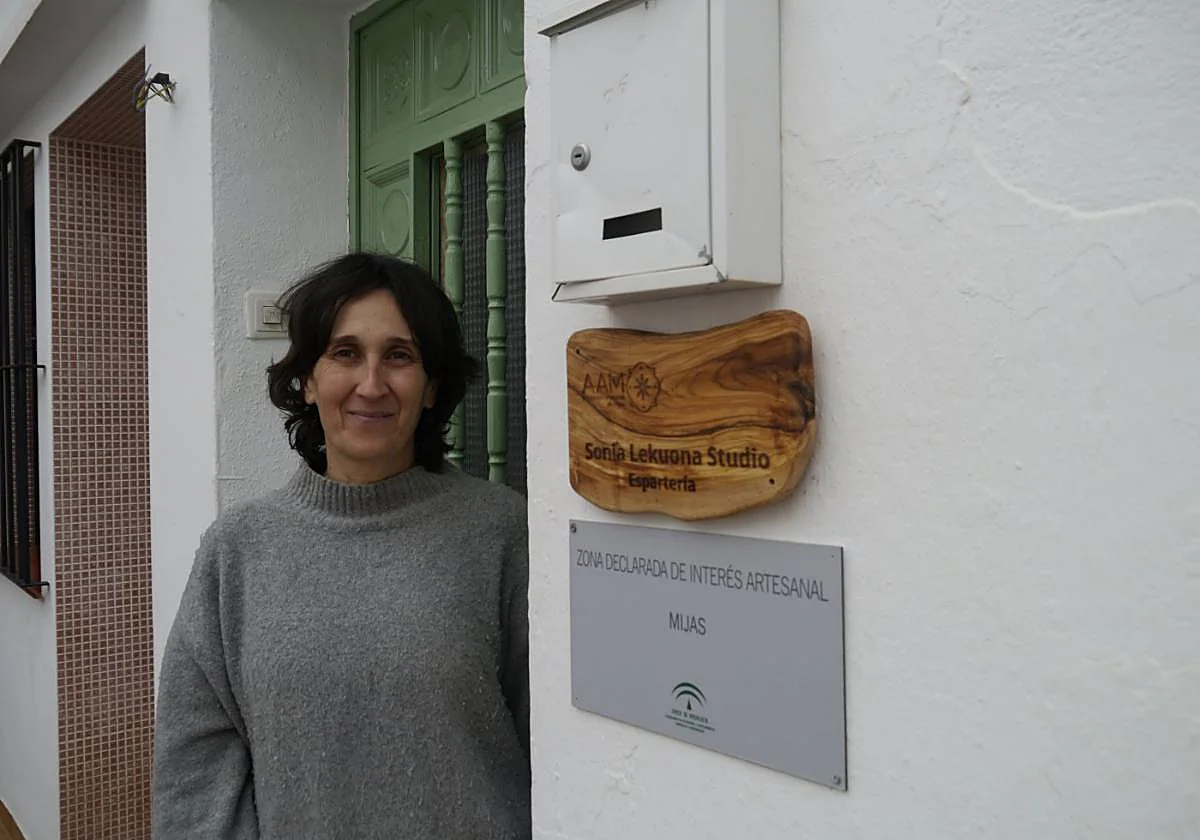
Sonia Lekuona López studio. Declared an artisanal zone of interest Heritage Reviving one of Andalucía's ancient cultural traditionsMijas resident, artisan Sonia Lekuona López, explores her passion for esparto and the value in the craft today
Anya Soares
Friday, 16 January 2026, 12:46
Sonia Lekuona López, 52, is one of few artisans left in Malaga province who work with esparto grass, an incredibly versatile material utilised for paper production, woven baskets, ropeand footwear, to name just a few uses. It was even named Spain's "national fibre" as a result of its significant contribution to boosting the country's economy during the Franco regime.
Residing in Mijas Pueblo with her husband and two daughters, Sonia is half Basque and half Andalusian. She committed herself to 'espartería' (the craft of working with esparto) in 2017, although this career path wasn't her original plan, having completed an archeology degree at the Universidad Autónoma de Madrid (UAM). However, due to the impact of the 2008 financial crash on the job market, she struggled to find work in her field, pointing out that the first sector "to be cut is culture". That year, she found a job at a textiles company, which she owes to her Basque grandmother who was a seamstress at Balenciaga, and was the one who taught her how to sew. Using her hands, she says, revitalised her interest in working with esparto.
Although, perhaps it's more accurate to say that her fascination with the material has followed her since childhood, surrounded by 'espartales' (esparto fields) in North Africa. She recalls how lucky she was, growing up with a family that travelled often, where she spent the first 16 years of her life in Algeria, Morocco and Tunisia. Naturally, this experience was the nucleus that formed her curiosity for espartería. For example, she noted that in Morocco, the craft is intimately tied to local culture, with woven baskets often seen in markets, whereas in the Iberian Peninsula, the industry is more homespun and operates on a much smaller scale.
"The craft should not become something you see in a museum - the trade should live on"
Like other Andalusian laboral traditions, rooted in the countryside (such as grape harvesting in the Axarquía) the work is often dictated by gender. Initially, this was a problem for Sonia, who wanted to make the transition from working in the textiles industry to esparto weaving but couldn't find a teacher because "the men collected the esparto, the women plaited it, then they stitched the plaits together".
Zoom
In 2017, she embraced esparto weaving and found her first teacher, Paco Moreno, who decided to take her on as a student. Her second teacher was a family friend called Ana, who was an expert in plaiting esparto. For two and a half years, she studied diligently with Paco in his studio in Mijas, and later with Ana, which was a turning point for her career.
Sonia, who is passionate about espartería, now runs regular workshops for anyone who wants to learn and is a member of the Swiss-based Homo Faber craftsmanship association. She sees it as her mission to teach and promote the craft, "so that it doesn't become something you see in a museum - so that the trade lives on".
Notably, she is one of 40 esparto artisans in Malaga province and only one of 10 who teach. Numbers are low, she shares, due to the risk of designs being copied by competitors, and then sold at online marketplaces, such as Etsy and Amazon handicrafts. Despite this, she would still rather teach because "if not, nobody would know how to read or to write".
Her studio is a joyful place, facing Mijas town centre (where she says she likes to people-watch sometimes) against the gorgeous mountainscape. Halfway through every month, she plans upcoming projects and then begins to flesh out her designs. There are fieldnotes everywhere: a book filled with different types of pressed esparto branches inside, goat head designs made from esparto, esparto bunches dyed various colours hanging from the walls - it is an artist's playroom.
Much like her studio, she describes her style as "eclectic", adding, "I don't like to do things the traditional way, I like to innovate and combine ancient techniques, merge plant fibres with paper, metal, to experiment". Sonia investigates and refines her craft with academic rigour, sometimes soaking esparto in water for a month and then pounding it to get 'esparto majado cocido'. One of her peers taught her how to dye esparto, and so she does so using spirulina or even turmeric, to see if it will absorb the colour or not.
Learning from nature
All of the materials she uses are local, representing Andalucía's cultural heritage. What's more, this allows the artisan to reconnect with her natural environment. "I don't impose, it's nature that tells me when I should do things." For Sonia, espartería has taught her how to respect "nature's rhythms" - that harvesting can only happen in the summer, and must be done with care, not by uprooting the plant; plaiting must happen in the winter. In the spring, she puts her energy into creating new designs.
This year, Sonia is combining the theme of nature with 'Al-Andalus' in a new collection, centred on agricultural products i.e. oranges, carob and lemon trees, that were brought over from the Middle East to the Iberian Peninsula during its period under Islamic rule. Currently, she is working on a piece inspired by the pomegranate, utilising copper wire and esparto to represent the fruit.
Zoom
Additionally, this month she will represent Malaga's artisanal heritage at Fitur (International Tourism Fair) in Madrid, where she will exhibit two pieces: one design will be a piece called Nur (meaning light in Arabic); a collaboration between herself and designer Carlos Giménez, featuring blinds made from esparto. The other is an interactive experience where the participant can touch esparto, while wearing headphones to listen to sounds of the 'espartales' (esparto fields) - in what will be an immersion into an ancient cultural tradition, through a modern lens.
Noticia Patrocinada
Publicidad
Historias visuales Ver más historiasEl proceso detrás de 'Cloud Dancer' y otros colores Pantone del año
Leticia Aróstegui
FútbolLa maldición de ser entrenador español en el Real Madrid con Florentino Pérez
Javier Varela, Guillermo Villar y Álex Sánchez
Así es la sanguinaria Guardia Revolucionaria iraní encargada de eliminar las protestas contra los ayatolás
Miguel Pérez, Óscar Beltrán de Otálora y Josemi Benítez (Gráficos)
Esta funcionalidad es exclusiva para registrados.
Tu nombre * Tu correo electrónico * ¿Qué error has visto? * Política de privacidad Reviving one of Andalucía's ancient cultural traditionsWhatsApp
Facebook
X
LinkedIn
Telegram
Bluesky
Threads
© Prensa Malagueña, S.A.
Registered office Málaga, Plaza Félix Sáenz, 4, planta 2ª, 29005, Málaga (con entrada por la c/Sebastián Souvirón nº1-3).
Vocento Webs
As far as possible, for the resolution of online disputes in consumer matters in accordance with Regulation (EU) 524/2013, the possibility that the European Commission provides as an online dispute resolution platform and that is available at the link https://ec.europa.eu/consumers/odr.
Go Home