Zoom
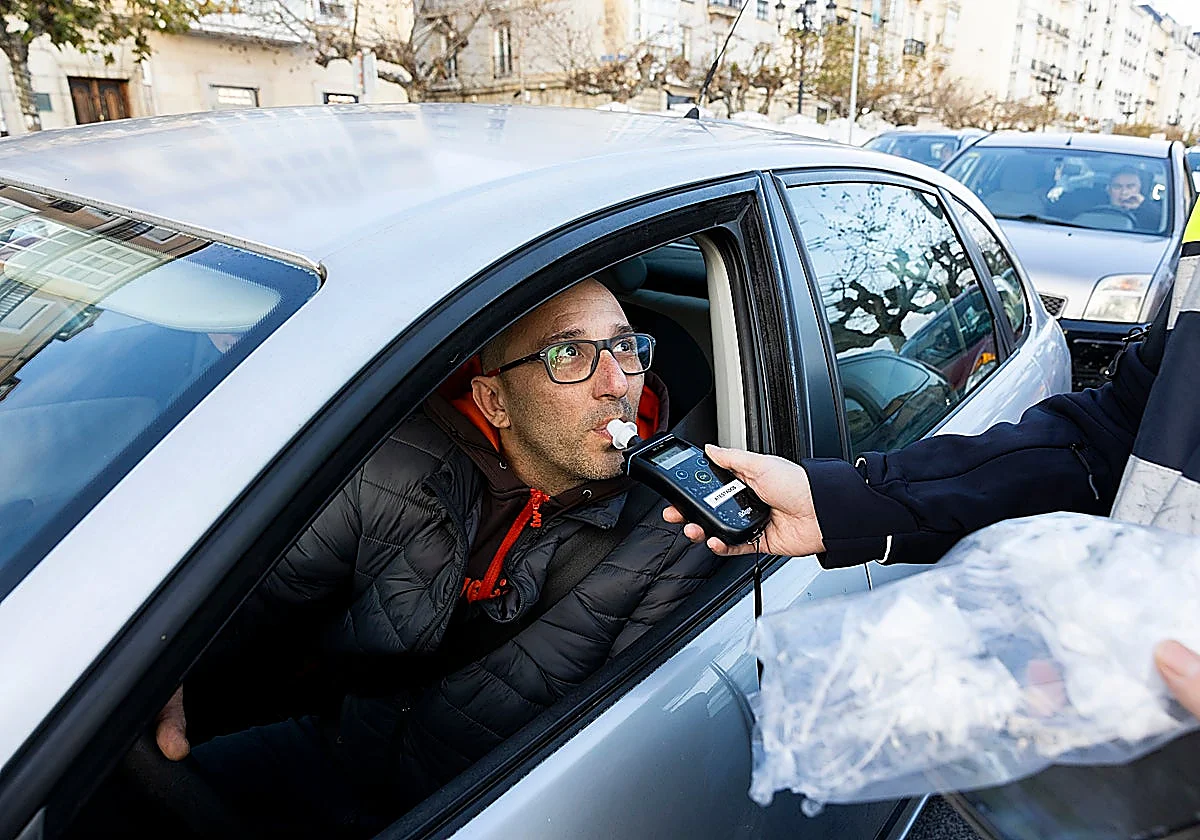
A driver undergoes a breathalyser test during a police checkpoint. J. SANTAMARÍA Right-wing and separatists parties block halving the maximum drink-driving limitThe ‘no’ votes from PP, Vox and the ERC defeated the PSOE bill to reduce the legal limit from 0.25 milligrams per litre of exhaled air to 0.1
Madrid
Thursday, 19 March 2026, 19:17
The lower house of the Spanish parliament has rejected lowering to less than half the maximum legal alcohol limit at which a driver can get behind the wheel of their vehicle in Spain without being fined.
The defeated PSOE bill, which modified the traffic law and established new maximums that were practically equivalent to zero alcohol on the road, was explicitly supported by the main Spanish associations of victims and relatives of traffic accidents.
The reform, which ended up being rejected due to the 'no votes' of the PP, Vox and the republican left of Catalonia (ERC), lowered the legal limits of alcohol levels from the current 0.25 milligrams of alcohol per litre of exhaled air to 0.1 milligrams for all types of vehicles and drivers.
The Popular Party justified its rejection on the grounds that the Socialist initiative was nothing more than a manoeuvre unsupported by any technical report and with technical deficiencies. The PP clamied this was done to cover up the ineffectiveness of its road safety policies and the increase in road deaths.
In the case of the pro-independence supporters, it was a response to their failure to get the Catalan police authorised to act as driving licence examiners alongside DGT technicians, and for the government to accept voluntary early retirement for professional drivers. Vox limited itself to saying that the law is only aimed at tax collection.
The defeat of the initiative not only drew harsh criticism from the Socialists and the interior minister, Fernando Grande-Markaska, who said that it was about "saving lives", but also sparked outrage against the 'no' parties from the associations of road accident victims. These claimed that "political polarisation" had led to the loss of "a historic and unrepeatable opportunity" in the fight against road accidents.
The rejection of the initiative provoked outrage of road accident victims' associations, whose public appeal for support was ignored
David Pérez de Landazabal, the vice-president of the stop accidents association, faced with the possibility of the reform being rejected, had already warned that "those who vote against it will have to explain it to the tens of thousands of families who have lost a loved one on the road in our country, more than 70,000 in the last 25 years". "Saving lives has no political colour or ideology. Reducing drink-driving is a question of solidarity and common sense", he said.
The victims' association Aesleme, for its part, said that this proposal was a "pending account" with road safety and is now "a lost historic opportunity". The association said that "political polarisation and other types of political strategies, which have nothing to do with road safety, cannot be allowed to interfere with a necessary measure".
The now-abandoned reform was set to be the first reduction of the maximum permitted blood alcohol limit for driving in Spain in 25 years. Its main change was that the legal maximum alcohol level in the body for driving would drop from the current 0.25 milligrams per litre of exhaled air (0.5 grams in blood) to 0.1 (0.2 in blood), a reduction of 60 per cent. It stated that anyone registering between 0.1 and 0.25 milligrams in a breathalyser test would commit a serious traffic offence and be fined 200 euros, along with the loss of two driving licence points. The new maximum rate was identical for all drivers, thus eliminating the current distinctions, which lower the limit to 0.15 milligrams in exhaled air for professional drivers and novice drivers.
The introduction of the new limit would also make the current maximum an aggravating factor. Drivers with a positive test of 0.25 or above would commit a very serious offence and would be fined 500 euros and four points. Those who exceeded 0.5 in the breath alcohol test were to be fined 1,000 euros and have six points withdrawn, a punishment that is now only reserved for repeat offenders.
Reasons for change
Both the proponents, as well as the ministry of interior and those responsible at the DGT, justified the change by citing the need to continue reducing road deaths in Spain, which have remained stable at around 1,800 people per year for several years. The explanatory memorandum itself pointed out that one third of all fatalities in Spain (whether passengers or pedestrians) are due to accidents linked to alcohol, and that in 2023, the courts convicted more than 50,000 Spaniards for driving or causing accidents under the influence of this legal drug.
The choice of the new maximum rate was justified by two arguments. The first is that the 0.1 milligrams of alcohol per litre of exhaled air is the same rate as the two most advanced countries in road safety, Sweden and Norway, and the rate recommended by the European Commission and leading experts. Secondly, the most recent studies show that even moderate doses of alcohol at the wheel are the source of numerous accidents. Drivers with alcohol levels of between 0.05 and 0.25 milligrams of alcohol are three times more likely to be involved in a fatal accident than their sober counterparts.
Controls alerts
The original reform presented by the Socialists included another significant innovation, aimed at putting an end to the increasingly common existence of organised groups that use social media or instant messaging chats to alert others about the locations of traffic checkpoints, considering them a serious threat to road safety and to the life and integrity of travellers. For this reason, anyone spreading notices about the location of checkpoints would be fined 500 euros, as their behaviour was classified as a very serious offence.
However, this change had already been left out of the proposal. It disappeared with the deletion amendments already introduced in the first debate on the regulation, because the measure was opposed by the Catalan MPs of Junts, whose yes votes were indispensable to be able to move forward with the central nucleus of the reform.