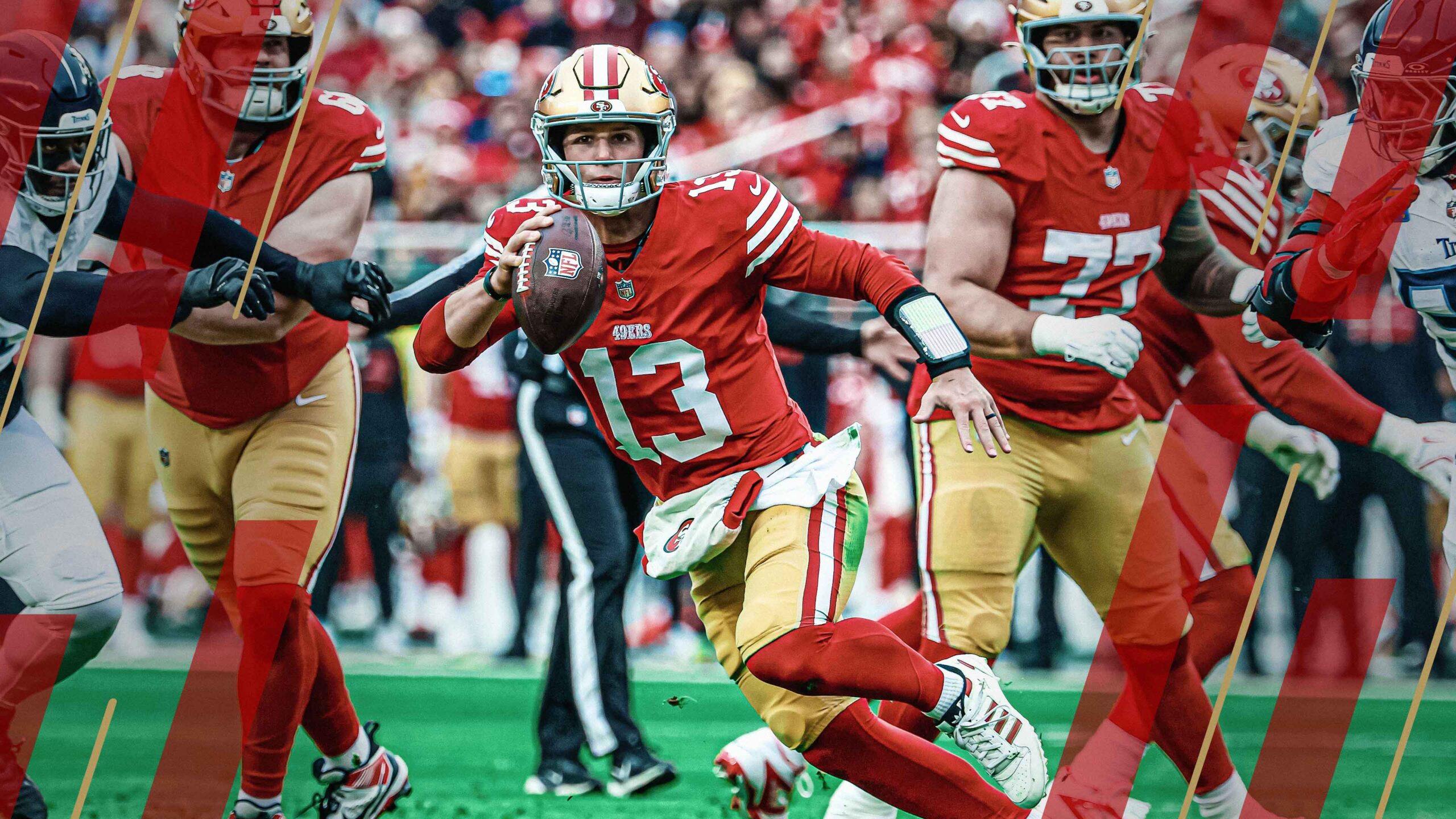
As part of PFF's celebration of 20 years of NFL data, we're building an All-Star team for every franchise, highlighting the best players at each position from the PFF era. This installment turns to theSan Francisco 49ers.
PFF's database dates back to the 2006 NFL season, providing a unique lens for evaluating and comparing players across eras. More details on the methodology used to construct these teams are available at the bottom of the page.
Offense
- QB: Brock Purdy (2022-2025)
- HB: Christian McCaffrey (2022-2025)
- FB: Kyle Juszczyk (2017-2025)
- WR: Brandon Aiyuk (2020-2024)
- WR: Michael Crabtree (2009-2014)
- Slot WR: Deebo Samuel (2019-2024)
- TE: George Kittle (2017-2025)
- LT: Trent Williams (2020-2025)
- LG: Mike Iupati (2010-2014)
- C: Jake Brendel (2021-2025)
- RG: Dominick Puni (2024-2025)
- RT: Joe Staley (2007-2019)
The 49ers were one of the most interesting teams to build because they had two distinct peaks: one from 2011-13 under Jim Harbaugh, when they made three straight conference championship appearances, and another from 2019-25 under Kyle Shanahan, when they reached four conference championship games.
The Harbaugh-era teams featured an excellent defense and a good offense, while the Shanahan-era teams excelled on both sides of the ball. As a result, most of the offensive selections came from the more recent era, with a few exceptions. While players such as Frank Gore and Vernon Davis were both Pro Bowl-caliber talents, Christian McCaffrey and George Kittle have arguably been the best players at their positions at various points in their careers.
One of the toughest decisions came at right tackle. Trent Williams has earned four first-team All-Pro selections over the past five seasons, while Joe Staley's highest honor was a second-team All-Pro nod. Fortunately, Staley played a full season at right tackle for the 49ers in 2007, and there was a significant gap between him and the rest of San Francisco's tackle options, making him the logical choice for the position.
Defense
- DI: Justin Smith (2008-2014)
- DI: Arik Armstead (2015-2023)
- NT: Aubrayo Franklin (2007-2010)
- ED: Nick Bosa (2019-2025)
- ED: Aldon Smith (2011-2014)
- LB: Patrick Willis (2007-2014)
- LB: Fred Warner (2018-2025)
- CB: Tarell Brown (2007-2013)
- CB: Charvarius Ward (2022-2024)
- Slot CB: Nate Clements (2007-2010)
- S: Jimmie Ward (2014-2022)
- S: Michael Lewis (2007-2010)
The 49ers' defense has primarily been known for its front seven, and this team perfectly blends the franchise's two strongest eras of the past 20 years. Patrick Willis, Aldon Smith and Justin Smith from the early 2010s join Fred Warner, Nick Bosa and Arik Armstead from recent years to form an unstoppable front.
Several great players were left off this team because of the position group's depth, but none more notable than NaVorro Bowman. Only eight off-ball linebackers have played more than 5,000 snaps and earned a career PFF defensive grade above 90.0, and the 49ers happened to have three of them. Because San Francisco played nearly twice as many snaps in a 3-4 defense as a 4-3 during this period, there was no good way to fit all three onto the team.
The 49ers faced a similar problem at cornerback. While they haven't had the same consistent All-Pro presence there as at other positions, they have had a long run of quality outside cornerbacks. Jimmie Ward could have been the team's slot cornerback, but it made more sense to place him at safety and use Nate Clements in the slot based on his one season there, allowing Charvarius Ward to make the team. Richard Sherman, Tramaine Brock Sr., K'Waun Williams and Walt Harris were among the other cornerbacks who graded well over multiple seasons but ultimately missed the cut.
Methodology
Selections were based on normalized PFF grades adjusted by season. To balance peak performance and longevity, only a player's five best seasons with a franchise from 2006-25 were considered. Any season with an overall PFF grade below 60.0 was excluded, ensuring that strong years helped a player's case while weaker seasons were not held against him. Postseason play was included, though all seasons were capped at a 16-game equivalent to maintain consistency across eras. At each position, the player with the highest score under this methodology earned the spot.
Each team consists of 12 offensive and 12 defensive players. Because 11 personnel and nickel defense were the league's most common alignments over the past two decades, those personnel groupings served as the foundation for every roster. Teams received either a second tight end or a fullback, depending on whether they used more 12- or 21-personnel. Defensively, teams received either a third interior defender or a third linebacker depending on whether they primarily operated from a 3-4 or 4-3 front.
Players who logged significant snaps at multiple positions during their tenure with a franchise were eligible at either spot. In most cases, those players were assigned to the position where they provided the greatest value, though their versatility occasionally influenced the final roster construction.
Unlike some All-Pro teams that group offensive linemen by position type, these rosters were built according to where players actually lined up. If a team's two best tackles both played exclusively on the left side, only the top left tackle was selected. One of the three wide receivers and one of the five defensive backs was also required to have significant slot experience. In a 4-3 defense, one linebacker needed experience at the Sam linebacker position, while in a 3-4 defense, one defensive tackle needed experience at nose tackle.
When multiple players are listed at the same position, the first name represents the top selection. Players designated as slot wide receiver, slot cornerback, nose tackle or Sam linebacker were selected specifically for those roles rather than as the third-best player within their broader position group.