Seven months after Seattle walked off the field at Levi’s Stadium as champions, the 2026 season opens with the same two teams — only this time, under the lights at Lumen Field.
It is the rarest kind of Week 1 matchup: a Super Bowl rematch between two teams picking up exactly where they left off in February. Both teams went 14-3 last year. Both finished among the top four in PFF overall team grade. Both saved some of their best football for January and February. Both now start the year with a clean slate and a chance to prove themselves again.
Everything that follows comes directly from a PFF Premium Stats Pro‘s game page — first from the Super Bowl, where this matchup left off, and then from the Week 1 page for Wednesday night.
Where This Left Off: Super Bowl LX
Seattle and New England were separated by just four total yards in Super Bowl 60 — 335 to 331 — and the Patriots actually averaged more yards per play, 4.9 to 4.7. By conventional box-score measures, this was a relatively even game.
The separation shows up in the bottom two rows, which is where PFF’s version of the box score starts to tell a different story. New England averaged -0.322 EPA per play compared with Seattle’s -0.060, and the Seahawks won the success-rate column despite losing the yardage columns.
New England reached the Seattle 20 exactly once all night, running two plays and scoring one touchdown. That gave the Patriots 100% red-zone efficiency, but almost no volume. Seattle made four trips, ran 10 plays inside the 20 and came away with one touchdown and two field goals.
The QB Performance module puts the two passers side by side, and the contrast helps explain why Seattle left with the trophy.
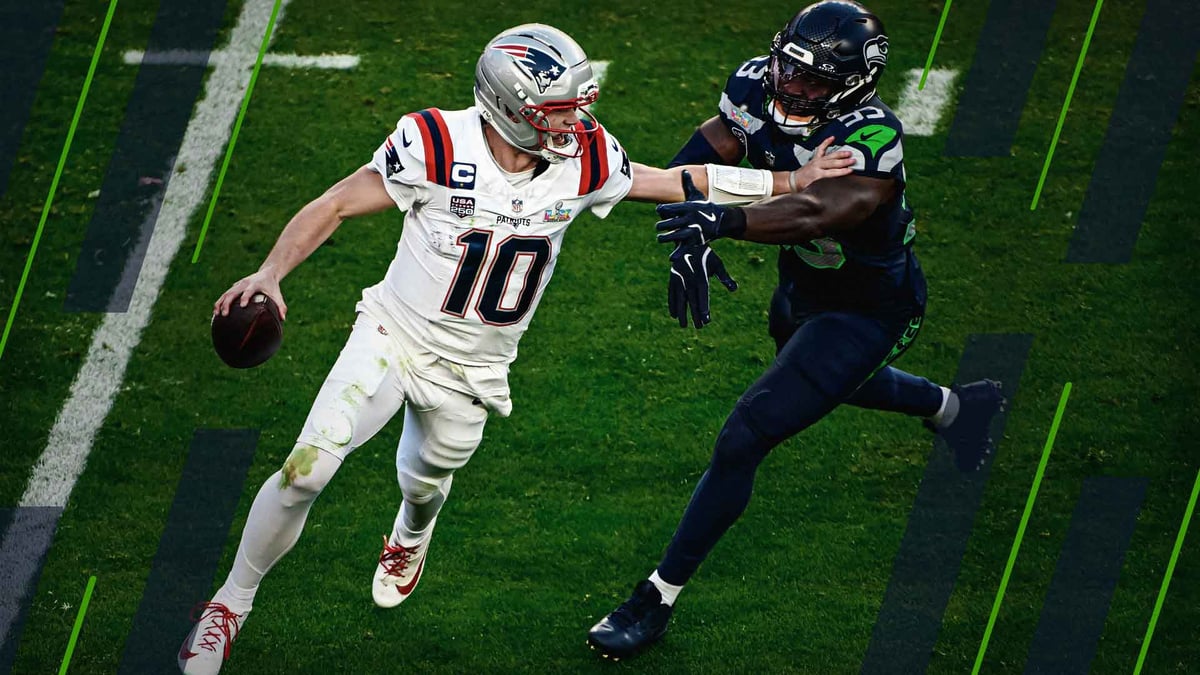
Drake Maye out-produced Sam Darnold in the box score — 53 dropbacks to 40, 295 passing yards to 202 and two touchdowns to one — but he also threw the game’s only two interceptions and was sacked six times. He ultimately ended the night with four turnover-worthy plays.
Darnold was sacked just once and produced only one turnover-worthy play.
Kenneth Walker III carried the ball 27 times for 135 yards, averaging 5.0 yards per attempt and 3.26 yards after contact per carry. He earned a 78.5 rushing grade on the back of 88 yards after contact, eight forced missed tackles and seven total first downs.
Wednesday Night: The Week 1 Matchup Page
The 2026 page for this game is built the other way around — no plays have been run yet, so every module is populated with last season’s data, ranked league-wide.
The Highest Graded Players module opens the page with the top five players by PFF grade on each unit, with a minimum threshold of 25% of team snaps.
Seattle had three players above 85.0, led by Jaxon Smith-Njigba at 92.9 and Kenneth Walker III at 91.4, with Zach Charbonnet at 85.1. Walker is now in Kansas City, but Smith-Njigba and Charbonnet remain, as do the other two Seahawks in the top five: right tackle Abraham Lucas at 81.0 and Sam Darnold at 79.0.
New England’s list was flatter, and its highest-graded player is gone. Stefon Diggs led the Patriots at 82.7 (with nobody else above 81.0), but he is now in Washington.
So the graphic doubles as an offseason snapshot. Four of Seattle’s five highest-graded offensive players from that team are still in place, but the one who left happened to be the Super Bowl MVP.
Devon Witherspoon earned a 90.1 PFF grade last year, higher than every player on either offense except Jaxon Smith-Njigba. DeMarcus Lawrence followed at 82.1. New England’s highest-graded defender, Christian Gonzalez, finished at 75.1, a mark that would rank fifth on Seattle’s defensive list.
Maye and Darnold finished eighth and ninth, respectively, among 43 qualifiers in overall PFF grade last season, and they got there in remarkably similar ways. Both were excellent from a clean pocket, with Darnold’s 90.6 grade ranking fifth and Maye’s 90.1 ranking sixth. Both dropped off when the pocket broke down: Darnold graded 53.1 under pressure (17th), while Maye earned a grade of 46.5 (23rd).
Darnold got the ball out in 2.8 seconds — 13th among qualifiers — while posting a 5.7% big-time throw rate that ranked sixth. Maye held the ball for 3.1 seconds — 36th out of 43 — and pushed it deeper than almost anyone, with his 9.7-yard average depth of target ranking third.
Their turnover-worthy play rates were nearly identical at 3.3% and 3.2%.
The Efficiency and Scoring module is the one to send to anyone still arguing from total yards.
It pairs each offense with what the opposing defense allowed, with league ranks on both sides, and the headline is that both were among the NFL’s best scoring defenses. Seattle ranked first at 16.9 points allowed per game, while New England ranked third at 17.9.
The offensive splits are more revealing. New England ranked fourth in passing EPA per play at +0.19 but just 27th in rushing EPA per play at -0.09. Its 37.4% rushing success rate ranked 29th. It was a genuinely one-dimensional offense and still averaged 26.5 points per game.
Seattle leaned in the same direction, just not as heavily, and averaged 29.2 points per game, second in the league.
The Pressure Matchup module answers one question on each side of the ball: Who wins when the offense drops back?
Both answers favor the defense.
New England allowed pressure on 37.4% of its dropbacks last season (22nd in the league) and now faces a Seattle pass rush that generated pressure on 40.3% of snaps (7th). Seattle allowed pressure on 35.5% of its dropbacks (14th) against a New England pass rush that produced pressure at a 40.4% of snaps (5th).
Team Grades closes the page with nine rows covering both sides of the ball, each ranked across all 32 teams. Two of them frame the matchup.
The first is coverage, where these were the two best units in football. New England ranked first with a 90.0 coverage grade, while Seattle ranked second at 86.5.
The second is the clearest mismatch on the page, though one side has changed considerably since February. Seattle finished with the NFL’s No. 1 rushing grade at 91.3, while New England’s run defense graded at 62.0 (18th).
Seattle found that weakness in the Super Bowl, but the player who exploited it most is no longer on the roster. Walker rushed for 135 yards that night, including 88 after contact. His departure turns what was Seattle’s clearest advantage in February into one of the more interesting questions of the opener: whether the Seahawks can attack the same weakness without the back who made it matter seven months ago.