Ronda
Silvia Álvarez, the mother who finished the 101 Ronda race with her dead son's race bibThe runner moved the Serranía by completing the gruelling course with the number that David did not get to wear in the Ultra Sierra Nevada
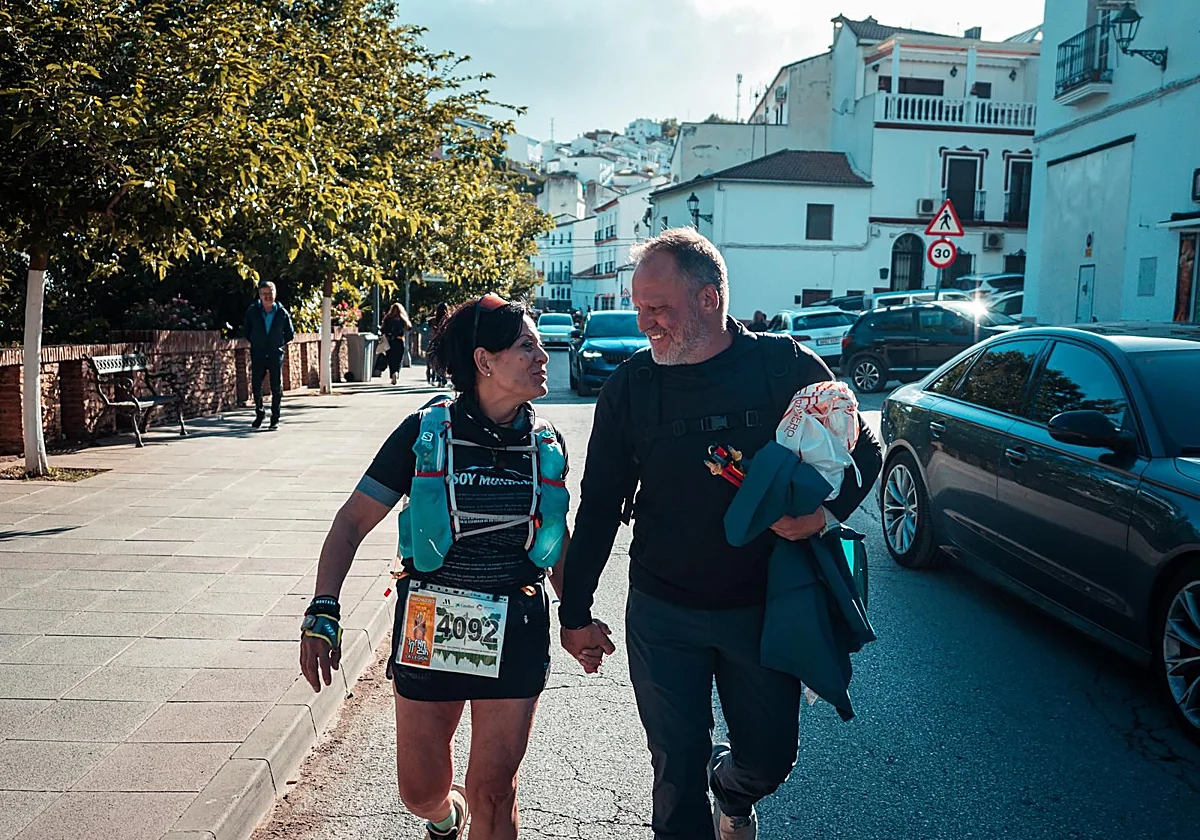
Añádenos en Google Silvia Álvarez and her husband in the 101 in Ronda. (SUR) 23/05/2026 a las 14:58h.Silvia Álvarez stopped a few seconds before crossing the finish line of the Spanish Legion's 101 Kilometres event in Ronda. She had just covered ... all 101 kilometres in nearly 24 hours, with the fatigue and blisters that that entailed, but what she was carrying weighed much more than all that: the race bib number 101 that belonged to her son David, who died twelve years ago before being able to compete in the Ultra Sierra Nevada event.
That is why, when she says that "mourning is like an ultra: it has death and breaths", she is not just talking about a race. She is talking about a way of continuing to walk with absence.
That is why her arrival in Ronda's Alameda del Tajo became one of the most moving images of the race. She had not won nor was she fighting for a classification, but her crossing the finish line ended up all over social media. There were the legionnaires, the public and, most importantly, her husband, David Calabuig, who ended up kneeling down in front of her to give her the medal. "That intimacy was not mine, it was shared," says Silvia.
Even days later, she speaks as if she still hasn't come back. "I have a mental fog. This is awesome. I still can't believe it," she admits. In other races and refreshment posts, many runners have come to embrace her. "They cheered me, lifted me up, sang to me. You can't even imagine what I have experienced."
The story, however, does not begin at the 101. It begins much earlier, with David, her son. A young man who ran in the mountains, did ultras, wrote, sang and had, according to his mother, "an awesome sensitivity". After his death, she began to read his texts. In one of them she found a phrase that would end up affecting everything: "I am you, I am mountain." From there 'Soy Montaña' was born, the vital project with which she now accompanies other people in mourning.
David had eagerly signed up for the Ultra Sierra Nevada. He had been assigned the bib number 101, but he died a month before he could run it. His friends then decided to take that number in relays to the finish line. That gesture touched the organisers so much that they decided to withdraw that bib every year as a tribute to the young man and give it to his mother. From then on, 101 no longer corresponded to just one race.
The organisation also gave her a refreshment point at the Ultra Sierra Nevada. And that aid station, in the middle of the mountains, ended up being a form of salvation for her. "That refreshment point gave me life. When you lose a child, you can lock yourself away, in bed, on the sofa, in a house, and not go out to live. That's what made me go out," she explains. Every year, she welcomes runners from all over the world. She gives them food, drink and encouragement, but she feels something else: "I don't feel that I receive runners. I feel like I welcome my son every year."
"I threw away all my high heels and swapped pills for trainers"
Silvia had never been a runner. Her son tried many times to convince her. "Mum, come with me, I'm going to introduce you to the happiness bug," he would say. She would reply that she couldn't even run around the corner, but after his death, everything changed. "I threw away all my high heels and exchanged pills for slippers. Tears turned into hugs."
Her presence in the 101
Nor was her presence in the Ronda 101 born out of a calculated decision. It was her husband who signed her up without telling her, convinced that she could do it. Silvia trained for four months. When she found out she had a place, she didn't think it was crazy. "I said: I can do it. I felt that energy coming from the sky. When you fight with your heart, you can reach your goals."
In the race, she says she never felt alone. "My two sons accompanied me every step of the way. David and also Dani. I didn't run towards the horizon, I ran towards him, and I always found him on the way."
The challenge also had a family feel to it. Her husband had previously run the Ronda 101 in tribute to his son and had also worn the 101 bib of the Ultra Sierra Nevada to a finish line. Silvia felt that her part was missing.
"I didn't run towards the horizon, I ran towards him, and I always found him on the way"
It was not easy. With ten kilometres to go, she thought she couldn't go any further. She called her husband and said: "Daddy, I'm staying here." She didn't see it as a failure. She was proud of every step. But her partner appeared, accompanied her and together they reached the goal in time. From the bridge, Silvia felt an unexpected strength. "I ran [across the finish line] because I felt an amazing injection of energy that heaven sent me. I didn't feel any pain."
When she reached the Alameda she stood still, looking at the people, unable to believe what she had just achieved. "I felt an awesome embrace from everyone, as if it was my son carrying me towards that goal through them". Then came the medal. Silvia had often imagined that it would be the colonel who would present it to her. But the gesture changed hands. Her husband knelt before her and hung the medal around her neck.
Silvia, who lives in Granada, does not talk about grief as if it were a closed story. For her, the death of a child is not something you get over. You learn to live with it. "Time does not heal. You learn to live with it and you learn to live from another place, from love." When someone asks her how long it has been since David's death, she always answers the same thing: "Yesterday."
In their marriage, loss did not separate them. There are moments of falling, of exhaustion, of wanting to give up. And there are others in which someone appears, lends a hand and allows them to go on. But if Silvia Álvarez is clear about one thing from her life experience, it is that "no one takes away the pain. The important thing is not to anchor yourself in suffering."