Health
Spain develops calculator to predict likelihood of developing breast cancer over five-year periodThe study will collect data from women in 14 regions to create a tool that will support screening programmes
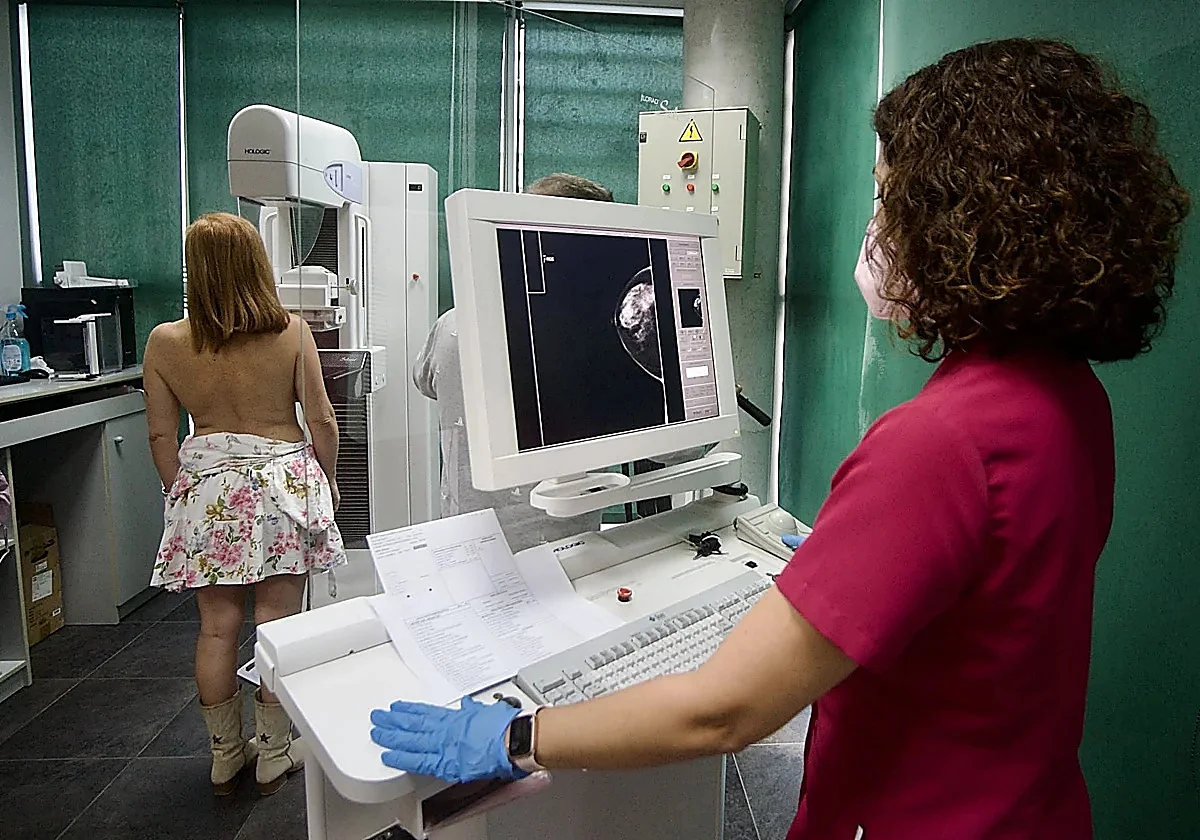
Añádenos en Google A woman undergoing a mammography at a medical centre in Spain. (Nacho García)Rocío Mendoza
21/07/2026 a las 13:16h.Three health research institutes have announced the launch of the first study in Spain to collect data from women to test a tool capable of predicting their five-year likelihood of developing breast cancer.
The project involves residents of 14 regions, both healthy and those with breast cancer, culminating in the creation of a calculator to support existing screening programmes, personalising monitoring and care for at-risk populations.
Until now, these preventative programmes have consisted of mammographies that the national healthcare system offered to women, based on their age and family history. These remain, to date, the best way to detect breast cancer early.
The goal now is to add tools that provide greater precision. The aim is to demonstrate how "a statistical model could predict each woman's risk based on her lifestyle, genetics and mammographic characteristics", as the Spanish cancer research centre (CNIO) says.
This is where the research project now under way ('MamoRisk') comes in. The researchers want, on the one hand, to provide this tool with enough information to ensure that the new model works, hence the massive data collection. On the other hand, they need to demonstrate that the calculator is accurate in practice.
It must successfully pass the trial period in which its predictions are compared with the actual data of the women participating in the study. This is essential if the aim is to "use it in population-based breast cancer screening programmes", which "could substantially improve early detection".
How will it work? The first phase involves collecting personal data from 10,000 women in Madrid, Cantabria, Castilla-La Mancha, Murcia, Extremadura, Asturias, Castilla y León, Andalucía, Aragon, Catalonia, La Rioja, Valencia and the Canary Islands.
A total of 4,000 women undergoing treatment and another 6,000 healthy women, chosen randomly, will be invited to participate in the study. All participants must have been monitored for at least six years through the regional screening programmes in order to compare their progress.
With epidemiological information (their lifestyle habits, for example) and genetic information (obtained from a saliva sample), the statistical model will use artificial intelligence to provide probability.
By having women whose cases have been followed over the years, it will be possible to verify whether the calculator's prediction was accurate: whether it correctly predicted that a particular woman had a risk of developing a tumour within three years.
This is an empirical way to test a tool that, if proven effective, will be implemented in existing cancer screening programmes. When the tool identifies a woman with a higher probability of developing the disease, she can be monitored much more closely in order to implement targeted and personalised preventive measures.
Sufficient funding
The Santiago de Compostela health research institute (IDIS), the CNIO and the Galicia Sur health research institute (IISGS) lead the project. Internationally, the collaboration of Antonis Antoniou, Professor of Cancer Risk Prediction at the University of Cambridge, is particularly noteworthy.
At IDIS, Manuela Gago coordinates the selection and recruitment of participants and collects clinical data. At CNIO, Anna González-Neira and Guillermo Pita conduct the genetic study of participants and estimate their genetic risk of developing breast cancer. José Esteban Castelao, from IISGS, applies artificial intelligence to the analysis of mammograms.
The Ministry of Science is funding MamoRisk with 1.2 million euros from public funds from the European programme NextGenerationEU.