Zoom
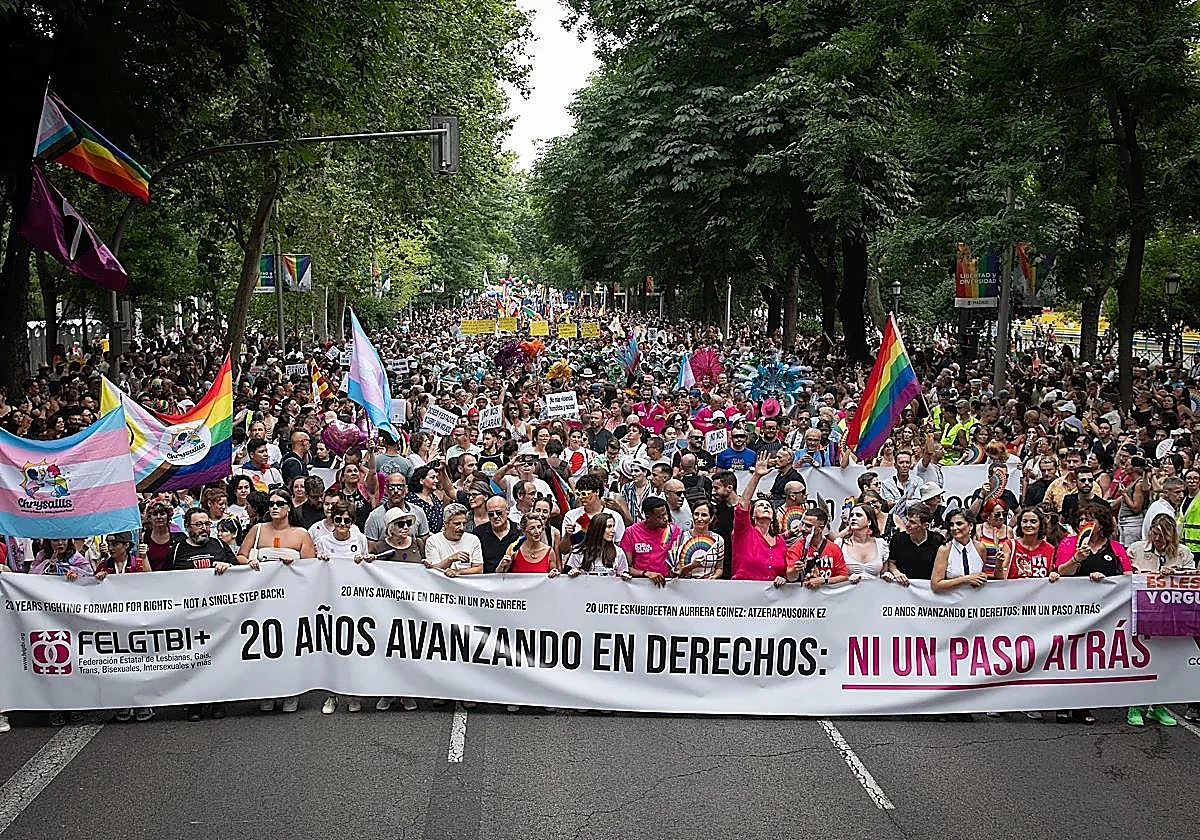
The Pride 2025 demonstration in Madrid. EP Society Spain experiences surge in LGTB+ people coming outA new report reveals that one in three members of the gay community has experienced homelessness due to family incomprehension and economic precariousness
Madrid
Wednesday, 17 December 2025, 12:28
More and more the LGBT+ community in Spain choose to make their sexual orientation and gender identity known to family, colleagues and friends. One in five members, however, continues hiding their personal choice from all or most of them, although there has been a clear surge in people coming out in the last two years.
This has been revealed by the socio-economic study carried out by Federación Estatal LGTBI in collaboration with analysts from the University of Salamanca.
The study estimates that 21% of the approximately seven million members of the community living in Spain (14.6% of the population) are still hiding, but this is 20% lower than the figure just two years ago, which was 25%. This has a lot to do with new generations, who are increasingly expressing a more varied and different sexual orientation from heterosexuality and who make up the bulk of those who come out.
The vast majority of LGTB+ members in Spain come out around the age of 20. Seven out of ten of those who take this step do so between the ages of 15 and 24 and the majority of them, four out of ten, between the ages of 18 and 24. In fact, those who do not take the decision before the age of 35 find it very difficult afterwards. Only 7% say they have come out after that age and almost all of them before the age of 44.
It is not surprising that the vast majority of the 21% of LGTB+ people who still do not make their identity known in public are over 45 years of age and above all over 55. Among those aged 45 to 54, 30% remain in the closet, 50% above the average, while in the 55 to 64 age group, 40% continue to keep their identity hidden, double the overall figure.
The risk of social exclusion among LGTB+ people is growing, with poverty and unemployment higher than average, especially among transgender people
Coming out is a personal liberation, but often also a source of misunderstanding and discrimination, if not hatred and violence. Proof of this is the enormous number of members of the community who have experienced homelessness first-hand. Many were forced to leave the family home because of the problems and LGTB-phobia unleashed after they disclosed their sexual orientation or gender identity. Others were evicted because of the higher rates of poverty, job insecurity and social exclusion they experience compared to the average population.
A third of the Spanish LGTB+ community say they have experienced varying degrees of homelessness in the last five years, mostly in the 30-34 age group. Half of those who were left without a place to live had to take temporary refuge in the home of a friend or acquaintance; a third had to resort to shelters or similar; almost another third lived in overcrowded or unhealthy places; and just over one in ten had to live on the street for a time. By far the most affected are transgender people, among whom almost half (47%) know what it is like to be homeless (13% more than the rest of the community) and among whom twice as many (9.4%) have had to live on the street.
Precariousness
LGTB-phobia in the family is the main trigger for homelessness, but so is economic insecurity, which can eventually lead to evictions. Proof of this is that half of those with an income of under 1,000 euros and half of those who have worked under three months in the last year have become homeless. Those with the lowest level of education comprise the highest portion of people who have had to resort to shelters or live on the streets. Among those who have gone through this traumatic experience, there are many who have been discriminated against, harassed or become victims of violence.
The report contrasts the simplistic image linking the economic boom to this community. In fact, it paints just the opposite picture for the majority. For the third year, it detects a general worsening of living conditions, with high levels of precariousness, poverty and exclusion, especially among transgender people and lesbians. The unemployment rate, which is 2% higher than last year, is above the national average. One in five LGTB+ members work less than 20% of the possible annual hours, which contributes to a poverty rate double that of the general Spanish population. Similarly, 11.5% of the community earns less than 1,000 euros per month (compared to 7% in general) and 43% suffers from energy poverty (more than double the average).