Zoom
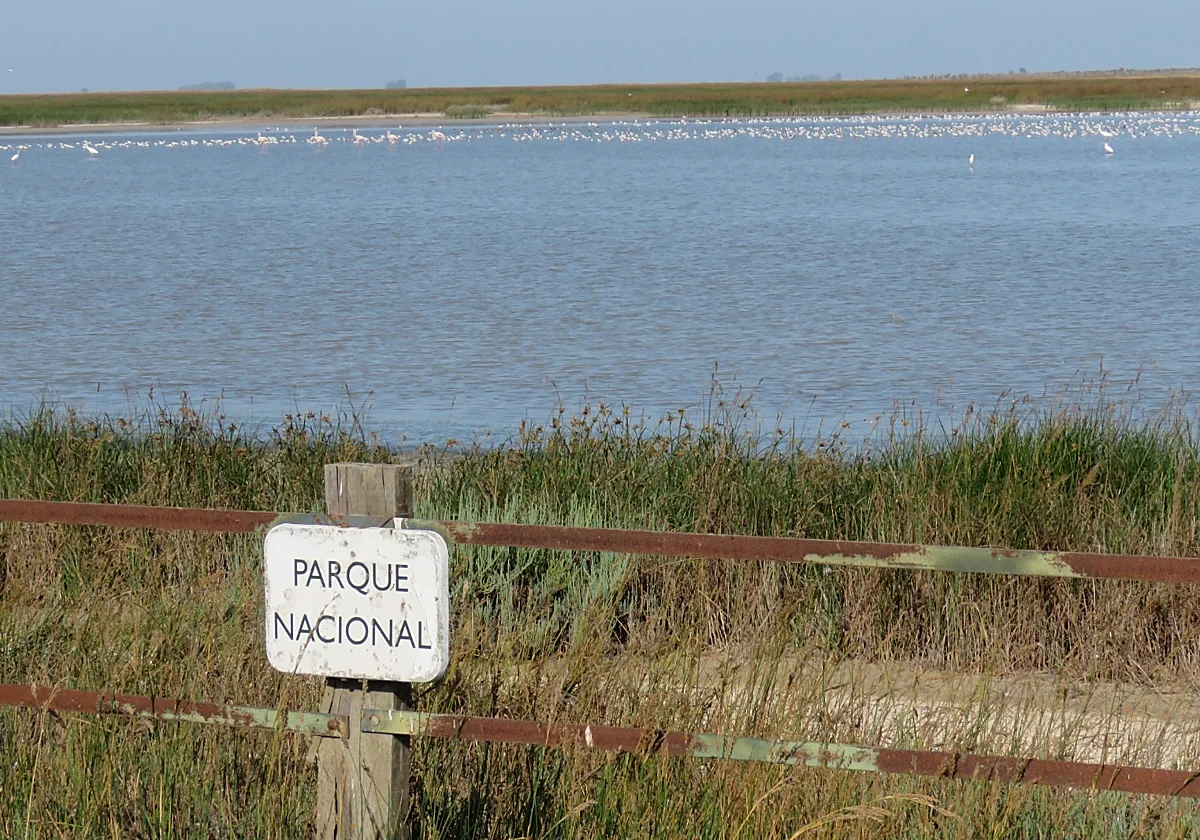
One of the open water spots in Doñana's marshlands. Environment Spain's National High Court accepts WWF's appeal against the demarcation of Doñana's marshlandsThe conservation organisation joins the appeal filed by the Junta and the objections raised by other interested parties, including the Doñana biological station, those managing Doñana's Natural Area and the Guadalquivir river basin authority
Seville
Thursday, 23 April 2026, 11:31
Spain's National High Court (Audiencia Nacional, AN) has formally admitted the contentious-administrative appeal filed by the WWF against the boundary demarcation of the Doñana marshland area, which was also appealed by Andalucía's regional government due to disagreements with central government over the limits of the tidal influence zone.
The appeal concerns the boundary demarcation order approved last October by the Ministry for Ecological Transition and the Demographic Challenge, through the directorate-general for coast and sea, regarding the Doñana marshes. The WWF appeal joins the one filed by the Junta de Andalucía, which was also recently accepted for review by this court .
The WWF highlights that opposition to this boundary demarcation is not limited to the WWF alone, but is shared by other state bodies such as the Doñana biological station (CSIC), the Guadalquivir river basin authority (CHG), Andalucía's regional government, the management of the Doñana Natural Area and Hinojos town council. All these interested parties have already spoken out against the proposed boundary.
The secretary-general for the WWF in Spain, Juan Carlos del Olmo, stated that "it is surprising to have to defend at this point that Doñana is also a freshwater marsh when all the scientific studies done over decades unequivocally demonstrate that its marshes are freshwater wetlands of pluvial-fluvial origin".
"The WWF opposes this demarcation as it is currently proposed since it redefines the nature of the Doñana marshland, considering that approximately two-thirds of the current marshland would be tidal land, and this proposal could have irreversible ecological consequences", said the head of this environmental organisation in Spain.
In Olmo's opinion, "one of the key aspects of the controversy revolves around Montaña del Río, a rise in the land parallel to the Guadalquivir river which the coastal authority maintains was artificially created in 1983, while the WWF and various scientific bodies, such as the CSIC, support the claim that its origin is not artificial, although it has been restored on several occasions due to erosion".
Juan Carlos Olmo believes that "this proposed boundary demarcation, adopted independently and against the majority opinion of the Doñana participation council, will force a reinterpretation of the management of the National Park, potentially causing saltwater intrusion into freshwater areas and jeopardising conservation efforts endorsed for decades by the scientific and technical community".
More than 270 scientists have already expressed their opposition to the current demarcation promoted by Madrid's Ministry for Ecological Transition, arguing that "it contradicts the existing scientific consensus on the hydrological functioning of Doñana".
The scientific community further warns that "this decision could have irreversible consequences, such as the loss of its freshwater wetlands and the profound alteration of its most valuable ecosystems, protected by national and international law".
The WWF representative is urging the Ministry to "listen to science and abandon this proposed boundary demarcation, which could lead to a lengthy legal battle and delay essential projects committed to the recovery of Doñana's threatened biodiversity." He also calls on the Ministry to "initiate a new procedure based on the broad scientific consensus regarding the ecology and functioning of this important marshland".
Despite accepting this WWF appeal and that of the Junta, the National High Court has not yet ruled on the precautionary measure of suspension requested by the appellants. The Ministry's decision has opened a demarcation process for state-owned, maritime-terrestrial public domain assets in this part of the Doñana marshlands, which includes land in the Huelva towns of Almonte and Hinojos and the town of Aznalcázar in Seville.