Zoom
Illustration by Alba Martín Campos Adobe stock Health Sweets, meat and more: 65% of choking incidents in children are caused by foodSUR consults with two medical specialists on how to handle an upper airway obstruction caused by a foreign body in children as well as in adults and also how to prevent this happening
Monday, 5 January 2026, 20:09
"In intensive care, as head of this service, I was concerned to see many cases of children arriving in cardiac arrest or in very dire straits that could have been avoided: 85% of these cases are due to accidents for which the adults caring for them bear a great deal of responsibility."
This is the opinion of Custodio Calvo Macías, former head of the paediatric intensive care unit at the Materno (Malaga city's children's and maternity hospital), also founding member and former president of the Spanish group for paediatric and neonatal cardiopulmonary resuscitation. Dr Calvo asserts that 65% of choking incidents in children and babies are caused by food, from sweets to chewing gum, nuts, biscuits, crisps and popcorn, bread, meat (especially sausages and ham), bones in meat and fish, chunks of fruit or vegetables and seeds.
The remaining 35%, states Calvo, are caused by coins (13%), followed by pieces of toys or puzzles, marbles, screws, drawing-pins, jewellery, pebbles, pen caps, batteries or pieces of balloons, plastic bags or bits of paper bags.
In Malaga, estimates indicate that there are around 20 deaths from choking each year, mostly among the over-65s, with only two children.
This paediatrician suggests some preventive measures: provide age-appropriate food for children and, if meat or fruit is being served to the child, cut it into small pieces. It is also essential to keep dangerous foods like nuts and small sweets out of reach of any children. While they are eating, they should ideally be seated or kept upright, chew solid foods thoroughly and avoid talking or laughing while they have food in their mouths.
As for objects, he advises that they should be kept out of reach of children. Also, children should only play with approved toys that don't have removable or detachable pieces. Floors and surfaces should be thoroughly cleaned. Dr Calvo recommends that families and carers should take a course in first aid and basic life support (BLS) or cardiopulmonary resuscitation (CPR). "It's vital to act fast in serious cases because, if there is complete obstruction of the airway, oxygen stops reaching the lungs and, therefore, the brain. If more than four minutes pass, the patient can suffer a cardiac arrest or be left with serious neurological damage." He adds, "If there is a severe obstruction, you have to act, not just call the emergency services or someone from 061, you have to resolve it yourself. Choking is the most frequent accident."
Clearing a baby's airway
Where there's a severe upper airway obstruction by a foreign body and the infant is conscious, but not coughing up effectively, not breathing well and has an increasingly pallid colour
Source: Custodio Calvo Macías
Clearing a baby's airway
Where there's a severe upper airway obstruction by a foreign body and the infant is conscious, but not coughing up effectively, not breathing well and has an increasingly pallid colour
Source: Custodio Calvo Macías
Clearing a baby's airway
Where there's a severe upper airway obstruction by a foreign body and the infant is conscious, but not coughing up effectively, not breathing well and has an increasingly pallid colour.
Source: Custodio Calvo Macías
Clearing a baby's airway
Where there's a severe upper airway obstruction by a foreign body and the infant is conscious, but not coughing up effectively, not breathing well and has an increasingly pallid colour
Source: Custodio Calvo Macías
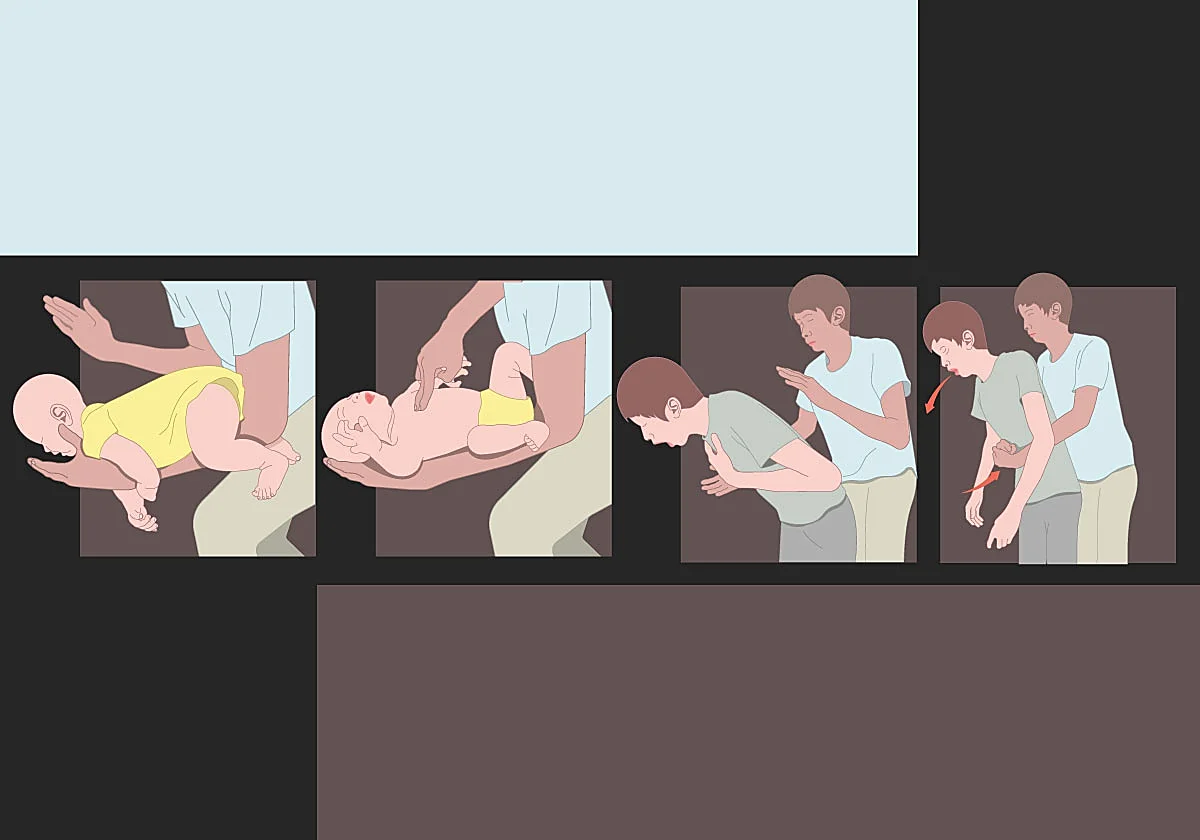
Manual removal of a foreign body is only indicated if the object is visible and easy to remove, as "we can further obstruct the airway and complicate its removal. If we can see it, we can remove it with a hooked finger," he stresses. In the case of babies, they should be placed face down on the forearm, with their head lower than the body and their jaw supported. Five firm blows should be given to the back, right between the shoulder blades with the heel of the hand. If that doesn't work, turn the baby face up, keeping their head lower than the body, and place two fingers in the centre of the chest, then give five quick and firm chest compressions. Then, alternate five back blows and five chest compressions. In the case of an older child, first try to get the child to cough up the foreign body by giving five back blows and then perform the Heimlich manoeuvre, which consists of rapid chest compressions to expel the foreign body.
A good cough-up
In any case, Dr Calvo insists, most of these cases are resolved "with a good cough-up". Once these manoeuvres have been performed, the child should be properly reassessed, as it is possible that part of the object may have remained in the airway and still cause problems.
Appropriate manoeuvres to clear an airway in children and adults
Where there's a severe upper airway obstruction by a foreign body and the person is conscious, but not coughing up effectively, cannot speak, is not breathing well and has an increasingly pallid colour
Source: Custodio Calvo Macías
Appropriate manoeuvres to clear an airway in children and adults
Where there's a severe upper airway obstruction by a foreign body and the person is conscious, but not coughing up effectively, cannot speak, is not breathing well and has an increasingly pallid colour
Source: Custodio Calvo Macías
Appropriate manoeuvres to clear an airway in children and adults
Where there's a severe upper airway obstruction by a foreign body and the person is conscious, but not coughing up effectively, cannot speak, is not breathing well and has an increasingly pallid colour
Source: Custodio Calvo Macías
Appropriate manoeuvres to clear an airway in children and adults
Where there's a severe upper airway obstruction by a foreign body and the person is conscious, but not coughing up effectively, cannot speak, is not breathing well and has an increasingly pallid colou
Source: Custodio Calvo Macías
Dr Ángel García Alcántara, a specialist in intensive care, states that, in the event of an adult choking, the ideal response is to remain calm. "The best physiological mechanism for expelling a foreign body is coughing." You must encourage the person to cough. If that doesn't work, give five sharp blows on their back, "with their head tilted forward and, taking advantage of the fact that the victim is about to cough, deliver the blows to coincide with their movement". If the foreign body is still not expelled, perform the Heimlich manoeuvre: "This involves approaching the victim from behind, placing one fist above their navel and the other hand on top of that fist. Once in place, perform inward and upward compressions to increase and raise the diaphragm, thereby increasing intrathoracic pressure and dislodging the object." If that is ineffective, perform CPR until emergency services arrive.
The victim's dentures, chicken or oxtail meat and squid are some of the items that cause choking incidents in adults
Dr García Alcántara asserts that these incidents are often related to the victim's dentures or meat, for example chicken and oxtail. "And squid is also quite dangerous". The doctor recommends cutting your food into small, elongated pieces, eating small portions, avoiding stuffing your mouth full, chewing slowly and thoroughly, avoiding laughing, talking animatedly or arguing while chewing and swallowing, plus avoiding hard foods and dishes that mix foods of different consistencies and textures.
"On average, seven or eight people per day choke to death in Spain," he says.
Be careful with dentures
Dr Ángel García Alcántara, a specialist in intensive care, explains that choking sometimes occurs in the elderly due to dentures becoming dislodged, although this is not a frequent occurrence in the general population. However, caution is still advised.
When these choking episodes occur, they tend to be concentrated in very specific groups. The risk increases in people of a certain age, especially those with removable partial or complete dentures that are ill-fitting or old.
It also affects individuals with severe neurological impairment such as those suffering the aftermath of a stroke, those with dementia or Parkinson's disease, as well as patients who are sedated or who have consumed alcohol or drugs that impair the reflexes. There is also a risk during meals if the dentures become loose and shift. The same goes for not removing such dentures when the patient is in an emergency department or undergoing some medical procedure.
In any case, it's not that dentures themselves cause choking, rather that they can become dislodged or hinder effective chewing, increasing the risk of a ball of food causing asphyxiation. In some cases, they can become dislodged and be aspirated. In cases of alcohol intake, which is common at this time of year, drinking relaxes the muscles in the mouth and pharynx, decreasing our coordination when swallowing. Alcolhol also reduces the gag and cough reflexes, which normally help expel objects or food that have been swallowed incorrectly.
Therefore, medical studies estimate that 30-40% of serious choking incidents in older adults are associated with alcohol consumption. If the dentures are removable, a piece of food can easily become dislodged and be aspirated.
When it comes to medical or dental procedures under sedation, a potentially dangerous combination raises its head: muscle relaxation and decreased consciousness greatly increase the risk of choking. This occurs in minor surgeries or with conscious sedation in dental clinics. It is recommended to remove dentures during these procedures.