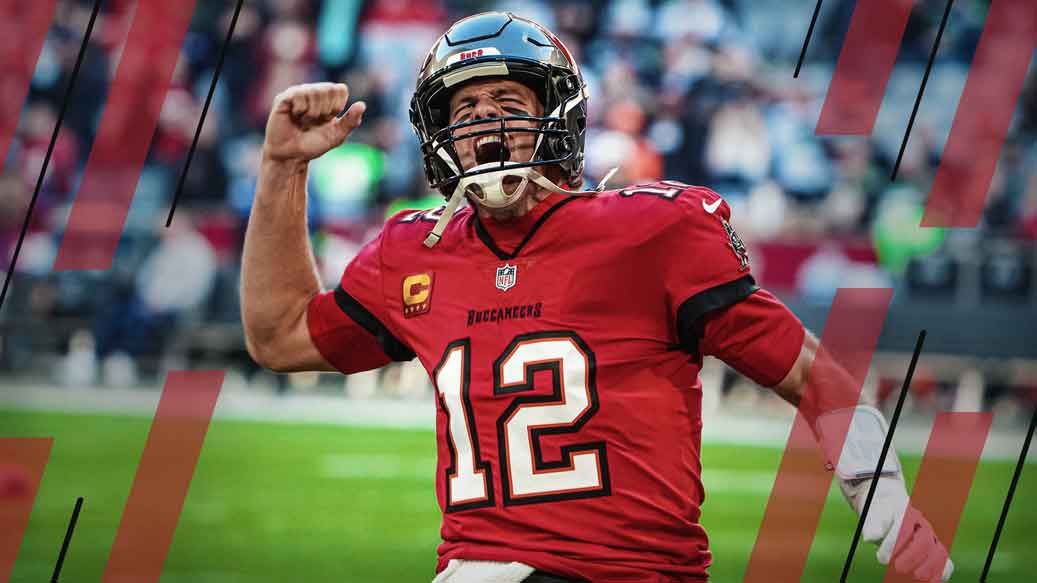
As part of PFF's celebration of 20 years of NFL data, we're building an All-Star team for every franchise, highlighting the best players at each position from the PFF era. This installment turns to the Tampa Bay Buccaneers.
PFF's database dates back to the 2006 NFL season, providing a unique lens for evaluating and comparing players across eras. More details on the methodology used to construct these teams are available at the bottom of the page.
Offense
- QB: Tom Brady (2020-2022)
- HB: Doug Martin (2012-2017)
- WR: Mike Evans (2014-2025)
- WR: Vincent Jackson (2012-2016)
- Slot WR: Chris Godwin Jr. (2017-2025)
- TE: Cameron Brate (2014-2022)
- TE: Rob Gronkowski (2020-2021)
- LT: Donald Penn (2007-2013)
- LG: Luke Goedeke (2022-2025)
- C: Ryan Jensen (2018-2022)
- RG: Ali Marpet (2015-2021)
- RT: Tristan Wirfs (2020-2025)
The Buccaneers made the playoffs just once during the first 14 seasons of the PFF era before adding Tom Brady and immediately winning a Super Bowl. Brady played at a high level throughout most of his three seasons in Tampa Bay and was the clear choice over Josh Freeman, Jameis Winston and Baker Mayfield for the top quarterback spot.
Eight of the other 11 offensive selections were also members of that Super Bowl team. The first exception was Doug Martin, whose 4,642 rushing yards are more than 1,800 ahead of any other Buccaneers running back during the PFF era. Vincent Jackson was another, edging out Mike Williams thanks to greater receiving production and a higher grade on a similar number of routes. Donald Penn was the third exception.
Along the offensive line, it was relatively easy to assemble the best five players because Luke Goedeke, Ali Marpet and Tristan Wirfs all spent time at multiple positions during their Tampa Bay careers.
Defense
- DI: Gerald McCoy (2010-2018)
- DI: Vita Vea (2018-2025)
- ED: Shaquil Barrett (2019-2024)
- ED: Stylez White (2007-2010)
- LB: Lavonte David (2012-2025)
- LB: Barrett Ruud (2006-2010)
- SLB: Anthony Nelson (2019-2025)
- CB: Jamel Dean (2019-2025)
- CB: Aqib Talib (2008-2012)
- Slot CB: Ronde Barber (2006-2012)
- S: Antoine Winfield Jr. (2020-2025)
- S: Keith Tandy (2012-2017)
The 2002 Buccaneers fielded one of the greatest defenses of all time, but most of the key contributors from that team were no longer on the roster by the start of the PFF era. Derrick Brooks was one of the few holdovers, though he was no longer playing at an All-Pro level. Ronde Barber was another and was the easy choice for the slot cornerback spot on this team.
While several members of the All-PFF defense were part of Tampa Bay's Super Bowl-winning team in 2020, there were a few notable additions from other eras. Gerald McCoy, for example, ranks fourth in franchise history in sacks despite spending his career at defensive tackle. Aqib Talib was another close call, narrowly earning the final spot over Carlton Davis III. It was a classic case of peak performance versus longevity: Davis spent more time with the Buccaneers, but Talib graded significantly better. In the end, Talib's dominance narrowly outweighed Davis' longer tenure.
Methodology
Selections were based on normalized PFF grades adjusted by season. To balance peak performance and longevity, only a player's five best seasons with a franchise from 2006-25 were considered. Any season with an overall PFF grade below 60.0 was excluded, ensuring that strong years helped a player's case while weaker seasons were not held against him. Postseason play was included, though all seasons were capped at a 16-game equivalent to maintain consistency across eras. At each position, the player with the highest score under this methodology earned the spot.
Each team consists of 12 offensive and 12 defensive players. Because 11 personnel and nickel defense were the league's most common alignments over the past two decades, those personnel groupings served as the foundation for every roster. Teams received either a second tight end or a fullback, depending on whether they used more 12- or 21-personnel. Defensively, teams received either a third interior defender or a third linebacker depending on whether they primarily operated from a 3-4 or 4-3 front.
Players who logged significant snaps at multiple positions during their tenure with a franchise were eligible at either spot. In most cases, those players were assigned to the position where they provided the greatest value, though their versatility occasionally influenced the final roster construction.
Unlike some All-Pro teams that group offensive linemen by position type, these rosters were built according to where players actually lined up. If a team's two best tackles both played exclusively on the left side, only the top left tackle was selected. One of the three wide receivers and one of the five defensive backs was also required to have significant slot experience. In a 4-3 defense, one linebacker needed experience at the Sam linebacker position, while in a 3-4 defense, one defensive tackle needed experience at nose tackle.
When multiple players are listed at the same position, the first name represents the top selection. Players designated as slot wide receiver, slot cornerback, nose tackle or Sam linebacker were selected specifically for those roles rather than as the third-best player within their broader position group.