Zoom
Huelva's loading pier. A. M. Saanders History The 'Fallen Eiffel Tower’, or Huelva’s last British legacy150 years of the ‘Muelle del Tinto’ ·
In March 1876, the British built Andalucía’s most impressive loading pier. This monument to English engineering has been listed as an Asset of Cultural InterestAlekk M. Saanders
Huelva
Friday, 27 March 2026, 11:42
The city of Huelva is home to the Muelle de Rio Tinto, which was designed and built by the British 150 years ago. In March 1876, this dock created by the Rio Tinto Company began operations, loading iron ore from the mines onto ships.
The story began in the second half of the 19th century. On 14 February 1873, the president of the first Spanish Republic, Estanislao Figueras, signed a decree under which the Riotinto mines were sold to a British consortium for 93 million pesetas. The Rio Tinto Company Limited established itself in the town of Minas de Riotinto and immediately set about implementing its ambitious project.
Technologically advanced
The company needed to build a railway line over eighty kilometres long to link the mines with the port, as well as construct a wharf on the Odiel River, at the port of Huelva.
The design was presented by renowned English civil engineers, Sir George Barclay Bruce and Thomas Gibson. It was first submitted to the company in February 1874, and subsequently to the Huelva Port Authority and the Ministry of Public Works.
Following approval of the design, the company entered into a contract with a reputable firm led by engineer John Dixon which at that time was the most technologically advanced.
The British company had achieved a significant breakthrough in the engineering of iron structures, apparently, ahead of the French. Incidentally, one of Dixon's achievements was in Gibraltar, where he located drinking water on the Rock.
Zoom
The design was presented by renowned English civil engineers, Sir George Barclay Bruce and Thomas Gibson
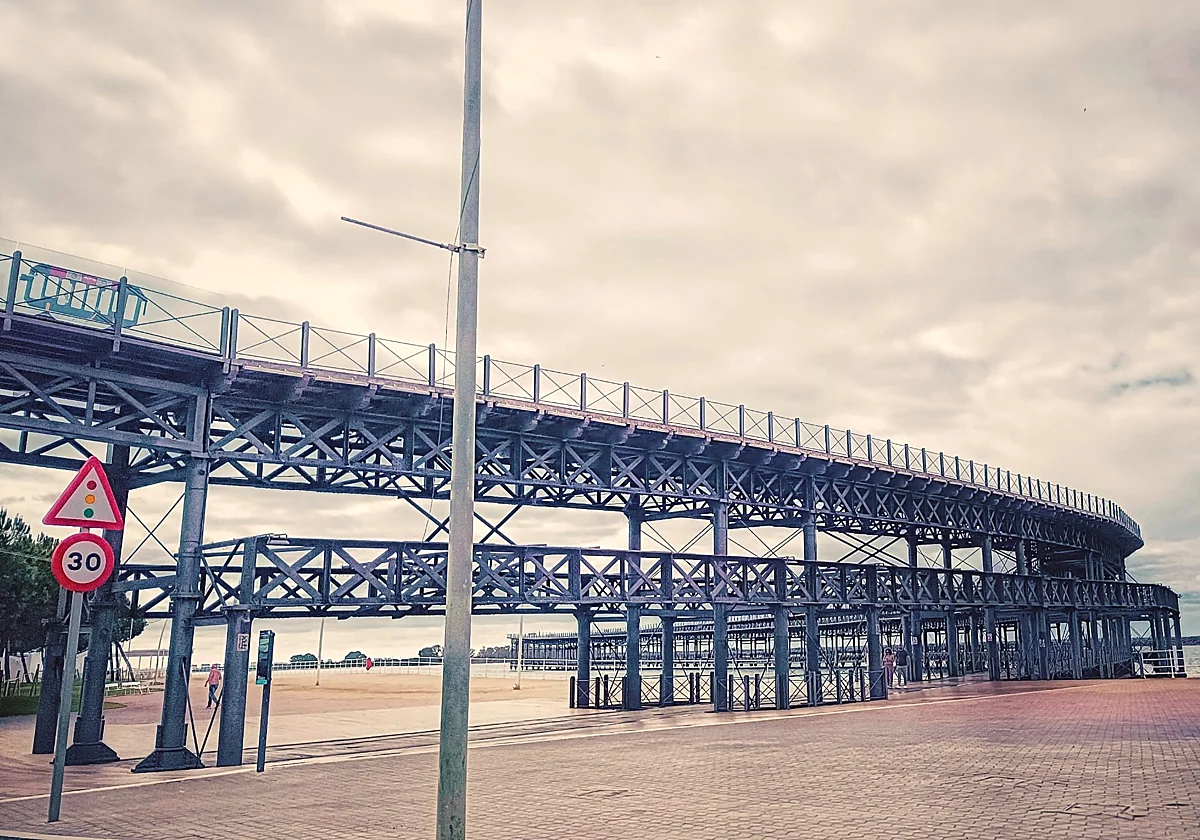
It was conceived as a three-tiered structure 1,165 metres long and three metres wide, supported by iron columns. On the landward side, it was connected by a 226-metre-long wooden viaduct, built to link it to the access pier.
Trains carrying ore were to run on the upper level, while freight trains were to run on the lower platform. It is stated that in the early stages, the pier project encountered serious difficulties due to, among others, the unstable terrain, which were overcome by means of wooden platforms resting on the riverbed.
Under the construction. AMSThe loading system was designed with a considerable height to compensate for the tall ships. So the material was lowered from above, as this was more economical and allowed for the movement of large wagons pulled by locomotives. They were then were able to transfer the ore into the ships with the help of gravity.
In the process of laying the railway, eight bridges were erected, several tunnels were dug and a dozen railway stations were built. A total of 264 kilometres of branch lines were also constructed, connecting mining sites, workshops, warehouses, various towns and mining settlements.
On 28 July 1875, construction of the main railway line was completed. The wharf was built a year later, on 23 March 1876, and began operations. An estimated 130 million (some sources say 150 million) tonnes of ore, mainly copper pyrite, were shipped via the Rio Tinto Company’s wharf. However, due to increased industrial activity and growing traffic in the 1960s, work began on dismantling the structure and in May 1975, the wharf ceased operations.
A tourist attraction
Given the importance of the Rio Tinto Company’s pier in the history of Huelva and its port, in March 2003 the structure gained protection having been listed as an Asset of Cultural Interest (Bien de Interés Cutural or BIC). Several restoration works have been carried out since the 1990s.
Last year, the Muelle de Rio Tinto was restored by the Huelva port authority, which allocated over 586,000 euros for the project. Nowadays, this symbolic historical element is a tourist landmark, allowing visitors to stroll and to fish along this monument to 19th-century British engineering.
Due to its architectural style, the structure is often mistaken for a design by Gustave Eiffel
Zoom
Start of Huelva's promenade. AMSDue to its architectural style, this structure is often mistaken for a design by Gustave Eiffel. In fact, the huge iron structure extends out into the sea, looking like a horizontal version of the Eiffel Tower.
Unsurprisingly, tourists flock to Huelva to have their photograph taken against the backdrop of the ‘Fallen Eiffel Tower’.