Zoom
Image of the Christ of Benagalbón Religion The 'Floating Christ' of Benagalbón: Why this hidden Malaga village is a must-visit for art loversSuspended 2.3 metres above the faithful, Salvador Mañosa’s unique sculpture is the centerpiece of an inland white village rich in murals and Axarquía tradition
Málaga
Monday, 2 February 2026, 17:01
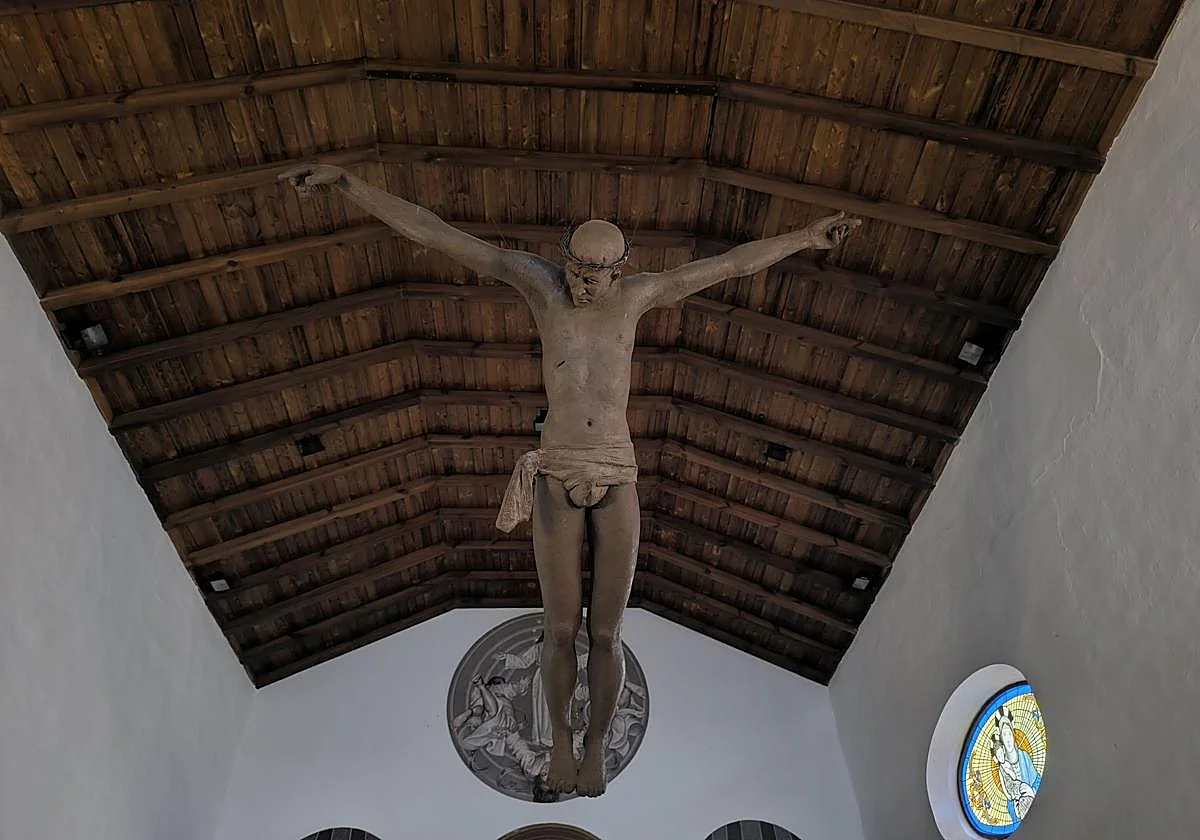
In the nave of Nuestra Señora de la Candelaria church in Benagalbón (Rincón de la Victoria), an image of Christ, without a cross, hovers above the pews, as if it's floating above the congregation.
With his arms fully extended, his body inclined and his feet together pointing downwards, the figure is accentuated by the contrast with the dark wooden ceiling, which clearly frames its silhouette. The piece, which is about 2.3 metres long and weighs approximately 50 kilos, is made of light materials that allow it to be suspended, giving an image that projects a mixture of serenity and drama.
The figure was first installed in the sixteenth-century church in 2005, thanks to the personal relationship between the Catalan sculptor Salvador Mañosa and the parish priest Benito Gil, both now deceased, who met in Malaga and maintained a close friendship.
Mañosa, who died in 2022, was noted for combining anatomical realism with less conventional formal explorations. Trained at the Escola Massana and a disciple of Francesc Juventeny, he developed an extensive collection of public sculptures in Spain and other countries as well as campaigning with different associations for those affected by asbestos.
Benito Gil, who died in 2020, left a deep mark on Malaga. He was one of those responsible for introducing 'Proyecto Hombre', an organisation which works with vulnerable men in Malaga province, during the 1980s and worked in various educational and youth care centres before arriving in Benagalbón, where he was the parish priest from 2002 to 2011.
In addition to the church with the 'floating' figure of Jesus Christ, Benagalbón is a pretty village where the streets are decorated with flowerpots and designed for strolling around in peace and quiet and Plaza de las Flores lives up to its name as a square full of plants and flowers.
A series of murals scattered around the village pay tribute to deep-rooted traditions such as verdiales (a traditional local folk dance); another, more modern mural depicts a large sparrow. The village is home to excellent restaurants and walking routes, such as the Tío Cañas hill, which provides excellent views over Malaga city and the Mediterranean.