Zoom
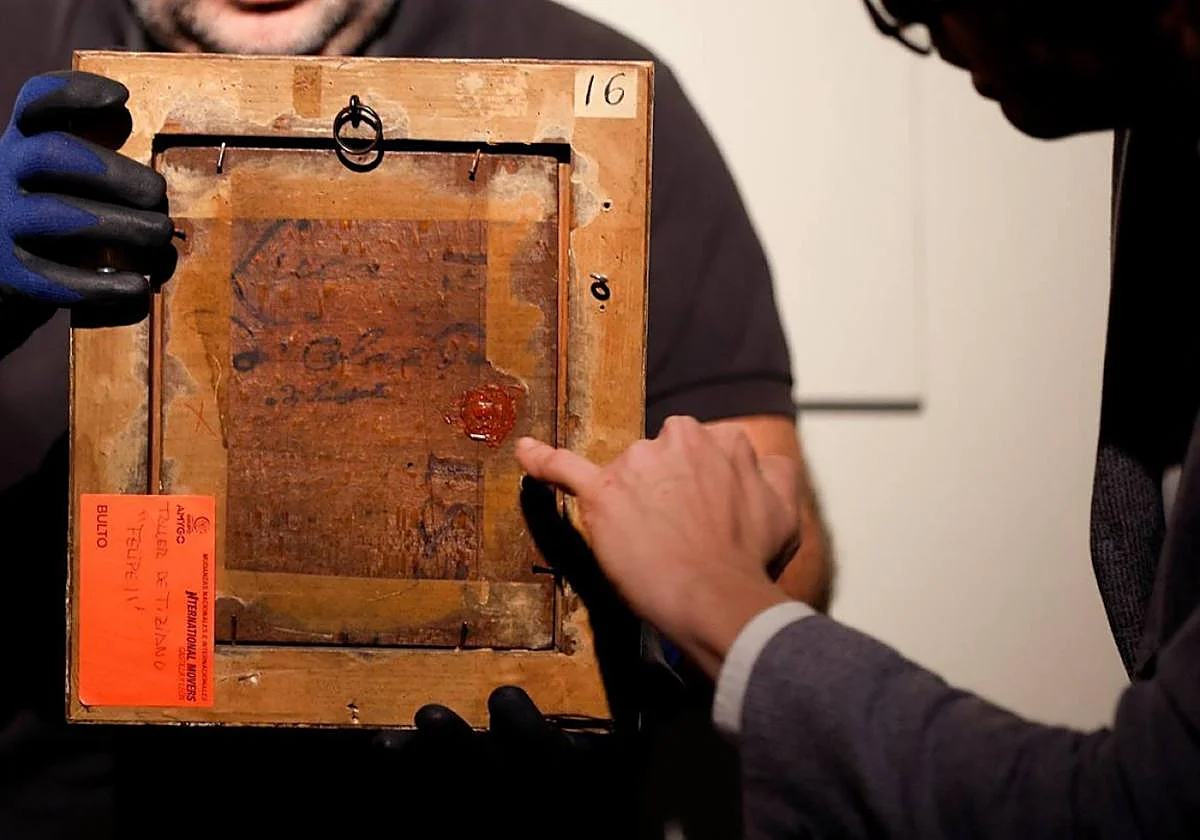
The curator points to the wax seal of the British monarchy on the back of the oil painting of Philip II. Marilú Báez Culture The portrait of Philip II that hides the secret behind his marriage to Mary TudorMalaga's Russian Museum is now home to Spanish and Flemish masterpieces belonging to collector Alejandro Sanz Peinado
Paco Griñán
Malaga.
Friday, 12 December 2025, 19:06
"Paintings speak of art, but it is on the back of them that we discover their history." With these words, collector and critic Alejandro Sanz Peinado announced last week that the small masterpiece before us held a secret.
The early portrait of Philip II of Spain was based on a work by Titian and signed by the Flemish school, and it was the first official 'photo' of the then 25-year-old prince.
Despite being a replica of the original, it is a detailed image where Philip II is depicted wearing the golden fleece, the highest distinction of the Spanish crown (it was recently awarded to Queen Sofía). Furthermore, this piece had a clear destination, the English monarchy, which is what was discovered on the back of the oil painting, and was probably how Mary Tudor first met her Spanish suitor. A sort of 16th-century 'Tinder' that ended in a 'match', as the two married in 1554, around four years after the completion of the painting.
"With this portrait they wanted to promote Philip II as a Renaissance prince, as the great king who would rule Europe, so they began to make copies like this one," explained Ángel Rodríguez Rebollo, curator of the exhibition El Arte de la Pintura, Confluencias en Tiempo de los Austrias en la Colección de Alejandro Sanz Peinado (The Art of Painting. Convergences in the time of the Habsburgs in the Alejandro Sanz Peinado Collection) was presented recently at the Russian Museum, which now shares its space in the Tabacalera building with the new MEET (Málaga Espacio Expositivo Tabacalera).
This show takes over the central and largest rooms of this cultural centre, which becomes, until September 2026, a small El Escorial or European museum of Renaissance and Baroque painting.
Among the 80 works from the Spanish, Flemish and Italian schools, the royal portraits of the Habsburgs, from Charles I to his great-great-grandson Charles II, stand out. And among them are some with hidden history on their back, such as the small oil painting of Philip II, which the collector and owner turned over during the exhibition launch to demonstrate this.
On one side, the inscription reads "Luca de Holanda" and, on the other, a red seal of the British royal family that indicates that the piece belonged to His Majesty's house and "surely Mary Tudor saw it to see the face of the person she was going to marry", said the curator about this work that was the prelude to a marriage that had more to do with political agreements than love. And which ended without children.
The young Philip the second, the work Saint Michael Vanquishing the Devil with partially obliterated signature and portrait of Charles V.Velázquez and his workshop
The portrait of King Philip is not the only painting with history in the exhibition. A painting of his father Charles V, which was a large oil on canvas signed by the Flemish School of the 16th century, does not show the monarch in military armour as he was depicted in Spain, but as Grand Master of the Order of the Golden Fleece, his costume shown in all of its splendour with the golden fleece hanging from a thick chain of links.
"Notice how the painting frame precisely matches the shape of the links of the insignia," said the collector Sanz Peinado, who explained that he keeps this valuable collection in a museum/bunker that he built in his house in Sierra de Madrid.
The Spanish royals, with their empires also reaching Holland and Italy, is the common thread that runs through the exhibition, which treasures European works from the Habsburg period and the Spanish Golden Age, with essential names such as Zurbarán, Diego Velázquez, José de Ribera, Anton van Dyck, Coello, El Divino Morales, as well as Villem van Herp, David Teniers and Pedro Pablo Rubens, to whom a small "chapel" room has been dedicated.
ZoomThe exhibition also includes a portrait of Philip IV, bearing the seal of the Velázquez workshop, as well as an oil painting of his successor, the last ruler of the Austrian dynasty, Charles II, whose face and red lips cannot conceal his haemophilia and inbreeding.
"It is a masterpiece portrait of the king, who was a sick man, but he was neither a fool nor an idiot, as this image depicts, rather, it represents the end of the Habsburgs, a bitter period in Spain," said the collector Alejandro Sanz Peinado, a restless and multifaceted art lover who, as a young man, was mayor of his town, La Cabrera, near Madrid.
He revealed that, in addition to these Renaissance and Baroque works, he also collects contemporary art, although he has barely fifty or so pieces because he is very caught up with current creators.
"Paintings have to stand the test of time. I'm waiting to see if my contemporary collection will in 50 years' time," he remarked.
According to Sanz Peinado, he began his collection with a 17th-century Dutch painting.
Specifically, he began with a delicate portrait, Lady with Gloves (c.1645-1650), an oil on panel by Jakob van Loo, for several reasons: he liked it, it was from a school that is "one of the gaps in the Prado" and it was also "cheap".
However, neither this work nor the rest of those on display in Malaga looks like a bargain.
In a similar vein, the oil painting that is being shown for the first time after its restoration, Saint Michael Vanquishing the Devil, is a Gothic piece that was completed in the transition towards the Renaissance movement, completed in 1510 and signed by artist Pedro Delgado. The work was put up for auction in 2022 for 355,000 euros, a high price after being declared of cultural interest to prevent its export outside Spain, but the collector did not let the opportunity pass him by.
This exceptional and unique work is now said to be dated to "around 1430 and is attributed to the Flemish school", he explained.
The fact is that sometimes the stories of the paintings are not only hidden on the back of the canvases, but are also hidden in front of our eyes.