Zoom
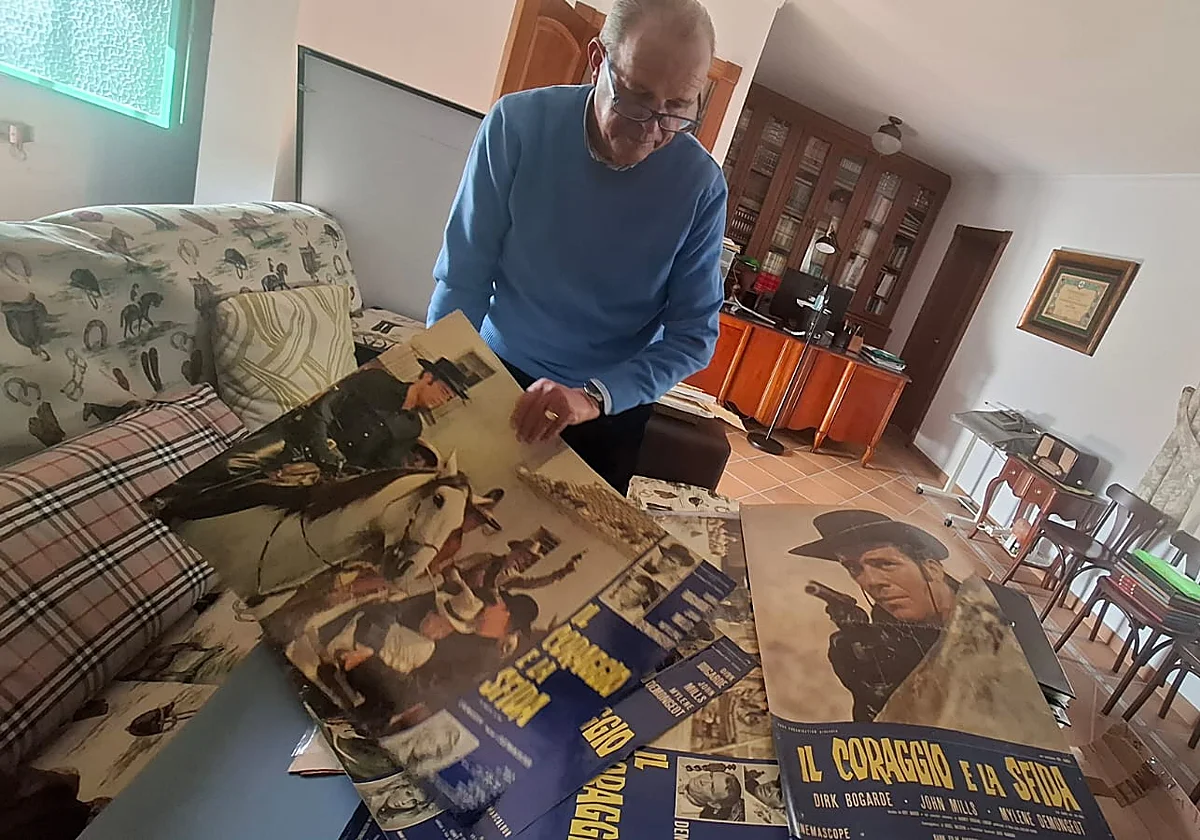
Miguel Barrionuevo González shows footage in Italian from the film. J. R. C. Lifestyle The secret Alhaurín de la Torre museum dedicated to a cult British WesternFrom Dirk Bogarde’s scandalous leather trousers to rare posters from Japan, a local collector preserves the legacy of the star-studded production of cult classic 'The Singer Not the Song'
Alhaurín de la Torre
Monday, 30 March 2026, 15:12
Marie Devereux was Elizabeth Taylor's body double in Cleopatra. Most scenes of that 1963 blockbuster were shot at the legendary Cinecittà studios in Rome. But before arriving in the Eternal City, Devereux spent a season in Alhaurín de la Torre.
"The story of this actress is very curious," explains Miguel Barrionuevo González. A resident of the municipality, former local government official, and passionate collector - having inherited the hobby from his mother, Margarita - the 70-year-old is a leading expert on the actress. Why? It’s all the fault of "a terrifying stuffed crocodile".
The lifeless animal was one of the props for the most famous film ever shot on Alhaurín soil: The Singer Not the Song.
It was an exotic Western, produced by Great Britain, a country not typically known for the genre. It was filmed in 1960 when Barrionuevo was just a boy and, as luck would have it, right on his doorstep near Plaza de San Sebastián.
Dirk Bogarde and John Mills arrive in town
It sparked a lifelong fascination for him and marked a milestone in recent local history. It was a full-scale landing of the "dream factory" in what, over six decades ago, was a simple village - a village gifted with the presence of a star-studded cast, including Dirk Bogarde and Sir John Mills, and a massive crew that transformed Alhaurín de la Torre into Mexico.
Since that moment - and despite the "panic" he felt toward the fake reptile, which was so intense that he wouldn't leave his house even when the floor manager invited him behind the scenes - Miguel Barrionuevo hasn't stopped hoarding material and researching the film.
He has created a museum at home, though he can only display a fraction of the thousands of pieces he estimates it contains. "My intention is to make the museum more well known, but in a premises I find myself," he announces.
Key details about the film:
The Singer Not the Song (1961),was a British Rank Organisation production starring Dirk Bogarde (as the bandit Anacleto), John Mills (as Father Keogh), and Mylène Demongeot (as Locha)
Shot in Spain: While set in Mexico, the film was shot on location in Spain, specifically around Alhaurín de la Torre and near Torremolinos.
Plot: The film focuses on a battle of wills between a devout Irish priest (Mills) and a charismatic, leather-clad bandit leader (Bogarde) who controls a small Mexican village.
Cult Following: Despite being considered a flop upon release - with Bogarde calling it a "travesty" and Mills calling it one that "went wrong" - the film has gained a cult following due to its camp style, the apparent, intense chemistry between Bogarde and Mills, and its unusual take on the Western genre.
It was directed by Roy Ward Baker and released in some Spanish markets as El demonio, la carne y el perdón.
Thanks to his life-long obsession, Miguel knows the life and work of Devereux, one of the film's supporting actresses, for whom he has a complete file including photographs.
"I started collecting interesting artiles and pictures from magazines, a shop in Malaga that had cinema items, and later, via the internet... there came a point where I thought I had so many things I had to organise them," he says. Not only has Miguel amassed a remarkable collection, but he intends to fully 'catalogue' the movie.
To that end he has devised a strategy that is simple but requires patience.
He claims the French version of the film is the best preserved, as it maintains the full CinemaScope format. Thanks to this copy, Miguel is taking on the challenge of identifying the locals who appeared as extras, using only a "pause" button and a notebook. He watches the film over and over to scrutinise its secrets, pausing the credits to take notes and the scenes to name everyone who appears.
Zoom
Regarding Dirk Bogarde, the villainous Anacleto on screen, Miguel knows (and has photos to prove it) that he arrived in a Rolls-Royce and that a local man was hired solely to look after the luxury car.
Sexual tension
He also knows the horse Bogarde rode was named Escándalo (Scandal) - a fitting name given the stir the film might have caused in Spain if the original version had been shown. In that, the sexual tension between the bandit and the priest (played by John Mills) is evident. In Spain it was censored.
What the censors couldn't hide was the style Bogarde chose for his character. He donned tight black leather trousers, far too transgressive for the time. According to Barrionuevo, tight leather was associated with "rebellion" and, subtly, with the underground gay subculture of the 1960s. They were a statement of intent and a way to provoke.
Bogarde, contractually obliged to one last performance for The Rank Organisation, arrived in Alhaurín de la Torre "wanting to annoy" the director. By wearing the leather trousers, Bogarde was "stepping across" the line of acceptable leading-man attire to irritate his director and perhaps signal a hidden identity.
"Gay people consider this film an icon," Miguel says of Bogarde’s gesture, amid long-standing rumours regarding the actor's hidden sexuality.
Rebellious trousers steal the scene
Before Bogarde’s rebellious trousers and before Roy Baker shouted "action," there was the novel The Singer Not the Song (published in Spain as El jardín del padre Keogh), which Miguel also keeps in several languages. The book would likely occupy the first display case of his future cinema museum.
The following cases would be filled with film stills, lobby cards, radio scripts, and the original sheet music by Philip Green - which, as the collector adds, "I still haven't managed to get the municipal band to play in their cinema concerts."
Then there are the "jewels in the crown": the posters. He has acquired several, including large-format ones, kept in pieces for future assembly. There are posters from Italy (Il coraggio e la sfida), Japan, Australia, Belgium, Brazil, and France.
And after all these years Miguel is still making acquisitions, which arrive from as far afield as Thailand and Russia. They include snapshots taken in Torremolinos where producer Herbert Smith and star Mylène Demongeot stayed at the Hotel Cervantes while scouting locations.
He also has acquired photos of the London premiere and interviewed one of the few local officials at the time who spoke English and helped find locations for the film.
While the Hollywood stars have long since moved on, their ghosts remain captured in the frames and ink of Miguel’s archive. In a quiet corner of Alhaurín, the 'dream factory' never truly stopped running; it simply found a permanent home in the hands of the boy who refused to look away.