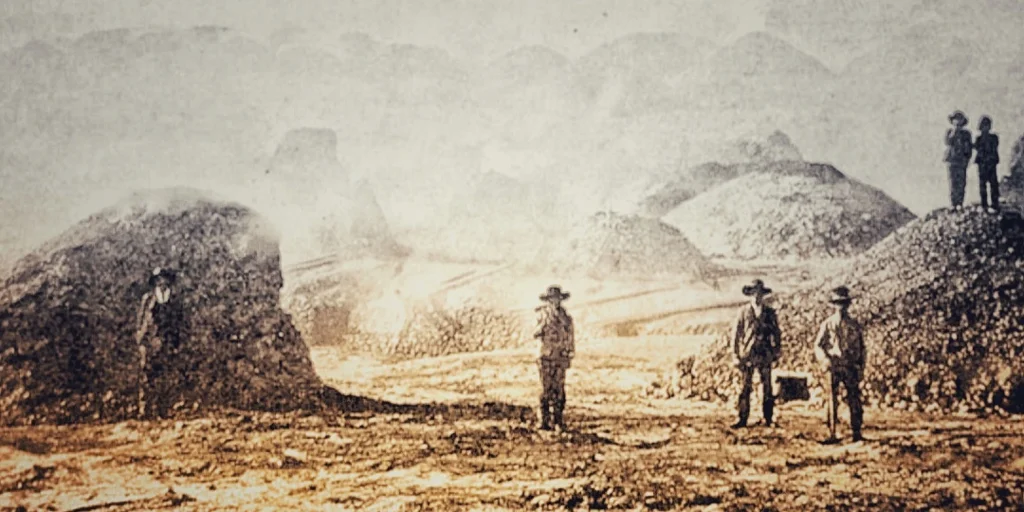
The Riotinto. (SUR) Liebert Wolters Vonsiohielm, a native of Stockholm, took part in the War of the Spanish Succession as an ensign in a Dutch regiment. In 1719 Wolters was discharged from the army in Spain and became a businessman.
It is believed he was the first who invented a diving apparatus. Be that as it may, Wolters applied to the Spanish government for a contract to raise sunken ships. Soon, from the depths of the sea, Liebert Wolters decided to delve into the depths of Andalucía.
Modern history began in 1556, when the Madrid priest, Diego Delgado, travelled to the Riotinto area to inspect the huge slag heaps
In 1725, the Swedish businessman applied for a 30-year concession for operating the mines near Huelva, including Riotinto. The application was approved by the Spanish authorities and this can be considered a revolutionary moment in that period, as a long-term lease was granted to a foreigner, and a Lutheran at that.
The Swede's application was approved by the Spanish authorities and this can be considered a revolutionary moment in that period, as a long-term lease was granted to a foreigner, and a Lutheran at that
To carry out this venture, Wolters (together with a Spanish partner) organised one of the first joint-stock companies established in Spain. Moreover, to raise capital for the mining enterprise, he conducted a successful marketing campaign, describing Riotinto as mines yielding gold and silver.
Apparently, for the mining operations, Liebert Wolters promised to provide a group of Swedish miners and two modern drainage pumps. As a result the Swedish initiative led to a visible reactivation of Riotinto.
Incidentally, in 1728 Liebert Wolters asked his nephew Samuel Tiquet, a young mining engineer from Stockholm, to take charge of mineral extraction at Riotinto and Aracena, and he agreed with great enthusiasm.
Under Swedish management, iron and copper sulphate were produced at Riotinto from 1741, and copper from 1747.
It is worth noting that the project faced significant logistical challenges, notably the high cost of transporting minerals to the sea without a railway system.
Despite the questionable implementation of large-scale mining projects, Samuel Tiquet left behind a good reputation as an enterprising and knowledgeable miner, largely thanks to his work at Riotinto.
Under Swedish management, iron and copper sulphate were produced at Riotinto
After the Swedes there was a rather bleak period for the mining industry in Huelva's mines, apparently due to a lack of international experience and a shortage of skilled labour.
For some decades, Riotinto was managed by Spain itself, with mixed results. In 1829, Riotinto was leased for 20 years to the Marquis of Gaspar Remisás who undertook the exploitation of the copper deposits, seeking to maximise profits whilst minimising costs.
Followed by Brits
Later, the Spanish government attempted to sell Riotinto on several occasions, but without success. Consequently, in 1869, they decided to launch a more extensive sales campaign, targeting foreigners as potential buyers.
In 1871, an advertisement for the sale of the Andalusian mine was placed in newspapers across Europe and four bids were received. A group of businessmen from London led by Hugh Matheson made the best offer.
The Scottish entrepreneur and industrialist became famous for playing a key role in the development of early trade relations with Meiji-era Japan as well as in supporting Presbyterian missions in China. However, he is remembered in history primarily as the founder of the Riotinto Corporation.
In February 1873, Hugh Matheson reached an agreement with the Spanish government and assembled a financial syndicate to acquire these mining enterprises.
In March 1873, the Rio Tinto Company Ltd. was established in London with the participation of a number of major banks from Scotland, England, France and Germany. A significant influx of capital enabled Riotinto to become one of the world’s largest industrial centres. Consequently, the company quickly became a dominant player in the global pyrite market.
Under British control, the company industrialised the Riotinto region, building railways and modern mining facilities. By the end of the 19th century, the British-owned Riotinto had become the world’s leading copper producer.
However, due to economic difficulties and political pressure, the British company sold two-thirds of its shares in 1954, bringing an end to full British control over the Spanish mines.
The Riotinto mines are currently being actively operated by Atalaya Mining, founded as a Cypriot company under the original name Emed Tartessus.
In January 2025, Atalaya Mining renamed its Spanish subsidiary Atalaya Mining Copper, S.A. with its headquarters in Andalucía.