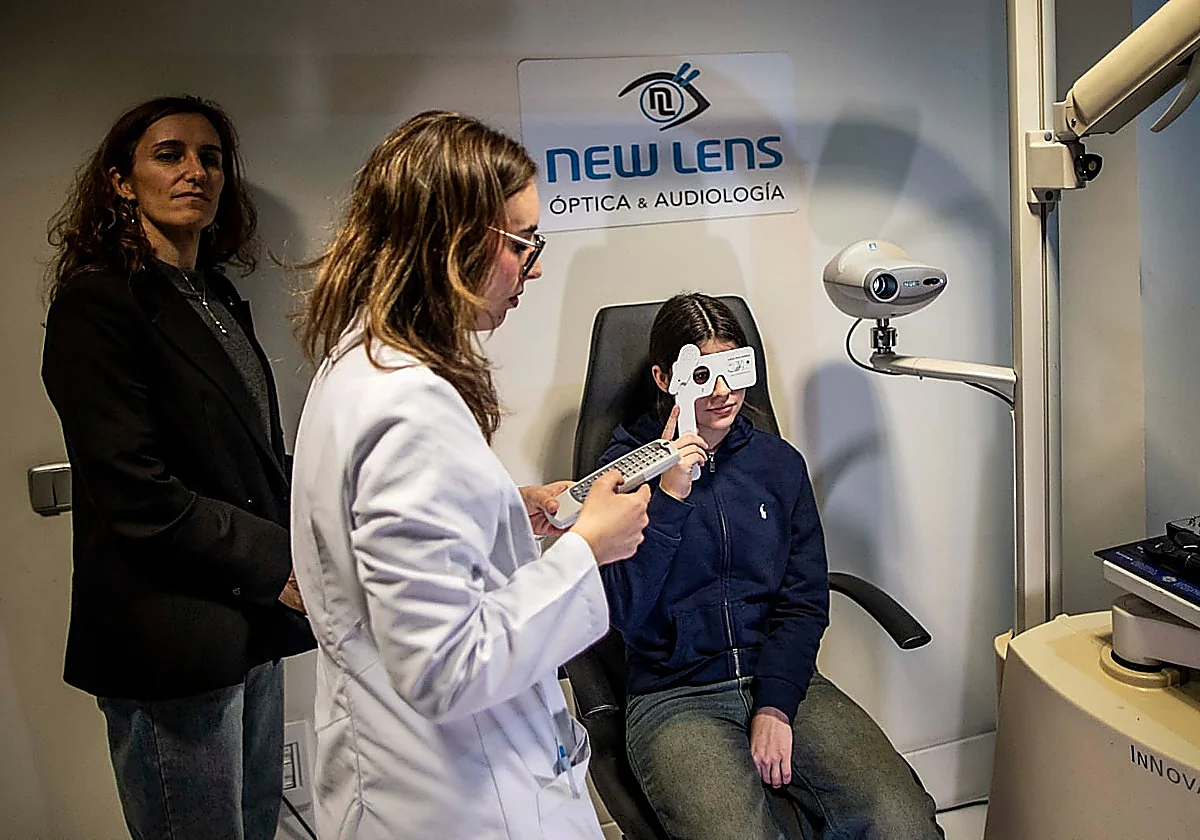
Zoom
Children in Spain are now eligible for 100 euros towards glasses or contact lenses. Ministerio de Sanidad J. V. Arnelas Health This is how to get 100 euros towards the price of glasses or contact lenses for children under 16 in SpainThe government grants, which will benefit more than half a million youngsters, will be processed and delivered between now and 31 December 2026
Madrid
Wednesday, 17 December 2025, 20:39
Spain's Ministry of Health today (Wednesday 17 December) launched its 'Plan Veo' programme of direct grants for the purchase of glasses or contact lenses for any child or adolescent aged 16 or under living in Spain.
The grant, which amounts to a maximum of 100 euros per beneficiary, will cover the cost of essential optical products, such as glasses or contact lenses.
The Veo Plan has funding of 47.7 million euros and the programme is being implemented in collaboration with the General Council of Opticians-Optometrists' Associations, which will be the intermediary in the direct delivery of the subsidy. The purchase of glasses or contact lenses must be formalised from 17 December 2025 to 31 December 2026, although payments corresponding to operations carried out in the month of December of next year may be executed throughout the financial year 2027.
Who can benefit from the Veo Plan?
It is a universal benefit, with no limits according to family income levels, for all children up to the age of 16 (inclusive) resident in Spain, who are entitled to free public health and who have a diagnosed with a visual problem (such as myopia, hyperopia or astigmatism) which can be corrected.
The parents or guardians of the beneficiary must manage the application after completing and signing Annex I of the agreement that will be provided to them in the optical health establishments participating in the Plan Veo.
What does the plan include?
- 1
Prescription glasses and contact lenses: this can be either the complete pair of glasses (finances the basic frame with prescription lenses with anti-reflective coating) or just the lenses (for situations where only the lenses of existing glasses need to be replaced).
- 2
Or contact lenses: this includes contact lenses made of hydrophilic or gas permeable material. It also pays for the liquid solution needed to maintain contact lenses for a period of one year.
How does the financing work?
If the cost of the glasses or contact lenses purchased is less than 100 euros, the Plan Veo will finance the full price of the product and the beneficiary pays nothing.
If the price is more than 100 euros, the Plan Veo will finance up to 100 euros and the beneficiary will have to pay the rest.
Is it compatible with other benefits?
The Veo Plan is compatible with other benefits, aid or resources that the beneficiary may have received previously for the purchase of glasses or contact lenses as long as the maximum amount of 100 euros is not exceeded. In the event of having received previous help, the amount received must be declared and the Plan Veo will cover the difference between the maximum amount fixed (100 euros) and the previous money received.
Where to ask for help and glasses or contact lenses?
At participating opticians which must have a special sticker displayed on the outside, as well as information inside the premises. The General Council of Opticians and Optometrists has made available a search engine for people to find participating centres.
What information do you have to provide to qualify?
To access the Veo Plan you need a prescription indicating the need for glasses or contact lenses. It must include, at least, the identification of the health professional or service issuing it, the name of the health centre and the date of validity of the prescription.
The authority to issue the prescription varies according to age and whether it is a first or second access to the Veo Plan:
- 1
First access with children aged five years and under. A prescription from an ophthalmology or ophthalmic-optometry professional from public or private ophthalmology service is required.
- 2
First access with children aged six years or older. The prescription can be issued by the above professionals or by an optician-optometrist from an optician's health establishment participating in the Veo Plan.
- 3
For second access to the plan. The beneficiary will be able to access by means of a check-up carried out by an ophthalmology professional, in the public or private sector, or by an optician-optometrist who provides services in these areas or in one of the opticians' establishments that are members of the plan. For this second access, 365 days must have elapsed since the previous acquisition through the Veo Plan.
What is the exact documentation to be submitted (summary)?
- 1
The prescription in the correct format.
- 2
Name and surname of the beneficiary.
- 3
Name and surname of father/mother/guardian.
- 4
Identification document number (DNI/NIE) of the beneficiary (if any) and of the parent or guardian.
- 5
Number of the health card or of the document of recognition of the right to health care issued by the regional government.
- 6
Annex I of the agreement, which must be signed and completed by the responsible person.
Who manages the final processing?
TThe optician-optometrist of the centre participating in the programme is the one who enters this information in the Plan Veo web application and who uploads the necessary documentation to the platform in order to continue with the dossier.
Where to go if there are doubts or complaints?
The Ministry of Health has set up an email address planveo@sanidad.gob.es to which interested parties can send questions about the Plan Veo or complaints.
What is the potential number of beneficiaries?
It is estimated that there may be around half a million conditions (such as myopia, hyperopia and astigmatism) that affect between 10 and 30% of the school-age population in Spain, with increasing prevalence, especially in contexts of intensive screen use and indoor life. In the absence of adequate correction, these problems not only affect the physical well-being of children but also their academic performance, psychosocial development and quality of life.
A plan against visual poverty
This is an exceptional measure that responds to a public health need, but also to the government's desire to reduce economic barriers that hinder access to glasses and contact lenses for children. Numerous studies have shown that children from families in more disadvantaged socio-economic situations have less frequent access to the necessary visual corrections, which perpetuates social and educational inequalities. This aid, says the Health Department, is intended to act as a tool for equity, ensuring that no child is excluded from the right to adequate vision for economic reasons.