Zoom
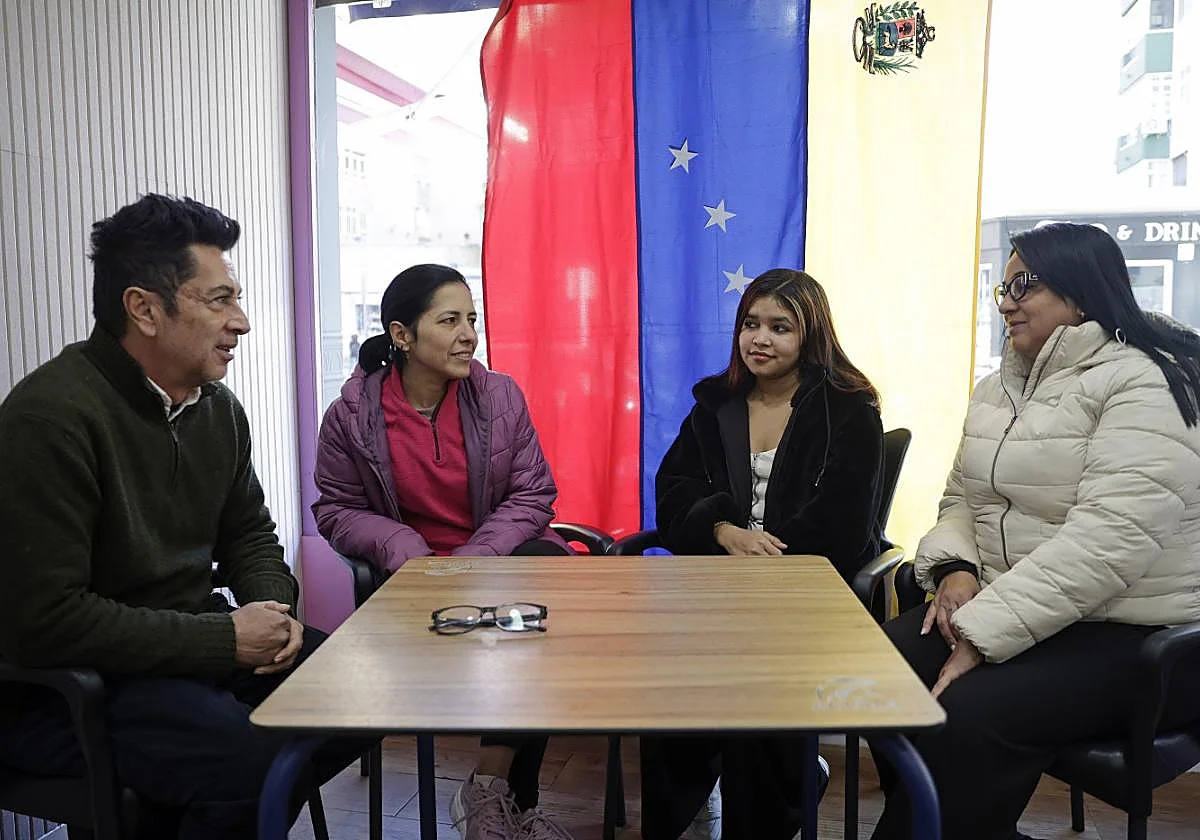
Javier Durán, Erika Fuenmayor, Diana Herrera and Yanny Blanco. Migue Fernández Report Venezuelans in Malaga: between relief and uncertaintyThey left their country in traumatic circumstances and now they are happy that Maduro is no longer president, resigned to continue losing natural resources and anxious about the future
Cristina Vallejo
Friday, 16 January 2026, 13:30
They all have traumatic stories to tell. They explain why one day they left their country, Venezuela, to come to Spain. Javier Durán, who ran a car sales company, says he was constantly subjected to economic extortion and that in 2017 he was caught helping anti-Chávez protesters. Erika Fuenmayor, who runs La Marquesa, a bar specialising in Venezuelan gastronomy in Malaga's Cruz del Humilladero, also says she was threatened and forced to leave the premises where she had her business, and the attempted kidnapping of her daughter was the trigger for her to immediately pack her bags and get on a plane to cross the Atlantic.
María (not her real name), still in her twenties, was a government official and could not stand the fact that one of the tasks of the police station where she worked was to collect 'vacunas' (bribes). Yusmeiry Chavarri was also a former civil servant who fled corruption and threats six years ago.
Yanny Blanco was a 'guarimbera' - the name given to people who protest against the government - after the 2024 elections in which Nicolás Maduro claimed victory but which international observers, such as the Carter Center, certified that the opposition led by Edmundo González had won. Blanco knew she was being persecuted and after spending a few days seeking refuge at her sister's house, she came to Spain as soon as she could.
Diana Herrera, 19, just wanted some opportunities for her son that she felt he would not have in Venezuela and says that on her journey from her city to the airport she was stopped by the police who looked at her mobile phone where they found the anti-Maduro messages that were circulating on WhatsApp; the officers told her that for that she could be taken to jail, which she avoided by paying 100 of the 300 dollars she had in her pocket.
Mobile control
What happened to Herrera a few months ago, and which she has engraved in her memory, is what makes her not want to ask her family and friends who are still in Venezuela how they are feeling: "I prefer to find out what is happening through the news; I don't want them to have conversations on their mobile phones, because you go out on the street, they ask you for it and they can send you to prison," she says. So the Venezuelans SUR spoke to recommend that their family and friends delete messages before going out or leave their phones at home.
However, according to Yanny Blanco, right now the country is "calm", "the supermarkets are full" and "there is petrol".
This group of Venezuelans meet at La Marquesa, the restaurant that Erika Fuenmayor opened in Calle Edison last May, almost eight years after arriving in Spain, after working as an employee in the hotel and catering business and training in cooking. A graduate in advertising and marketing, she speaks with emotion and from the wound that emigration always produces.
Zoom
Erika Fuenmayor runs La Marquesa Migue FernándezThis perhaps explains why they see what has happened with different eyes from those of experts in international law or United Nations itself - whose human rights office was expelled from Venezuela after constant complaints about the deterioration of the country's democracy.
These institutions describe the events, the Trump administration's forcible removal of Nicolás Maduro, as a violation of the laws governing relations between countries, which state that no country can interfere in the internal affairs of another, least of all with violence.
"We no longer had legal recourse to remove the government," Fuenmayor justifies. And Durán adds: "There has been a great degradation of institutions, there are no guarantees, all powers are taken over by the government and there are no rights."
Fuenmayor also points out that "Trump did this not to free Venezuela, but because Maduro has a drug trafficking case in New York."
Maduro is out of the government and out of the country and is imprisoned in the United States awaiting trial, but it is his deputy, Delcy Rodríguez, who has assumed the presidency, as stipulated in the constitution - which also states that elections should be held within 30 days - and the regime they detest continues.
"In Venezuela there is an authoritarian regime. A Venezuelan cannot be happy that Maduro is in prison," reflects Fuenmayor, who justifies this by stating that "the cutting off of heads" will be "gradual", because otherwise the country would enter a situation of chaos, even civil conflict. They are hopeful that US intervention can help the country's path to democracy. "From here it looks beautiful, but there they see it in silence; it seems that there they can't even think that today's dawn is more beautiful because Maduro is no longer there," adds Fuenmayor, poetically.
"Predator"
But they are also full of uncertainty: "Trump is not a panacea. We are not in the hands of God, but of the biggest predator on the planet," says Javier Durán. "Sometimes we don't know if the cure is worse than the disease, but it's the price we have to pay. We know it's not going to be free," he adds. That same phrase, "we don't know if the cure is worse than the disease", is repeated by Yusmeiry Chavarri, who says she has a "bittersweet" feeling: she is happy because a "dictator" has fallen, but she is sad because she feels that Venezuela is a country without an owner and "like a prostitute that everyone is taking advantage of", referring to its natural resources.
Zoom
Javier Durán points to the stars on the Venezuelan flag, expressing his fear that the republic will become the 52nd star of the American one. Migue FernándezJavier Durán brings up another of his fears: that the Venezuelan flag with seven stars will be replaced by the US flag with its republic turned into the 51st star. It is not lost on them that Venezuela is the first domino to fall, that the Trump administration has rescued the Monroe Doctrine (after President James Monroe who proclaimed it in 1823 to repel European colonialist anxieties on the American continent) in its most extreme version - and renamed 'Donroe', after Donald - to extend its domination over the western hemisphere, including Greenland, a territory under Danish sovereignty.
And regarding the suspicion that the US has entered Venezuela exclusively to get its hands on the country's oil and other natural resources, Diana Herrera is ironic: "People try to confuse us, the left is very concerned that Trump is going to take the oil, but we Venezuelans have not seen it, the country is destroyed".
"Venezuelans have not seen any of the oil: it has been in the hands of Iran, Cuba, Russia, who have been extracting it for the last 25 years", reiterates Erika Fuenmayor, who adds: "We don't care if the United States takes the oil to put an end to this nightmare. What is material is recoverable".
Zoom
Diana Herrera Migue FernándezAnd here she links a "but" to Javier Durán's reflection, despite his own reminder that the US has always been involved in the exploitation of the country's black gold: "We'll see what happens when Venezuelans see a pipeline connected from their country to Alaska, when 50 million barrels of oil come out of Venezuela." Perhaps he foresees a revival of Venezuelan nationalism, a reaction against the economic protectorate that some people - Brazil, for example - perceive that Trump will establish over the Caribbean state. Meanwhile, Yanny Blanco has faith that the US president's promise that Venezuelan oil revenues will be invested in the country's infrastructure will be fulfilled.
No going back
They are worried about their loved ones who are still in Venezuela, they have turned La Marquesa into a meeting place to keep each other company, talk politics and speculate about what might happen in the future - the day they woke up to the news of the American intervention it was a hive of activity, they say - but they don't seem to have much desire to return to their country. Javier Durán, who has been in Spain for eight years now, who has built up a support network for his compatriots, who has a delivery and removals company in Malaga, says he does not want to start again from scratch in Venezuela, where he has nothing left.
"You arrive here and two years go by in documentation. I don't have time to waste: I'm already over 50," he reflects.
Erika Fuenmayor explains that as she couldn't work in her own field (advertising and marketing), she got into the hotel and catering business. At first it was an office job, but she soon got into the kitchen, became head chef and as soon as she could she borrowed money to set up her own business: "I come from a family of traders and I knew I was going to open my own place," she says. For her "it's too late to go back and start again". But she believes that the possibility that does open up is that her children (now 13 years old; they arrived when they were five), "once they are professionals, can return to a recovered Venezuela". Or perhaps she, in her old age, to a house by the sea.
But there are those who do not rule out returning to Venezuela, like Yanny Blanco. Although first she has to wait and see what happens: "I left my flat and my things there," she explains. The former police officer also wants to return, although she qualifies: "It depends on the situation, on whether all corruption falls, from Maduro down." "My whole family is all over the world. We're all scattered around", Erika concludes.
Zoom
Yanny Blanco Migue FernándezIn Spain alone, there are more than 200,000 Venezuelans with residence permits, of whom just over 6,500 live in the province of Malaga, according to data from the Ministry of Inclusion, Social Security and Migration. But the census figures greatly increase the real size of the Venezuelan community: in 2025 there were 692,316 in the whole country, of whom 17,319 are registered in Malaga, which is the ninth province in terms of Venezuelan residents after Madrid (210,408 of the total), Barcelona, Santa Cruz de Tenerife, Valencia, Coruña, Alicante, Pontevedra and Las Palmas. "The Venezuelans in Spain are upper-middle class. Some may be delivery boys, but they all have a degree," Chavarri says.
Noticia Patrocinada
Publicidad
Historias visuales Ver más historiasEl proceso detrás de 'Cloud Dancer' y otros colores Pantone del año
Leticia Aróstegui
FútbolLa maldición de ser entrenador español en el Real Madrid con Florentino Pérez
Javier Varela, Guillermo Villar y Álex Sánchez
Así es la sanguinaria Guardia Revolucionaria iraní encargada de eliminar las protestas contra los ayatolás
Miguel Pérez, Óscar Beltrán de Otálora y Josemi Benítez (Gráficos)
Esta funcionalidad es exclusiva para registrados.
Tu nombre * Tu correo electrónico * ¿Qué error has visto? * Política de privacidad Venezuelans in Malaga: between relief and uncertaintyWhatsApp
Facebook
X
LinkedIn
Telegram
Bluesky
Threads
© Prensa Malagueña, S.A.
Registered office Málaga, Plaza Félix Sáenz, 4, planta 2ª, 29005, Málaga (con entrada por la c/Sebastián Souvirón nº1-3).
Vocento Webs
As far as possible, for the resolution of online disputes in consumer matters in accordance with Regulation (EU) 524/2013, the possibility that the European Commission provides as an online dispute resolution platform and that is available at the link https://ec.europa.eu/consumers/odr.
Go Home