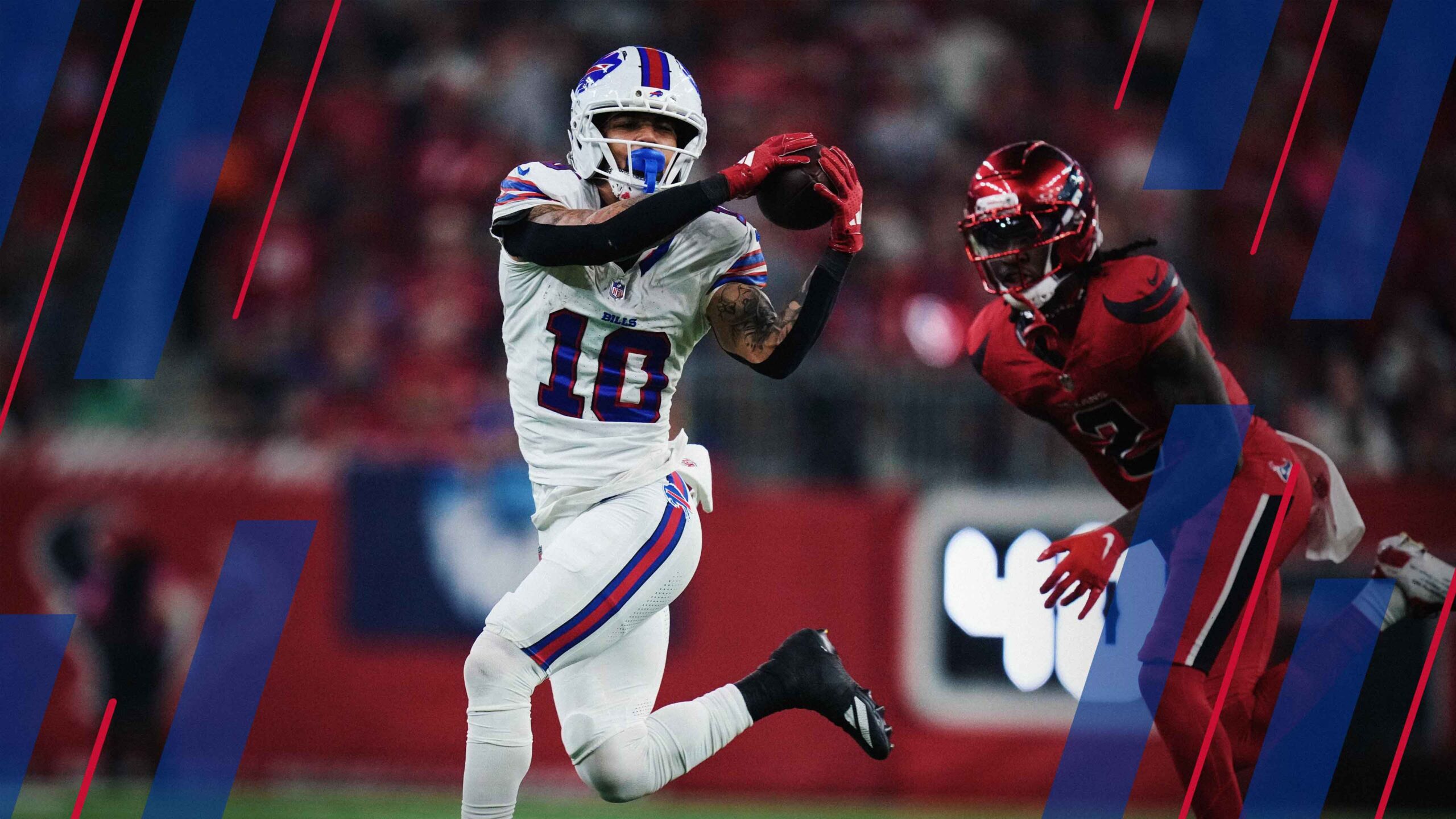
Last year, I introduced a new framework for understanding wide receiver play, quarterback decision-making and offensive potential. This framework relies on an XGBOOST model and PFF’s impressive collection of route-level data. Using machine learning and this breadth of PFF data, we can create models with the goal of predicting where a target should go on a given play.
The resulting metrics, Share of Predicted Targets and Share of Predicted Air Yards, are both more stable than their “actual” counterparts.
Week 15 Recap
- Wan’Dale Robinson: 10 targets, 28.57% target share
- Jerry Jeudy: 4 targets, 12.9% target share (dropped/stolen touchdown)
- Romeo Doubs: 3 targets, 8.57% target share
- D.J. Moore: 5 targets, 18.52% target share (two touchdowns)
Potential Breakouts: Week 16
These are players who were open far more often than they were targeted in Week 15. In general, players who show up on this list see an uptick in targets per route run and target share relative to both themselves and all players with similar target shares.
Alec Pierce may struggle to realize his target potential the rest of this season. Per PFF Premium Stats, in his return, Phillip Rivers averaged 5.2 air yards per attempt (fourth-lowest in Week 15), while Pierce owns a 19.4-average depth of target (second-highest in 2025). That 14.2-yard gap suggests Pierce will be under-targeted as long as Rivers is the quarterback.
The rest of the pool is in play for target-share increases.
Week 15 “Coach, I Was Open” Review
WR Alec Pierce, Indianapolis Colts
Rivers taking meaningful snaps in 2025 is a story in itself. He even put the Colts ahead late against one of the NFC’s best teams before Indianapolis ultimately fell short.
The performance was gritty, though the 55.0 overall PFF grade (29th of 32 quarterbacks with at least 10 dropbacks) reflects expected rust after five years away. It also underscores why Pierce may struggle with Rivers under center.
On this play, Rivers drops with a relatively clean pocket, feels contact as he releases and takes a hit. Tyler Warren tries to finish a catch in triple coverage but absorbs a shot and cannot complete it. Meanwhile, Pierce runs a sharp route and earns a +1 play-level PFF grade — excellent and hard to achieve — creating a window an average NFL quarterback should convert.
Rivers no longer has the arm to drive that throw, and those deeper routes are exactly where Pierce thrives. It mirrors, in more extreme form, the season-long disconnect I’ve noted between D.K. Metcalf and Aaron Rodgers. Unless Pierce’s role adjusts to Rivers’ current arm strength, average depth of target and time to throw (2.41 seconds, second-fastest in Week 15), targets will be scarce for the rest of the season.
WR Chris Olave, New Orleans Saints
Chris Olave has been a weekly feature of this article and the “Route Based Heroes” piece. He has excelled at getting open the entire year. Per Premium Stats, even with the fourth-most targets for wide receivers, Olave is somehow being undertargeted relative to his openness.
This play is a perfect example. The snap occurs on second-and-10 in the 4th quarter with 9:55 to go. The Saints are losing 17-10.
Tyler Shough drops back in a clean pocket with time to read the defense. Olave is running a simple corner route into a Cover-3 defense, and Jaycee Horn fails to drop back far enough while playing the outside third of the Cover-3. Olave is wide open for what would have been a touchdown in a crucial part of the game.
Shough instead threw to Kevin Austin Jr. for 18 yards, a positive 1.43 expected points added (EPA) play — but Olave’s predicted EPA on the corner was 2.20. The Saints later turned it over on downs on the same drive. If Shough had found Olave on that snap, New Orleans likely would have tied the game with a touchdown instead of leaving points on the field.