Agriculture
Winter storms have 'ruined' subtropical fruit harvest on Granada province's Costa TropicalMango and avocado growers are pruning their trees and estimate that production will fall by up to 40 per cent while they await financial support
Añádenos en GoogleMJ Arrebola
Granada
14/07/2026 a las 14:56h.After years of drought in which crops were dying of thirst, the rain finally returned to the coast this winter and seemed, in a ... way, to be a relief. Days of cold, rain and gusts of wind reaching up to 100 kilometres per hour lashed the Costa Tropical in Granada province relentlessly, leaving a devastating landscape with plastic sheeting torn away, embankments that had collapsed, uprooted trees and thousands of kilos of fruit strewn across the countryside.
According to the province's subtropical fruit sector, the trail of storms has left the mango and avocado season is “practically lost”. Juan Camacho, head of subtropical crops at COAG Granada, describes the situation as “disastrous” and explains that the national association of tropical crops estimates that mango and avocado production has fallen by between 35 per cent and 40 per cent compared with last year.
Camacho claims that "there isn’t a single farm in the whole of the Costa Tropical that has escaped damage”, in an area where avocados and mangoes account for 70 per cent of subtropical fruit production, compared with the 30 per cent accounted for by custard apples.
Exactly a year ago, for the first time in a long while, there was a sense of optimism, and according to figures from the sector they might once again see figures similar to those of six years ago, when it enjoyed one of its best periods. This year, according to the farmers, “it’s disastrous”.
For three years, the wells in Almuñécar and La Herradura had had become salinated due to the lack of fresh water. This winter’s rain fell abundantly, replenishing the aquifers and bringing relief to growers. However, the problem arose when it rained incessantly in a very short space of time, a volume of water fell that had not been seen for 15 years.
Water stress
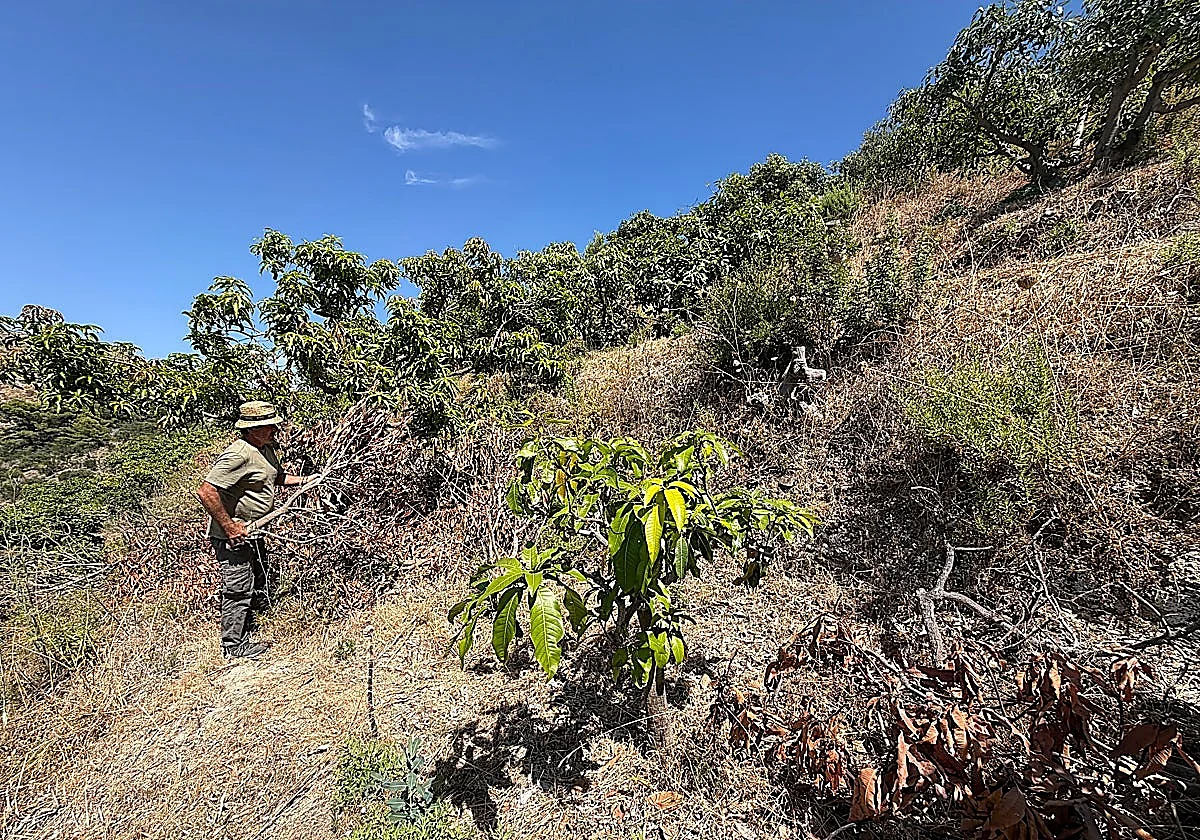
That combination of torrential rain from mid-December and throughout winter and early spring and a succession of storms bringing gale-force winds caused much of the crop to fall to the ground before it could be harvested. Camacho describes the consequences in the fields: many mango trees have lost their leaves. This damage encourages the onset of necrosis in the plant – a condition that arises when leaves and branches break – forcing farmers to carry out ‘very aggressive’ pruning in an attempt to save the trees.
Too much water, just like too little, causes what is known as ‘water stress’ in the plant. Added to this was a problem with temperatures that are rather unusual for that time of year, just as the trees were flowering, "which prevented the fruit from setting properly". As a result, the new blossoms and the small avocados that were already forming fell to the ground due to the shaking and rubbing of the branches.
One of the farmers affected is Gregorio Jiménez, who has more than 150 hectares of mango, avocado and custard apple orchards spread along the entire coast. He says that last year he produced around one million kilos of mangoes; this year he estimates the yield will be between 400,000 and 500,000 kilos – in other words, half as much.
In view of this situation, should the forecasts ultimately prove accurate and there be insufficient domestic production to meet demand, traders will have to turn to external producers. Against this backdrop, the custard apple has been the only subtropical crop to come through unscathed. It is a deciduous tree that sheds and renews its foliage and the storm struck just as it was in the process of changing its leaves. As it had hardly any foliage at the time, the wind was unable to cause the same damage as it did to the mango and avocado trees.
‘In dribs and drabs’
Farmers have been assessing the damage for months, contacting insurance companies and receiving visits from loss adjusters, while they wait for public aid which, they claim, “is trickling in” and in many cases “has not yet arrived”. The Andalusian regional government has launched a package of aid to address flood, wind and other damage, but according to farmers, it is bogged down in a ‘never-ending’ administrative process.
According to farmers’ organisations, the central government promised to grant a minimum of 5,000 euros to each affected farmer in the regions included in the aid package, which includes the Costa Tropical, but the aid is only trickling in.
As part of the aid provided by the central government and the Andalusian regional government, 3,700 million euros were announced to compensate for crop losses, repair water infrastructure and rural roads, and replace damaged greenhouses.