Zoom
Fire Horses. SUR Lifestyle 2026 Year of the Fire Horse: the ancient Spanish ritual that brings the legend to lifeAs the Chinese New Year ushers in a rare 60-year cycle, the village of San Bartolomé de Pinares keeps a centuries-old 'purification by fire' tradition alive
Alekk M. Saanders
Avila
Tuesday, 3 March 2026, 15:45
The vibrant Lantern Festival, held today on 3 March, marks the conclusion of the 15-day celebration welcoming the Year of the Fire Horse.
In Chinese astrology, the combination of the Yang Fire element and the Horse brings intense, fast-moving energy, urging people to pursue personal goals with newfound speed and boldness.However, this "Fire Horse" energy is not confined to the East.
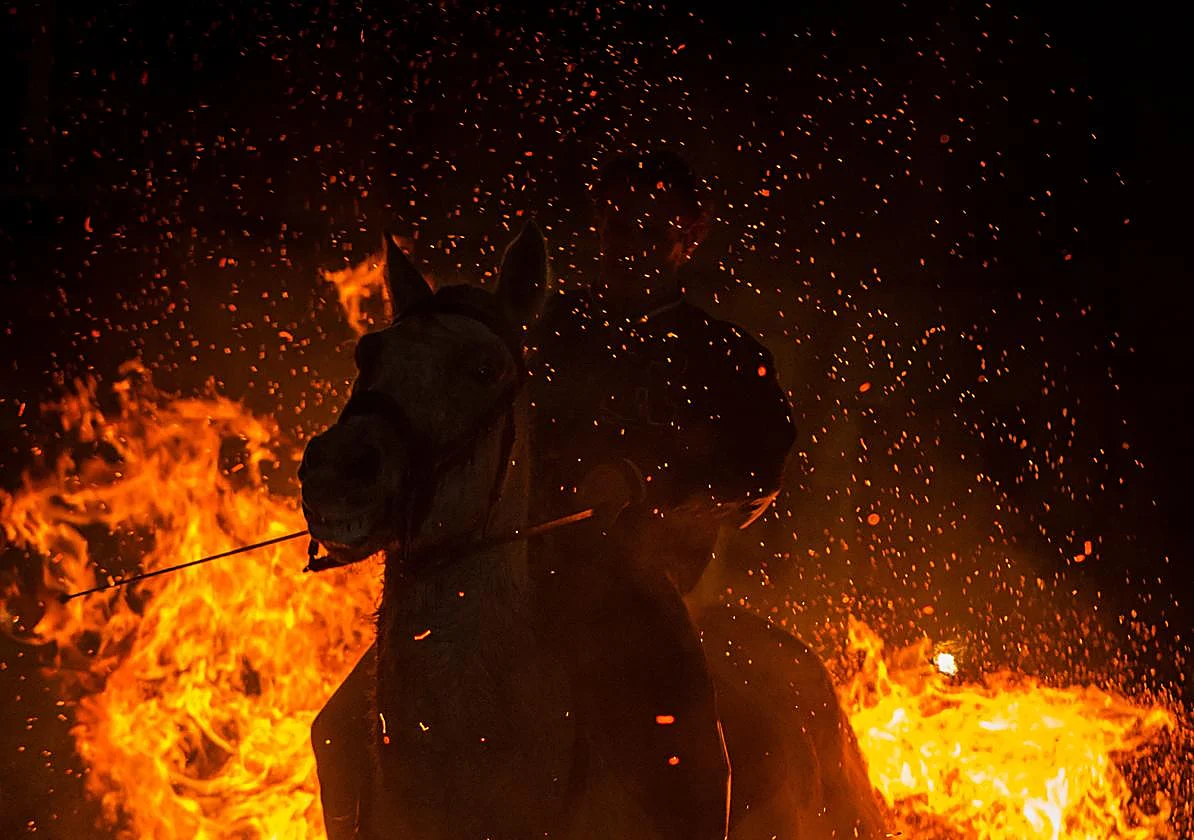
Every year on 16 January, the village of San Bartolomé de Pinares in Ávila (Castile and León) becomes a living embodiment of this symbol. Here, the ancient Fiesta de las Luminarias (Festival of Lights) draws thousands of spectators into a sensory whirlwind of smoke, embers, and thundering hooves.
San Bartolomé de Pinares in Castile and León, with a population of less than 500, hosts the traditional Fiesta de Luminarías (Festival of Lights), in which horsemen jump through bonfires
The origins of the ‘fiesta’ in San Bartolomé de Pinares are a matter of debate. Various studies point to the possible existence of ancient purification rituals involving livestock and fire. (They were common in many pre-Roman cultures.
In addition, both religious and livestock health reasons are cited as causes. According to one of the most common versions, in the 18th century, a serious horse disease threatened the lives of local village horses.
Existing treatments were ineffective and the survival of the villagers themselves without horses seemed impossible. So the frightened people had no choice but to promise Saint Anthony that if the animals survived, they would burn the 'malas nieblas' (evil mists) with smoke from plants every year.
Therefore, when the epidemic subsided, the ritual became an obligation, or rather amatter of honour, which has been observed continuously ever since. Since then, riders on their horses have been jumping over bonfires so that the smoke would purify the animals and rid them of diseases.
Preventative measures
Nowadays the ‘ayuntamiento’ implements a number of preventative measures to minimise any risk. Both the town hall and the government of Castile and Leon hire veterinarians to attend the event.
A few days before the festival, all horses are checked, and before the ritual begins, their tails and manes are braided and tied with cotton ribbons so that their hair does not catch fire. It is always stressed that the participating horses are accustomed to the environment and human handling, which helps reduce stress. Moreover, contact with fire is brief, and the bonfires, covered with ashes and green brooms, do not reach extreme temperatures on the ground.
A feast ending
Incidentally, before the ritual, the parish priest blesses the animals. The bonfires are tended by bonfire keepers, who use long poles to open up the bonfire just before the horse enters. This prevents the coals from burning the jumping animal. The bonfire keepers also add fresh branches to increase the amount of smoke. Crowds of people freeze in silence, then burst into cries.
“The event attracts tourists to the village from as far as eastern Japan and Korea, as well as Western Europeans,” María Jesús Martín Gómez, the mayor of San Bartolomé de Pinares told SUR in English.
The bonfires are tended by bonfire keepers, who use long poles to open up the bonfire just before the horse enters
Although this ritual is intended to purify, heal, and protect horses for the coming year, people do not forget about themselves either. The festival ends with a feast. After the ritual, the logs are used for a mass barbecue, where local meat products are grilled. Incidentally, the next Fiesta de Luminarías will be held in San Bartolomé de Pinares on 16 January which according to the Chinese calendar will still be the Year of the Fire Horse (it will last until 5 February). This means that there is still opportunity to see horses and fires in a special context.