3 min read
Curiosity Blog, Sols 4743-4749: Polygons in the HollowMars Science Laboratory Mission Team Members
Dec 18, 2025 ArticleWritten by Lucy Lim, Planetary Scientist at NASA’s Goddard Space Flight Center
Earth Planning Date: Friday, Dec. 12, 2025
The weekend drive starting from the “Nevado Sajama” drill site brought Curiosity back into the “Monte Grande” boxwork hollow. We've been in this hollow before for the “Valle de la Luna” drill campaign, but now that the team has seen the results from both the “Valle de la Luna” and “Nevado Sajama” drilled samples, we've decided that there’s more work to do here.
Overall science goals here included analysis of the other well-exposed bedrock block in Monte Grande to improve our statistics on the composition of the bedrock in the hollows, and also high-resolution imaging and compositional analysis of portions of the walls of the hollow, other than those that had been covered during the Valle de la Luna campaign. These are part of a systematic mini-campaign to map a transect over the hollow-to-ridge structure from top to bottom at this site.
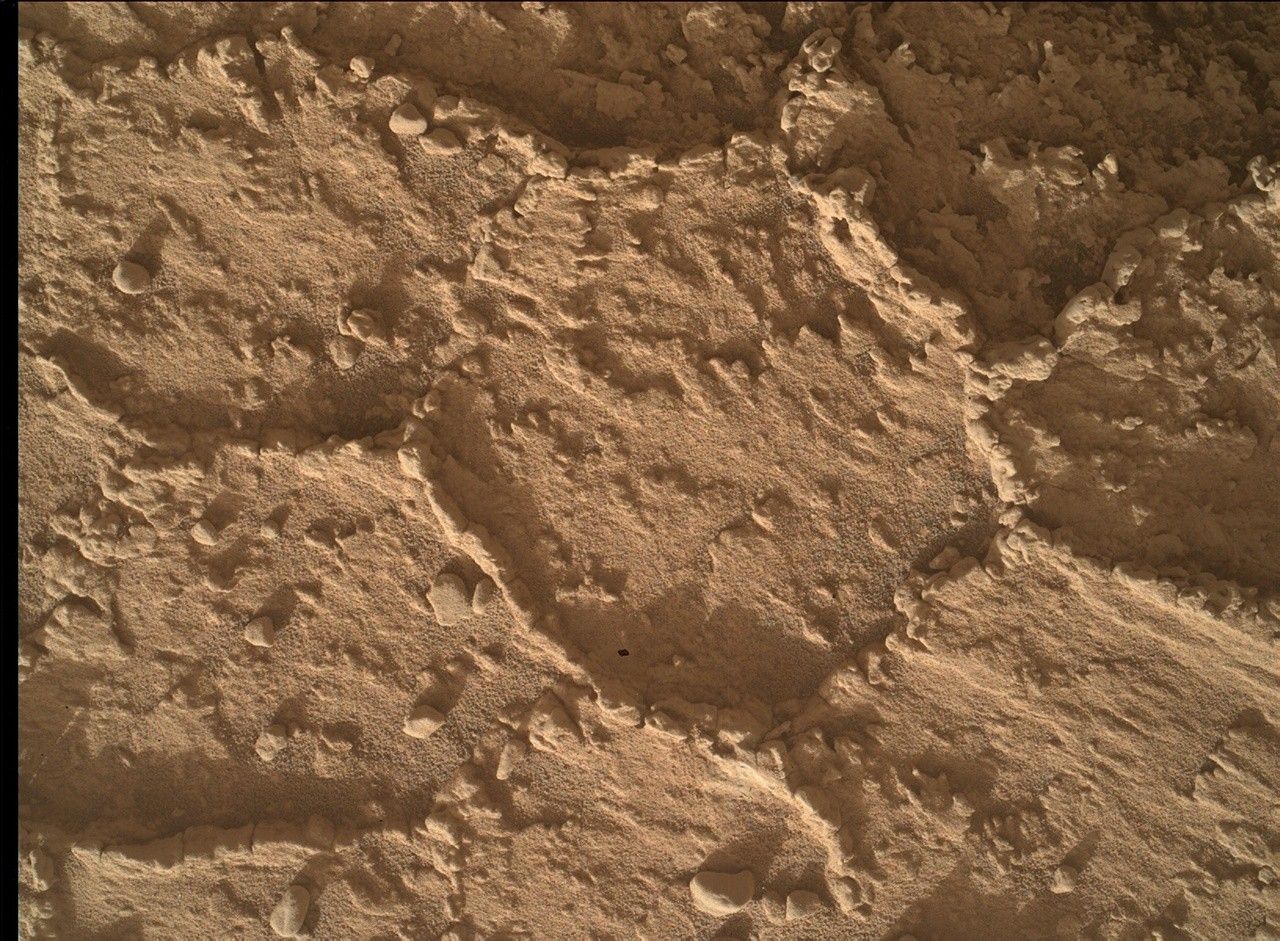
The post-drive imaging revealed a surprise — Valle de la Luna’s neighboring block was covered with polygons! As it turned out, the rover's position during our previous visit for the Valle de la Luna drill campaign happened to have stood in the way of imaging of the polygonal features on this block so this was our first good look at them. We have seen broadly similar polygonal patterns in various strata in Gale Crater before — recently in the layered sulfate units (for instance, during Sols 4532-4533 and Sols 4370-4371) but we hadn't seen them in the bottom of a boxwork hollow. Interestingly, this block looks more rubbly in texture than many of the previously observed polygon-covered blocks.
We're interested in the relationship of the visibly protruding fracture-filling material here to fracture-filling materials seen in previous polygons, and also in the relationship of the polygonal surface on top to the more chaotic-appearing exposures lower on the block, and to the equivalent strata in the nearby wall of the hollow. We therefore planned a super-sized MAHLI mosaic that will support three-dimensional modeling of the upper and lower exposed surfaces of the polygon-bearing block. Several APXS and ChemCam LIBS observations targeted on the polygon centers and polygon ridges were also planned, to measure composition. Meanwhile, Mastcam has been busy planning stereo images of the nearby hollow wall in addition to the various blocks on the hollow floor.
The hollow also included freshly exposed light-toned material from where the rover had driven over and scuffed some bedrock, so another APXS measurement and a ChemCam LIBS went to the scuffed patch to measure the fresh surface.
We'll be driving on Sol 4748. As we drive we'll be taking a MARDI “sidewalk” observation, to image the ground beneath the rover as we approach the wall for a closer view, and hopefully some contact science in next week's plans.
Want to read more posts from the Curiosity team?
Want to learn more about Curiosity’s science instruments?
Share
Details
Last Updated Dec 18, 2025Related Terms
Explore More
2 min readHi ya! Hyha
Article 1 day ago 3 min readCuriosity Blog, Sols 4731-4742: Finishing Up at Nevado Sajama
Article 1 week ago 2 min readCuriosity Blog, Sols 4723-4730: Digging Into Nevado Sajama
Article 1 week ago Keep ExploringDiscover More Topics From NASA
Mars
Mars is the fourth planet from the Sun, and the seventh largest. It’s the only planet we know of inhabited…
All Mars Resources
Explore this collection of Mars images, videos, resources, PDFs, and toolkits. Discover valuable content designed to inform, educate, and inspire,…
Rover Basics
Each robotic explorer sent to the Red Planet has its own unique capabilities driven by science. Many attributes of a…
Mars Exploration: Science Goals
The key to understanding the past, present or future potential for life on Mars can be found in NASA’s four…