3 min read
Curiosity Blog, Sols 4750-4762: See You on the Other Side of the SunMars Science Laboratory Mission Team Members
Dec 22, 2025 ArticleWritten by Lucy Thompson, Planetary Scientist and APXS team member, University of New Brunswick, Canada
Earth planning date: Monday, Dec. 22, 2025
As we all prepare for the holiday season here on Earth, we have been planning a few last activities before Curiosity and the team of scientists and engineers take a well-deserved, extended break. This holiday season coincides with conjunction — every two years, because of their different orbits, Earth and Mars are obstructed from one another by the Sun; this one will last from Dec. 27 to Jan. 20. We do not like to send commands through the Sun in case they get scrambled, so we have been finishing up a few last scientific observations before preparing Curiosity for its quiet conjunction break.
As part of a pre-planned transect between our two recent drill holes, “Valle de la Luna” (hollow) and “Nevado Sajama” (ridge), we successfully completed chemical analyses and imaging of a ridge wall. These observations were acquired to document changes in texture, structure, and composition between the two drill holes and to elucidate why we see such contrasting physical features of resistant ridges and eroded hollows in this region. Mastcam and ChemCam also imaged a little further afield. ChemCam continued observations of the “Mishe Mokwa” butte and captured textures in the north facing wall of the next, adjacent hollow. Mastcam imaged the central fracture along the “Altiplano” ridge above the wall we were parked at, as well as polygonal features in our previous workspace.
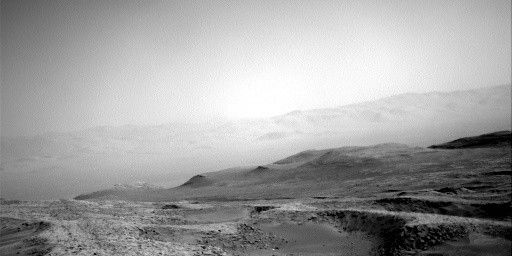
The rover engineers then successfully orchestrated Curiosity’s drive back up onto the nearby ridge to ensure a safe parking spot over conjunction. We documented the drive with a MARDI sidewalk video, tracking how the terrain beneath the rover changes as we drive. Although we could not use APXS and MAHLI on the robotic arm from Friday on, owing to constraints that need to be in place prior to conjunction, we were able to use the rover’s Mastcam to image areas of interest in the near field, which will help us with our planned activities when we return from conjunction. These will hopefully include getting chemistry (with APXS and ChemCam) and imaging (with MAHLI) of some freshly broken rock surfaces that we drove over.
The environmental scientists were also very busy. Navcam observations included: Navcam suprahorizon and zenith movies to monitor clouds; Navcam line-of-sight observations; and Navcam dust-devil movies and surveys as we enter the dust storm season on Mars. Mastcam tau observations were acquired to monitor the optical depth of the atmosphere, and APXS analyses of the atmosphere were also planned to monitor seasonal variations in argon.
Today we are uplinking the last plan before Mars disappears behind the Sun and we all take a break (the actual conjunction plan to take us through sols 4763-4787 was uplinked a couple of weeks ago). Because of constraints put in place to make sure Curiosity stays safe and healthy, we were limited to very few activities in today’s plan. These include more APXS atmospheric argon measurements and Hazcam and Navcam imaging including monitoring for dust-devil activity.
As usual, our plans also included background DAN, RAD, and REMS observations, which continue through conjunction.
It has been a pleasure to be a part of this amazing team for another year. We are all looking forward to coming back in January, when Mars reappears from behind the Sun, to another exciting year of roving in Gale crater.
Want to read more posts from the Curiosity team?
Want to learn more about Curiosity’s science instruments?
Share
Details
Last Updated Dec 22, 2025Related Terms
Explore More
3 min readWind-Sculpted Landscapes: Investigating the Martian Megaripple ‘Hazyview’
Article 3 days ago 3 min readCuriosity Blog, Sols 4743-4749: Polygons in the Hollow
Article 4 days ago 2 min readHi ya! Hyha
Article 5 days ago Keep ExploringDiscover More Topics From NASA
Mars
Mars is the fourth planet from the Sun, and the seventh largest. It’s the only planet we know of inhabited…
All Mars Resources
Explore this collection of Mars images, videos, resources, PDFs, and toolkits. Discover valuable content designed to inform, educate, and inspire,…
Rover Basics
Each robotic explorer sent to the Red Planet has its own unique capabilities driven by science. Many attributes of a…
Mars Exploration: Science Goals
The key to understanding the past, present or future potential for life on Mars can be found in NASA’s four…