3 min read
Curiosity Blog, Sols 4832–4837: Driving the (Contact) Line!Mars Science Laboratory Mission Team Members
Mar 18, 2026 ArticleWritten by Catherine O’Connell-Cooper, APXS Strategic Planner and Payload Uplink/Downlink Lead, University of New Brunswick, Canada
Earth planning date: Friday, March 13, 2026
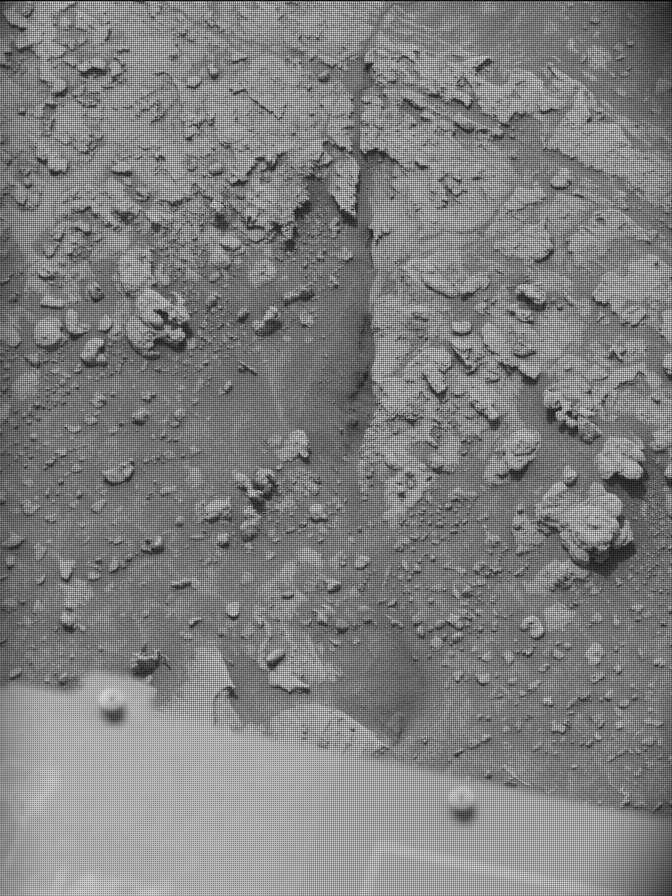
We are in our final phase of the boxwork campaign, investigating the contacts between the boxwork unit and the layered sulfate unit. As my colleague Bill reported here, last week we crossed out of the boxwork unit back into the underlying layered sulfate unit and then back into the boxwork unit for our Monday plan. We are now driving southward across the uppermost portion of the boxwork unit. This unit is characterized by smooth bedrock where the boxwork structures are not as obvious as they were back at our “Nevado Sajama” drill sites, where we took our boxwork “postcard.”
This past week, our goal was to characterize as much as we could before leaving. On Monday, MAHLI imaged the targets (all named after geographic locations around the Andes in South America) “Piedras Bonitas” and “La Calera” — the latter was brushed bedrock also analyzed by APXS. On Friday, MAHLI and APXS analyzed a brushed, nodular bedrock at “Jaruma” and a larger nodule (or cluster of smaller nodules) at the unbrushed “Constancia.” (Click on the name to see the MAHLI images!)
Mastcam had a very busy week! Typically, as we come toward the end of a science campaign, the wish list of Mastcam targets gets very large, and the ending of this boxwork campaign is following that tradition. Mastcam acquired two mosaics on the southern contact between the boxworks and layered sulfate unit: an 18x1 mosaic (i.e., 18 frames along one row) on Monday and 19x3 mosaic (“El Misti”) on Friday. These will be key to helping us understand the origin and evolution of the boxwork unit. Other mosaics include “Yungas” (a highly veined area), “Ujina” (looking at cross-sectional stratigraphy (both on Monday) and two mosaics on Friday on the target “Salar de Maricunga” (to characterize light-toned bedrock in the drive direction).
We did not neglect our environmental monitoring either. We continue to monitor dust in the atmosphere using different tools, including Navcam dust-devil monitoring and surveys, zenith and suprahorizon movies, and Mastcam taus.
The weekend drive is planned to take us about 23 meters to the west-southwest (about 75 feet) as we get closer and closer to leaving the boxwork unit. I have been a member of the boxwork working group (we call ourselves the “Fracture Townies”) since its inception about two years before we ever put a wheel on the unit. It is bittersweet to be so close to the end of this campaign, but we have so much data and imagery from here to work with, we won’t have too much time to be sad.
Want to read more posts from the Curiosity team?
Want to learn more about Curiosity’s science instruments?
Share
Details
Last Updated Mar 18, 2026Related Terms
Explore More
3 min readCuriosity Blog, Sols 4825-4831: Exploring the Borderlands
Article 1 week ago 3 min readCuriosity Blog, Sols 4818-4824: Thinking Out of the Boxwork
Article 2 weeks ago 2 min readCuriosity Blog, Sols 4812-4817: Back Into the Hollows
Article 3 weeks ago Keep ExploringDiscover More Topics From NASA
Mars
Mars is the fourth planet from the Sun, and the seventh largest. It’s the only planet we know of inhabited…
All Mars Resources
Explore this collection of Mars images, videos, resources, PDFs, and toolkits. Discover valuable content designed to inform, educate, and inspire,…
Rover Basics
Each robotic explorer sent to the Red Planet has its own unique capabilities driven by science. Many attributes of a…
Mars Exploration: Science Goals
The key to understanding the past, present or future potential for life on Mars can be found in NASA’s four…