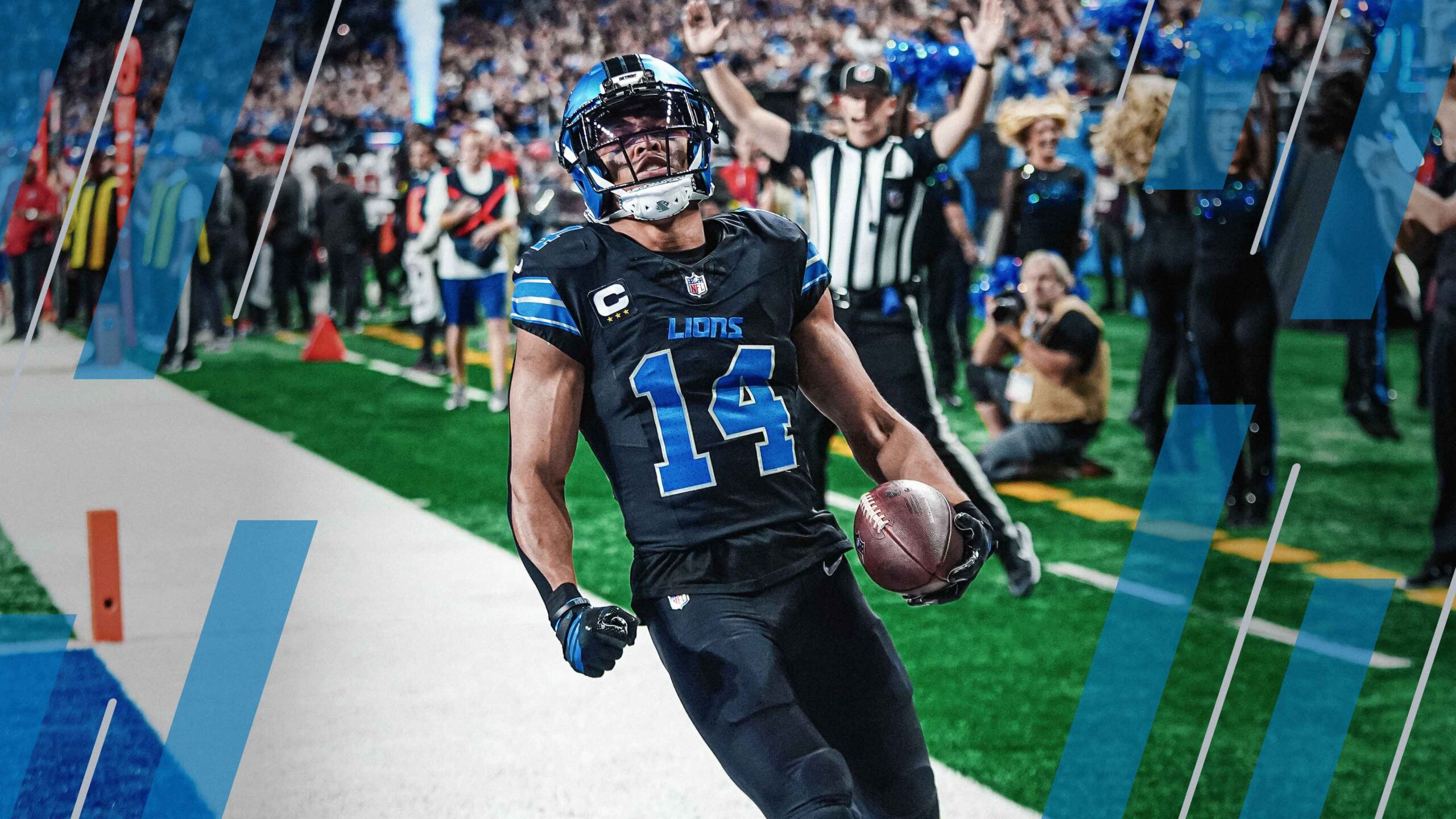
As part of PFF's celebration of 20 years of NFL data, we're building an All-Star team for every franchise, highlighting the best players at each position from the PFF era. This installment turns to the Detroit Lions.
PFF's database dates back to the 2006 NFL season, providing a unique lens for evaluating and comparing players across eras. More details on the methodology used to construct these teams are available at the bottom of the page.
Offense
- QB: Matthew Stafford (2009-2020)
- HB: Jahmyr Gibbs (2023-2025)
- WR: Calvin Johnson (2007-2015)
- WR: Amon-Ra St. Brown (2021-2025)
- Slot WR: Golden Tate (2014-2018)
- TE: Sam LaPorta (2023-2025)
- TE: T.J. Hockenson (2019-2022)
- LT: Taylor Decker (2016-2025)
- LG: Rob Sims (2010-2014)
- C: Frank Ragnow (2018-2024)
- RG: Graham Glasgow (2016-2025)
- RT: Penei Sewell (2021-2025)
The Lions' offense has been one of the NFL's best in recent seasons, with seven of the 12 players on this roster coming from the 2023 and 2024 campaigns. On paper, this unit would rank among the league's elite, especially with Hall of Fame wide receiver Calvin Johnson added to the receiving corps.
While the Lions' recent offensive success has come with Jared Goff at quarterback, Matthew Stafford was the clear choice using this methodology. Stafford's five best seasons during his 12 years in Detroit surpassed Goff's four seasons with the franchise.
The Lions have enjoyed unusual stability at both left tackle and center over the past 25 years. Taylor Decker played more than 1,000 additional snaps during the PFF era and earned an 86.7 overall grade compared to Jeff Backus' 84.9. However, Backus spent his first five NFL seasons before the start of the PFF era, so there is a reasonable argument that he was the better left tackle over the full 25-year period.
A similar debate exists at center. Dominic Raiola holds the advantage in longevity, but Frank Ragnow earned a 91.8 PFF overall grade compared to Raiola's 84.6. Like Backus, Raiola spent five seasons in the NFL before the PFF era began.
Defense
- DI: Ndamukong Suh (2010-2014)
- DI: Alim McNeill (2021-2025)
- ED: Aidan Hutchinson (2022-2025)
- ED: Ezekiel Ansah (2013-2018)
- LB: Stephen Tulloch (2011-2015)
- LB: DeAndre Levy (2009-2016)
- SLB: Jack Campbell (2023-2025)
- CB: Darius Slay (2013-2019)
- CB: Rashean Mathis (2013-2015)
- Slot CB: Brian Branch (2023-2025)
- S: Glover Quin (2013-2018)
- S: Kerby Joseph (2022-2025)
While the Lions' offense has garnered most of the headlines in recent seasons, Detroit has hit on several recent Day 1 and Day 2 defensive draft picks. Five players from the 2021-2023 drafts have already played well enough to make this roster. While Jack Campbell played more middle linebacker and Brian Branch played more safety in 2025, they played primarily as a Sam linebacker and slot cornerback as rookies, respectively, helping Detroit get its best defensive players on the field.
While the offense would feature a dream pairing of Calvin Johnson and Amon-Ra St. Brown, the defense has its own offensive-line nightmare in Ndamukong Suh and Aidan Hutchinson.
The Lions' offense and defense are particularly impressive, given that the team won only 12 games over the first four seasons of the PFF era. No one from the 2006 team is represented on offense or defense, and no one from the 2007 or 2008 defense made the roster.
Methodology
Selections were based on normalized PFF grades adjusted by season. To balance peak performance and longevity, only a player's five best seasons with a franchise from 2006-25 were considered. Any season with an overall PFF grade below 60.0 was excluded, ensuring that strong years helped a player's case while weaker seasons were not held against him. Postseason play was included, though all seasons were capped at a 16-game equivalent to maintain consistency across eras. At each position, the player with the highest score under this methodology earned the spot.
Each team consists of 12 offensive and 12 defensive players. Because 11 personnel and nickel defense were the league's most common alignments over the past two decades, those personnel groupings served as the foundation for every roster. Teams received either a second tight end or a fullback, depending on whether they used more 12- or 21-personnel. Defensively, teams received either a third interior defender or a third linebacker depending on whether they primarily operated from a 3-4 or 4-3 front.
Players who logged significant snaps at multiple positions during their tenure with a franchise were eligible at either spot. In most cases, those players were assigned to the position where they provided the greatest value, though their versatility occasionally influenced the final roster construction.
Unlike some All-Pro teams that group offensive linemen by position type, these rosters were built according to where players actually lined up. If a team's two best tackles both played exclusively on the left side, only the top left tackle was selected. One of the three wide receivers and one of the five defensive backs was also required to have significant slot experience. In a 4-3 defense, one linebacker needed experience at the Sam linebacker position, while in a 3-4 defense, one defensive tackle needed experience at nose tackle.
When multiple players are listed at the same position, the first name represents the top selection. Players designated as slot wide receiver, slot cornerback, nose tackle or Sam linebacker were selected specifically for those roles rather than as the third-best player within their broader position group.