Zoom
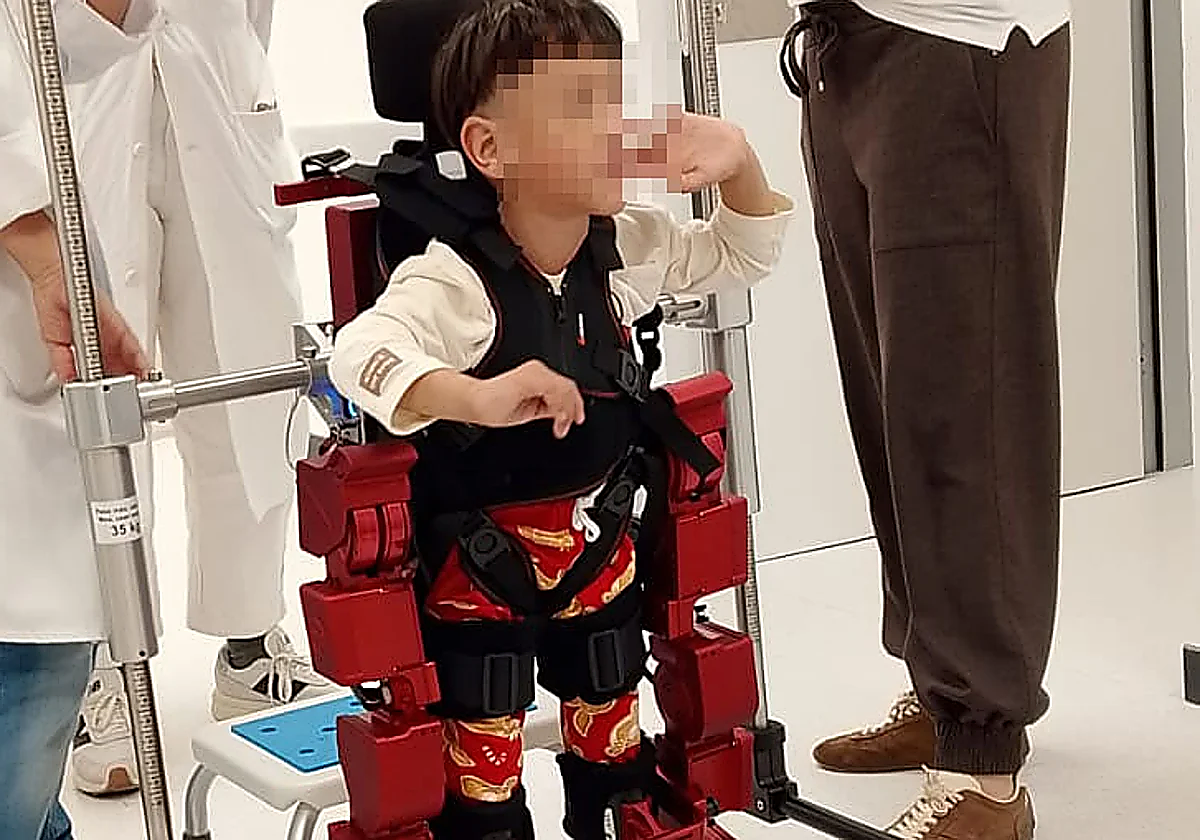
Four-year-old Alán Josué in Malaga with the exoskeleton that helps him walk. SUR Health Four-year-old Malaga boy with mobility issues takes first steps thanks to new robotic exoskeletonAlán Josué is among the first children in Andalucía to benefit from the Atlas 2030 robot, a breakthrough technology designed to help children with cerebral palsy and motor disorders walk through play-based therapy
José Antonio Sau
Thursday, 16 April 2026, 11:40
Alán Josué Rangel Manaure, a four-year-old from Malaga, faced an uphill battle from the start.
Born prematurely at just 23 weeks and three days, Alán suffered a brief but critical lack of oxygen at birth. As his mother, Yinsheller Manaure, explained to SUR, these complications severely impacted the mobility of his legs and lower hips.
Beyond walking: clinical benefits
The benefits of the Atlas 2030 extend beyond simple movement. Regular use of the exoskeleton:
Improves respiratory function
Reduces muscle spasticity
Delays complications like scoliosis
Increases muscle tone
Fortunately, medical advancements are bridging the gap between clinical theory and daily life. On 30 March, the Andalusian Health Service (SAS) announced that four regional hospitals, including the Materno Infantil Malaga, have incorporated advanced pediatric exoskeletons into their treatment plans.
These devices are designed to improve the quality of life for patients with rare diseases, neuromotor disorders, cerebral palsy, and spinal muscular atrophy.
For Alán, the robot has provided more than just physical support—it has given him the confidence to move. While he still requires the help of his parents or grandparents to take steps without the device, he is among the first children in Malaga’s public healthcare system to utilize this cutting-edge technology.
The therapy is a long-term journey, but the goal is clear: gradual, sustained improvement in mobility. The device, based on the Atlas 2030 model, was developed by renowned Spanish researcher Elena García Armada of the CSIC (Spanish National Research Council).
It allows children who are otherwise unable to walk to stand and navigate their environment. By using sensors and "smart joints" that replicate biological gait patterns - including 360-degree movement - the technology turns rigorous physical therapy into a form of play.
Professionals train to operate the robots
The regional government has purchased the equipment with NextGeneration EU funds. It is part of a strategy to promote personalised medicine and robotics in the public health system. The rehabilitation and physiotherapy teams at the four hospitals have received specific training in the operation of the robots.
Hospital Materno's physical medicine and rehabilitation unit, in coordination with electromedicine, is responsible for advancing this highly effective therapy for many children. The Virgen del Rocío hospital in Seville, the Virgen de las Nieves hospital in Granada and the Reina Sofía hospital in Cordoba also have this exoskeleton.
Alán Josué's mother, 32, came to Malaga from Venezuela eight years ago. She tells SUR about her son's challenges: "He doesn't walk, he doesn't stand up, he can use a stroller or something, but he doesn't walk on his own." Alán suffers from spasticity - a muscle rigidity that forces him to cross his legs (scissor gait), preventing him from walking.
The little boy has already undergone three 45-minute therapy sessions with the exoskeleton. Yinsheller Manaure says that there has been progress, which will be even more noticeable with the two weekly sessions he has ahead of him.
"He has shown great progress: they have made the adjustments and his legs now have the correct angle. He couldn't fully extend his knees - it was like the bone was contracted. Thanks to the project, it's now properly aligned. All of this will allow him to walk in the future," she states.
The healthcare staff play with the little boy. For example, he operates a small robot by remote control. "They switch it to manual mode so that he can take his steps little by little on his own. He takes the step himself and the exoskeleton helps him complete the movement correctly," the mother says. In other words, it assists him with walking.
Following these sessions, "the boy no longer crosses his legs and they're no longer in an X-shape". "You can see a huge difference because he keeps them apart and his mobility is much better, but he still can't walk on his own," Manaure says.
Alán Josué journey to learning to stand up
Prior to these sessions, Alán Josué couldn't stand up. Now he can pull himself up to a standing position by holding onto walls or doors. "Now he does it more safely thanks to the exoskeleton," his mother says, addding that "he has a chance" at walking in the future. He still has months of work ahead of him.
The boy's latest 'play' with the exoskeleton was on Wednesday. "It was spectacular, because his legs and knees were at five degrees, they lowered it to three. He did amazing today, he took steps backwards, which he wasn't able to do before."
Alán Josué is "happy and content", because training with the exoskeleton is a game that "keeps him distracted".
"I believe this technology has helped my son and will help many children," Manaure says. "Now he has gained the confidence to walk holding someone's hand, he takes steps without crossing his legs, while before he would cross them and trip."
The benefits of using the exoskeleton are numerous: improved breathing and reduced spasticity. It helps delay or prevent serious complications such as scoliosis and improves muscle tone, representing a historic advance in the treatment of other diseases that, until recently, meant almost complete immobility for those who suffered from them.