Amanda Fanale
Mar 13, 2026 ArticleContents
Scientific Visualizations
GVIS creates scientific visualizationsto explain complex scientific systems which are typically impossible to see with the naked eye. These visualizations can be for large systems such as engines and storage tanks and add useful supplementary information as to how the system functions. Scientific visualizations can display information on large and microscopic scales, providing powerful insight to the inner workings of mechanical systems.
Visualization of the Zero Boil-Off Tank Experiment NASA GVISAbove is a visualization of the Zero Boil-Off Tank (ZBOT), a long term propellant storage tank developed by NASA. Spacecraft fuels are volitaile cryogenic liquid propellants which must be maintained at extremely low temperatures and also must be guarded from environmental heat leaks into the spacecraft’s propellant tank. The featured visualization is an example of many experiments done on the ZBOT to investigate the best storage method for cryogenic liquid propellants. This visualizations shows the viewer the inner workings of the propellants inside the tank, bringing the experiment to life.
Our goal when developing visualizations is to engage the imagination, to provide insight and understanding. We aim to make the intangible tangible and turn the hypothetical into reality.
paul Catalano
Senior Extened Reality Developer
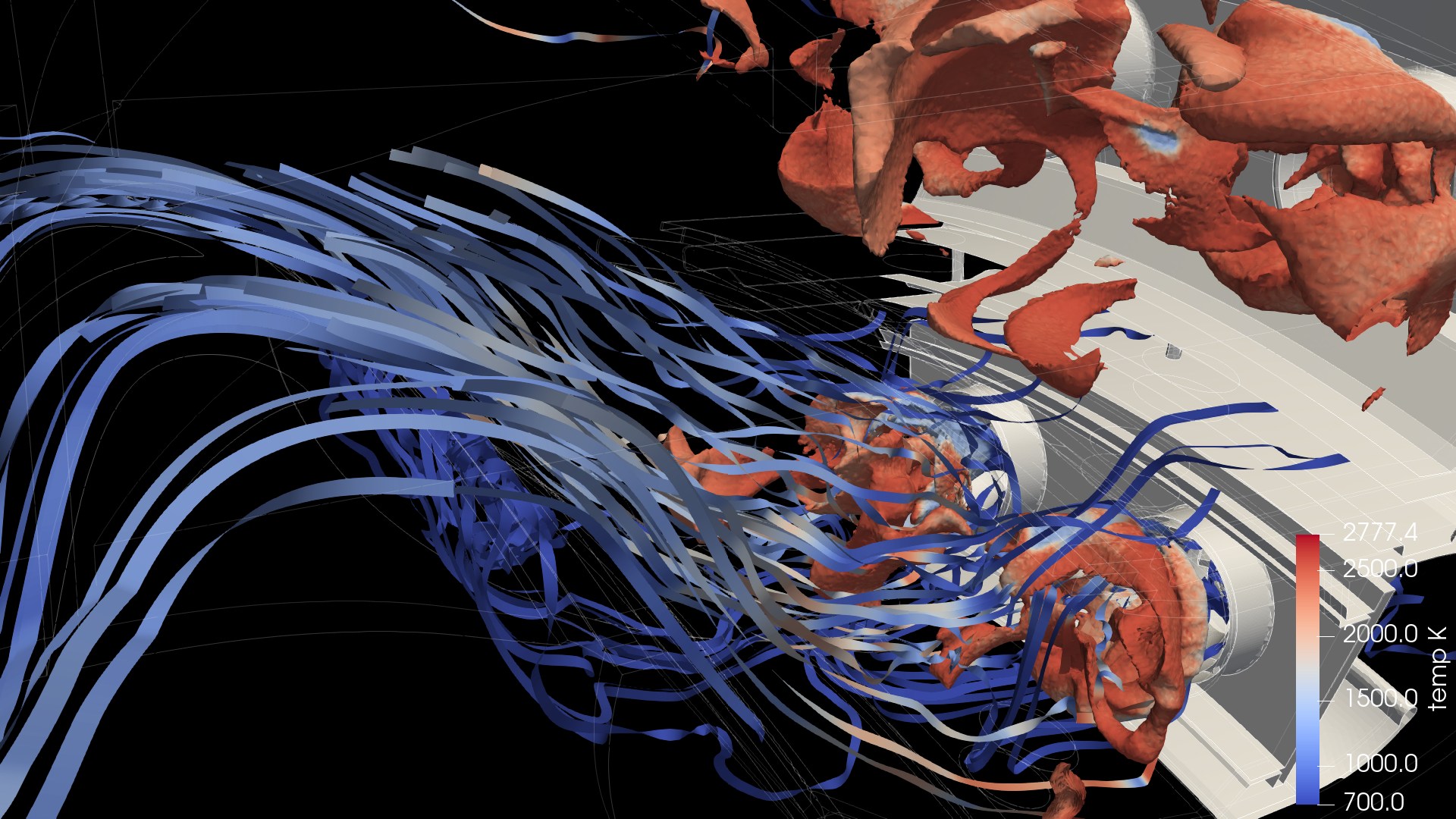
Ray traced image of combustor swirlers NASA GVIS Visualization of turbo machinery within an engine. NASA GVISTurbomachinery visualizations, such as those seen above, offer a visual representation of energy transfer. These representations of engines are vital tools in reducing the time and expense required to test and manufacture aircraft.
Scientific visualizations are indispensable educational tools. Visual forms of scientific concepts are easy to share, eliminate scientific jargon, used as supplements in lessons, and can be modified for different audiences. The barrier between scientific concepts and understanding are broke through the artistry of scientific visualizations.
Scientific Immersion
Magnetic flux demonstration of the HEMM motor. NASA GVISThe above visualization is of the High-Efficiency Megawatt Motor (HEMM). HEMM is a 1.4 megawatt electric machine being developed at NASA’s Glenn Research Center in Cleveland to improve efficiency in future aircraft with electrified propulsion systems.
Many scientific visualizations, such as the magnetic flux demonstration of the HEMM motor, are created for the GRUVE Lab. GRUVE, or the Glenn Reconfigurable User-Interface and Virtual Reality Exploration Lab, hosts the CAVE, a fully immersive, virtual, 3D environment. When in the CAVE users wear tracking active-shutter glasses, which ensures that models and simulations remain proportional and in-line with the user. This personalized experience allows for greater understanding and implementation of scientific systems.
You can learn more about GRUVE Lab by clicking here.
Contact Us
Need to reach us? In need of a scientific visualization? You can send an email directly to the GVIS Team (GRC-DL-GVIS@mail.nasa.gov).
About the Author
Amanda Fanale
Share
Details
Last Updated Mar 13, 2026Related Terms
Explore More
4 min readGVIS Virtual Systems Simulations
Article 1 hour ago 4 min readGVIS Conceptual Visual Designs
Article 1 hour ago 3 min readGVIS Test Facilities Visualizations
Article 1 hour ago Keep ExploringDiscover More Topics From NASA
Missions
Humans in Space
Climate Change
Solar System