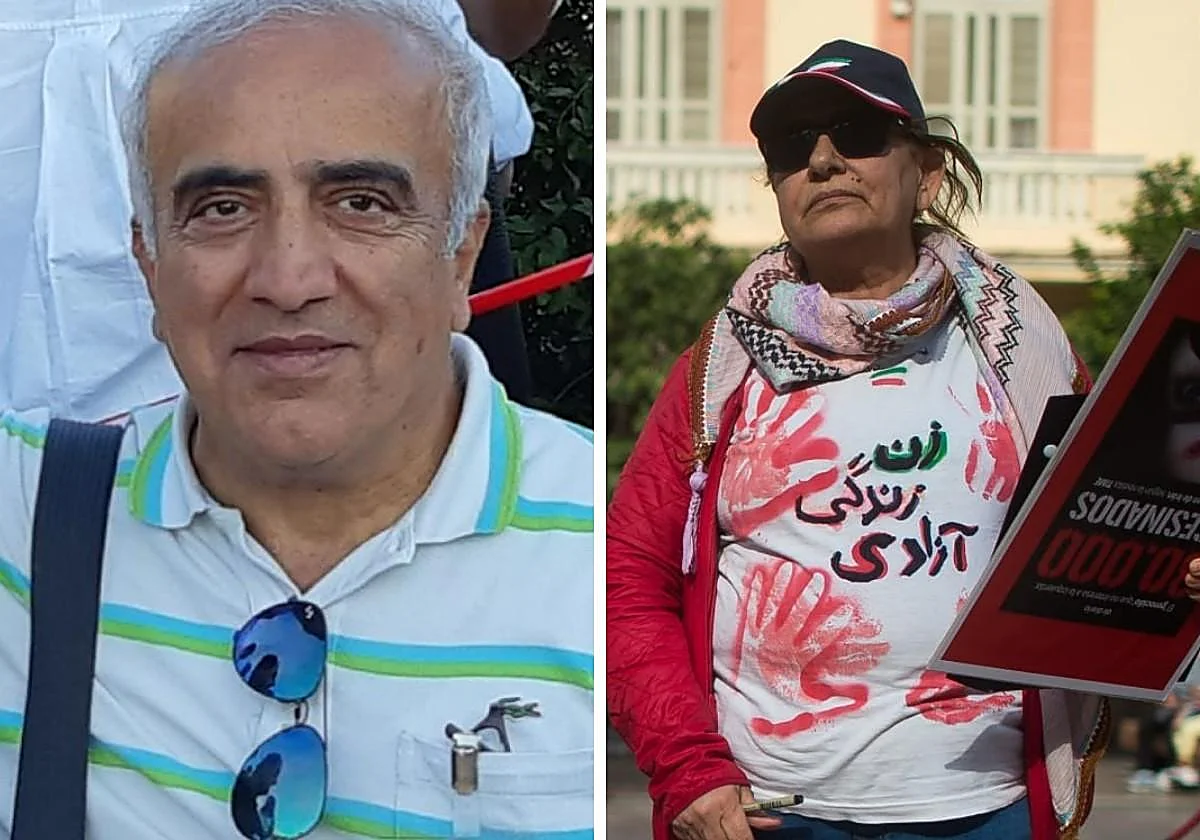
Zoom
Two Iranians who have lived in Spain for three decades. SUR Middle East war 2026 Iran's diaspora in Malaga divided over war but united in longing for democracyWith 20% of Spain’s Iranian population residing in Malaga, local exiles grapple with the ethics of foreign intervention versus the brutality of the Islamic Republic
Thursday, 5 March 2026, 12:54
The Iranian community in Malaga province find themselves watching events in their homeland unfold with a mixture of anguish, defiance and deep division over whether foreign intervention can ever deliver the democracy they long for.
Of the approximately 15,500 people of Iranian origin residing in Spain, practically 20 per cent have chosen Malaga as their home. In this article, SUR speaks to four members of the Persian diaspora to gather their thoughts on the US's attack on Iran.
While all of them agree that the regime of the Islamic Republic of Iran, established after the 1979 revolution, is terrorising the population, many condemn the bombings that the US and Israel have been launching since last weekend.
Nurse Sarah has spent 47 of her 63 years outside Iran. After Khomeini’s revolution, she first went to the UK and Sweden, but Benalmádena has been her home for the last 17 years. Her entire family had to leave Iran because of her activism for women's rights and civil liberties. She says that a large part of the Spanish population is not aware of the degree of repression that Iranian people suffer.
Despite her rejection of the ayatollahs' regime, she is highly critical of the operation launched by the US and Israel. "I don't want them to change the regime for us. I don't want 'big money' to be the one to overthrow the ayatollahs. It has to be the Iranian people who do it," she says.
"I don't want them to change the regime for us. I don't want 'big money' to be the one to overthrow the ayatollahs. It has to be the Iranian people who do it."
Sarah
According to Sarah, the two military powers "are destroying the country" instead of "acting in the best interests of the Iranian people".
Her hopes lie with the Iranian women, who have been at the forefront of the regime opposition in recent years. "Young women have been fighting for their freedom, for the ability to live their lives, for the ability to choose as European women do," Sarah says.
Sarah is equally against the prospect of the Pahlavi dynasty returning to Iran in the person of the last shah's son: "His father (referring to Reza Pahlavi, who was overthrown in the 1979 Iranian revolution) was a dictator installed by the US. He is not the solution. Perhaps a minority of Iranians want that dynasty to return, but not the majority."
"I stand with neither the Islamic regime nor with Trump or Netanyahu"
Nick Vaziri felt the atrocity of Khomeini's revolution closely, when the regime killed his girlfriend at the age of 23 in 1983. Nick went to prison, where his life was also hanging by a thread.
As soon as he could, he crossed the border into Pakistan through the mountains and from there took a flight to the Netherlands. He then came to Spain, where he has been living for 30 years and runs his own business in Benalmádena. A left-wing activist since his youth, he is still involved in various Iranian human rights movements, not only in Spain, but also in Austria, the Netherlands and Germany.
Despite his years-long commitment against the Islamic dictatorship, he disagrees with the US and Israeli military operation. "I am neither with the Islamic regime nor with Trump or Netanyahu. Iran needs international support and Europe and the UN need to collaborate with the opposition to the regime, but no war has ever brought democracy to any country."
He agrees with Sarah that the son of the last shah should not lead the new Iranian era. "How can a leftist support the shah's son?" he asks himself.
Wahid Rahmani has lived in Mijas since 2010, but he has been outside of Iran since 1982. "The shah's son would be a puppet of the US and Israel. He is not the solution. We want a democracy," he says.
His opinion on the current armed conflict, however, differs from that of his two compatriots. "When the Muslims took power, they stripped the people of all their rights. It's an unparalleled dictatorship. There's no similar example in the world. The Iranian population can't protest against the government, which controls everything," he says.
Wahid believes that there's no other solution. "Politicians who are considering this American imperialism are unaware that there is truly no other option. The bombs are welcome if the alternative is the regime killing 20 or 30 young people a day in prisons before dawn," he states.
Sarah, 50, has also chosen the Costa del Sol to change her life. Although she is outside of Iran, she doesn’t feel like she has escaped the regime and fears sharing too much information about herself. According to her, the Iranian regime can reach the Persian diaspora anywhere.
"I'm not happy about the bombings these days, but I'm not happy about the regime either. Nobody likes this government," she states. She has spent half her life outside her country. She left with her family a quarter of a century ago and took refuge in Dubai, where her mother lives. "The attacks aren't just impacting Iranians. What's happening is crazy. So many people are suffering," she says, sharing the pain of the Iranian community.