Health
Malaga baby with congenital liver condition is reborn in CordobaLaura was barely five months old when her aunt, also Laura, became her living donor
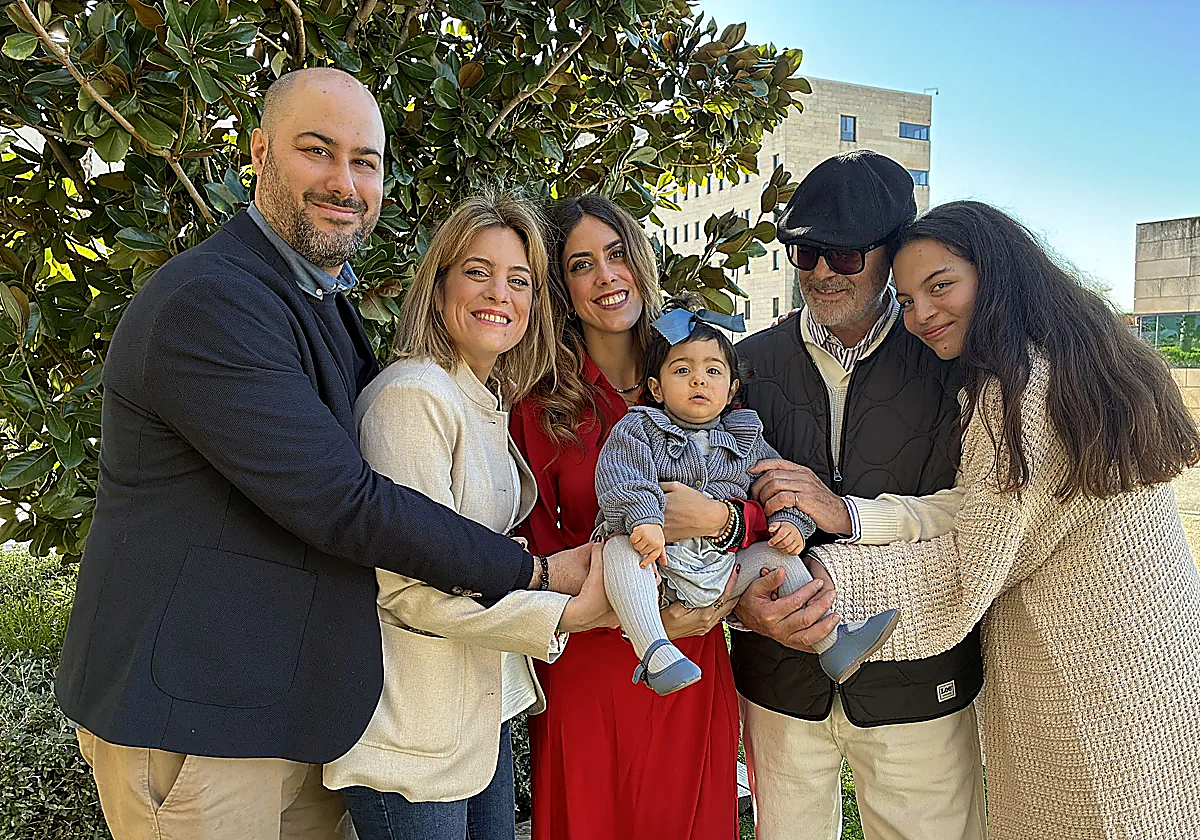
Añádenos en Google Little Laura in her aunt's arms, alongside her parents David Jiménez de la Plata and María de Haro, her sister and another relative. (SUR)Susana Zamora
03/06/2026 a las 11:33h.Little Laura loves to talk, although sometimes only those who live with her understand her. She's curious about everything, never stops moving and finds something new to explore every day. She runs, plays, protests when she doesn't like something and tests her parents' patience like any other child her age.
"She's pure joy," her mother, María de Haro, says. "She's light. She herself is a little bundle of light in our lives."
But just a year ago, this little girl's life depended on a transplant. "She was born on 20 December 2024, in Malaga, and was reborn on 21 May 2025, in Cordoba," Laura's family explains, summarising in a few words a complex medical process and an experience that changed them forever.
Related story
Laura was born at the Materno Infantil hospital with biliary atresia: a rare congenital condition in which the ducts responsible for transporting bile do not develop correctly. The progressive accumulation of this bile damages the liver and can lead to cirrhosis. In these cases, a liver transplant is the only cure.
At first, the illness presented similarly to other common conditions in newborns. The baby girl had jaundice. Her skin had a yellowish tint and she received the usual treatments. However, weeks passed and there was no improvement.
The worry grew until the family received a call that changed all their plans. Two months after the baby was born, they had to travel to the Reina Sofía hospital in Cordoba for further tests.
"We were prepared to stay for three days and it ended up being three months," María says. The biopsy in April last year confirmed the seriousness of Laura's condition. The doctors said that the girl needed an urgent transplant and she was placed on the national priority list. Time was running out.
"We weren't aware of how bad her condition was," her mother says. "But if our little girl hadn't gotten a transplant, she would have died."
Laura's aunt didn't hesitate to step forward. "I told my sister: I'm coming to Cordoba and tomorrow, if necessary, we'll get a transplant." So came the tests, the compatibility assessments and the psychological evaluations required in any living-donor transplant process.
Laura de Haro, a 40-year-old pharmacist and clinical nutritionist, was a match. The baby's father, David Jiménez de la Plata, and her mother could not become donors for medical reasons.
Pioneering technique
The procedure took place on 21 May 2025. Currently, only four Spanish hospitals have the capacity to perform living-donor liver transplants: La Paz, La Fe, Vall d'Hebron and Reina Sofía (the hospital in Cordoba).
The surgery incorporated a particularly advanced technique. Robotic surgery for living-donor liver transplant first launched in 2024.
Laura de Haro remembers little of the operating theatre and much of the recovery. She suffered severe anaemia, several months of sick leave and prolonged rehabilitation to recover from the surgery. "Of course it hurts," she says. "Anyone who says otherwise is lying, but the pain passes."
Meanwhile, little Laura was restarting a life that had barely begun before it was cut short. After the surgery, she remained sedated for several days. Her body needed time to adapt to the new organ. The doctors monitored every development, every test and every response of a body that was barely five months old. Her mother remembers that even then the little girl seemed determined to keep going.
The post-surgery period required wound care, checkups and a long list of medications that the family learnt to administer with almost pinpoint accuracy. As the months passed, they gradually reduced the daily steps in their routine. "Every time they took her off a medication, it was a joy," María says. "It meant she was doing well."
Nowadays, they still have to tick off certain boxes every day. Before meals, Laura must take specific medication and the entire family schedule revolves around those times. "We've adapted. If she has to have dinner at 8pm, we all eat at 8pm."
Beyond these measures, life is very similar to that of any other family with a young child. "If we don't tell anyone she's had a transplant, no one will know," María says. "She has her tantrums, her quirks, her picky eating habits. She's an absolutely normal child."
Medical checkups confirm that Laura is stable. Her growth is within the percentile for her age and the transplant response is proving to be "very positive".
For María, however, the learning goes far beyond clinical reports. Her time in the hospital changed the way she sees others and also the way she understands everyday problems. "We empathise much more with people going through a similar situation," she says. "We've learnt what is truly a problem and what isn't."
The experience has also strengthened family bonds, those between the little girl and her aunt, but also between the sisters. When María speaks of Laura, she is overcome by emotion.
"It's the most beautiful thing anyone has ever done for someone," she says. "My sister has given my daughter a second chance in life." Before ending the phone conversation with SUR, María shares: "I don't think I'll live long enough to thank her."
The story of Laura de Haro and her sister María is deeply intertwined with the El Palo district, where their family has left an indelible mark. Daughters of special education teacher Francisco de Haro, they come from a long line of educators, a legacy their grandfather Francisco de Haro established. He was a beloved teacher in the area and the roundabout named after him is a living proof.