Zoom
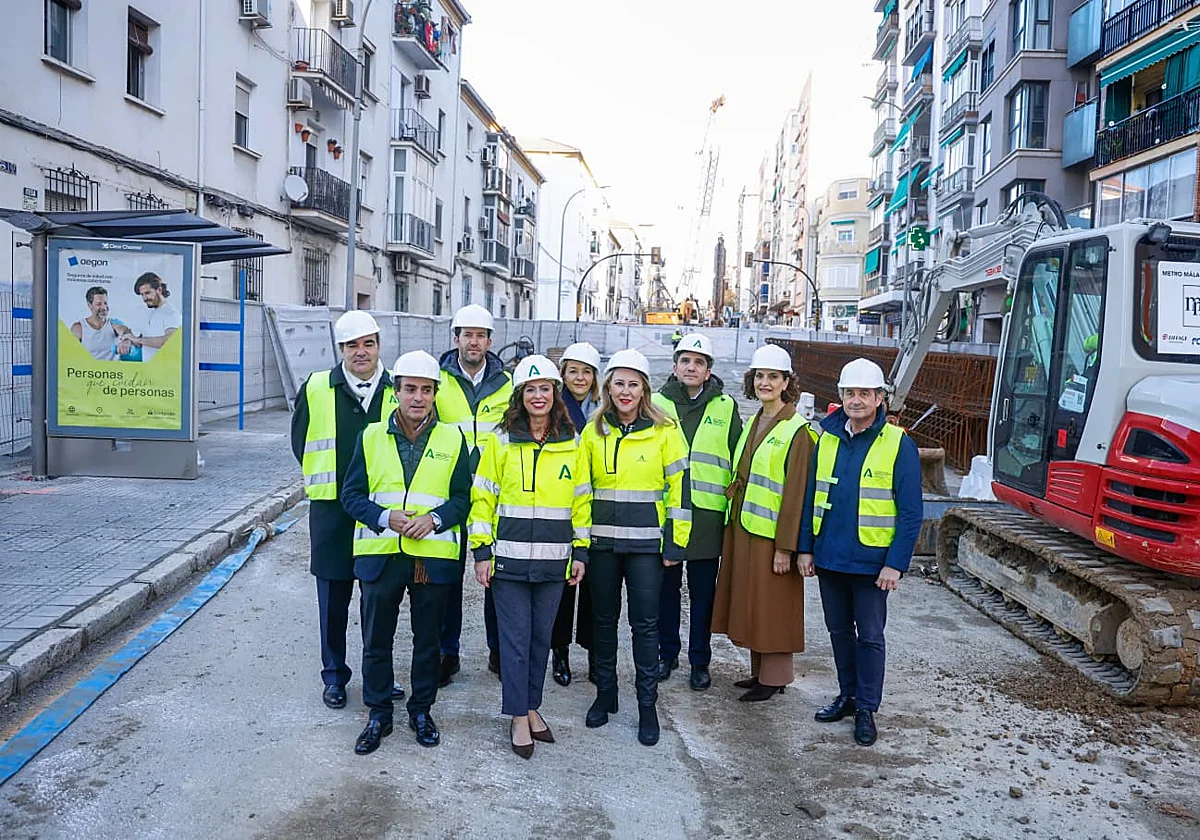
Regional ministers Díaz and España, (centre front), accompanied by other officials and site engineers. Marilú Báez Infrastructure Malaga metro work on track with all sections of new extension under way in 2026The underground line will run between the El Corte Inglés department store and the city's Civil Hospital, involving an investment of 244 million euros
Malaga
Wednesday, 31 December 2025, 11:47
The existing Line 2 of Malaga's metro system currently runs from the Martín Carpena arena to El Corte Inglés department store. From there, the Junta de Andalucía's ministry of public works (Fomento) reports they are making good progress on the extension up to the Civil Hospital and the future third hospital (Tercer), whose construction is scheduled to begin in January 2026 barring anything unforeseen, as the contract has just been awarded.
The new metro line will continue along Hilera, Santa Elena, Eugenio Gross and Blas de Lezo streets. The project has been divided into three sections. The first is 60% complete, with the retaining walls in place and work progressing on the roof slab that will cover the tunnel. Once finished, this will allow the street to be reopened to traffic and pedestrians. The second section, currently well into the excavation phase with two diaphragm wall-piling machines at work, is at 8% completion. The third section, extending to the hospital area, is in the tendering phase and will be awarded in the first quarter of next year. In short: the entire route will be under construction throughout 2026, when progress is also expected on the study that will indicate whether the next step is to take the metro to Ciudad Jardín, the PTA or the East.
244
million euros is the estimated investment budget, including the civil engineering work, construction of all facilities and architectural design and railway signalling for all three sections.
On Monday morning, the regional minister of public works, Rocío Díaz, and the Junta de Andalucía's minister of European funds and finance, Carolina España, visited the construction site in Calle Eugenio Gross. Both highlighted that the Junta president Juanma Moreno's political commitment is now being realised. They also mentioned, although it was not the purpose of the visit, the imminent start of construction on the future hospital.
60%
completion on the first section, between El Corte Inglés and Hilera. Wall-retaining screens are in place and work is in progress on the roof slab. The road surface will be restored shortly. A slight delay occurred due to the discovery of a Roman necropolis whose presence had not previously been documented.
The public and business information office for the metro extension work is also located in this area. According to the engineers in charge of the project, lighting and accessibility (with pedestrian walkways of 1.5 metres wide) are a top priority for the team, which is coordinating with the relevant municipal departments (traffic, commerce and so on). In fact, Malaga city council has launched a campaign to promote businesses in the area, with videos that can be seen, for example, on board the city's EMT buses.
Malaga city's councillors for mobility, Trinidad Hernández, and for social rights and the city centre, Francisco Cantos, were also part of the visiting delegation to view progress on the second section at Eugenio Gross.
8%
Work on the second section, between Santa Elena and Eugenio Gross, is underway and the work to install the retaining walls is progressing at a good pace.
The three extension sections constitute an investment of 162 million euros. According to Díaz, the two sections already under construction total 100 million euros.
"The investment figures clearly reflect the scale of the regional government's efforts. 2026 will be the first year in which all three sections, comprising the 1.8 kilometres of track between Guadalmedina station and the hospital, will be under construction at the same time," said Díaz.
Díaz explained that a budget of 51.8 million euros has been allocated for 2026, some 62% more than this year. "The need for the metro extension is reinforced by the recent awarding of the contract for the new hospital for 543 million euros."
"The metro is progressing, with investments, with work in progress and with respect for Malaga's history ", she stated, referring to the discovery of a Roman necropolis in Calle Hilera. She mentioned the experience gained from managing construction work alongside an archaeological dig and the ongoing coordination with the regional ministry of culture.
62
million euros is the budget currently out to tender for the third section, extending to Blas de Lezo. Sixteen companies are vying in their bids to build it.
Carolina España said was pleased with the progress: "I want to remind everyone that this was a promise made by Juanma Moreno when he wasn't even yet Junta president and he said that he would extend the metro underground to the Civil Hospital. Not only to the Civil, but also to the Maternity Hospital and the Third Hospital. This is a regional government that delivers for Malaga. These were unfulfilled promises made by the previous socialist-led Junta, specifically by María Jesús Montero, who made so many promises about the new hospital."
The second team to excavate and install retaining walls has joined the work on the second section of Malaga's metro extension in Calle Eugenio Gross, after the first team started work a couple of weeks ago on Calle Santa Elena. These diaphragm walls are the longitudinal walls that define the tunnel and station area along the metro line.
'Cut and cover' explained
The Malaga metro's new tunnel is being built using the 'cut and cover' method, which involves first constructing the longitudinal walls and then laying the concrete roof slab to cover the tunnel.
The Hilera-Eugenio Gross section is 653 metres long, including construction of La Trinidad station, for an investment of 46.4 million euros. Work on this second section began last June.
Following the construction site being set up along the entire route, including Avenida Purísima where the materials storage area has been set up, and the entire traffic diversion plan being implemented, the work site now occupies the entire route from the end of the first section on Calle Hilera to the intersection with Calle Blas de Lezo, which belongs to the third section leading to the Civil Hospital.
Temporary parking
This second section also includes construction of a temporary parking area for residents on Calle Jorge Loring, with 32 spaces, which will be made available in the first quarter of 2026 and will compensate for the loss of parking spaces on the streets occupied or affected by the ongoing work. Likewise, the main work in this first phase of the project consists of identifying and rerouting affected utilities, such as the sanitation and urban water supply networks. In addition, a large tree located along the route has been transplanted.
Slab covering
In the first section, Guadalmedina-Hilera, construction of the tunnel's slab covering continues, while excavation between the retaining walls has already begun at the western end of Calle Hilera, at the intersection with Calle Santa Elena. Beyond this area, along the axis of Calle Hilera, complex archaeological survey work continues following the discovery of a Roman necropolis from the high and late imperial periods (2nd to 4th centuries AD). This find has necessitated a revision of the project schedule, following the resolution issued by the regional ministry of culture confirming the scale and exceptional nature of the findings and their impact on our understanding of Malaga's history.
Utilities affected
At the other end of this first section, near Calle Armengual de la Mota and Avenida de Andalucía, 35 metres of the first tunnel level have already been excavated. Work is now under way to relocate affected utilities above the roof slab, which will allow the urbanisation and public road restoration work to begin in January in this key area of the city.
The extension of the Malaga metro to the new hospital, made possible with co-financing from the European Union's ERDF (European Regional Development Fund), will have a total length of 1.8 kilometres, entirely underground, and it has been divided into three sections for the execution of the civil engineering work, including the construction of a station in each section. The estimated investment budget, including the civil engineering work, construction of all facilities and architectural design and metro signalling, is 244 million euros.