Emily DeMarco
Writer/Editor (IV)
Feb 20, 2026 ArticleContents
- Part of Floreana Island is shown in the Galápagos, where ongoing restoration efforts aim to make the landscape ready for the return of giant tortoises.Credits: © Galápagos Conservancy, used with permission
That’s where NASA satellite data comes in.
NASA Earth observations allow scientists to map environmental conditions across the islands and track how vegetation, moisture, and temperature shift over time — clues to where tortoises can find food and water.
Using those records, Gibbs and Giorgos Mountrakis, the project’s principal investigator, and their team built a decision tool that combines satellite measurements of habitat and climate conditions with millions of field observations of tortoise locations across the archipelago to guide where, and when, to release the animals.
“Habitat suitability models and environmental mapping are essential tools,” said Christian Sevilla, the Director of Ecosystems at the Galápagos National Park Directorate. “They allow us to integrate climate, topography, and vegetation data to make evidence-based decisions. We move from intuition to precision.”
This map shows modeled giant tortoise habitat suitability across the Galápagos under current environmental conditions, with colors ranging from low to high, indicating increasing likelihood of suitable food, moisture, and nesting habitat availability.Wanmei Liang/NASA Earth ObservatoryThe decision tool draws on multiple NASA and partner satellite missions. Landsat and European Sentinel satellites track vegetation conditions. The Global Precipitation Measurement mission provides rainfall data. The Terra satellite helps estimate land-surface temperature, and terrain data adds elevation and landscape features. In some cases, high-resolution commercial satellite images, acquired through NASA’s Commercial Smallsat Data Acquisition Program, help teams evaluate potential release sites before field surveys begin.
With tortoise-environment relationships in hand, the team can map habitat suitability today and forecast how it may shift decades into the future as environmental conditions change.
“The forecasting part is critical,” said Mountrakis, of the State University of New York College of Environmental Science and Forestry in Syracuse. “This isn’t a one-year project. We’re looking at where tortoises will succeed 20, 40 years from now.”
Because the tortoises can live more than a century, habitat conditions decades from now matter as much as conditions today.
More Than Conservation
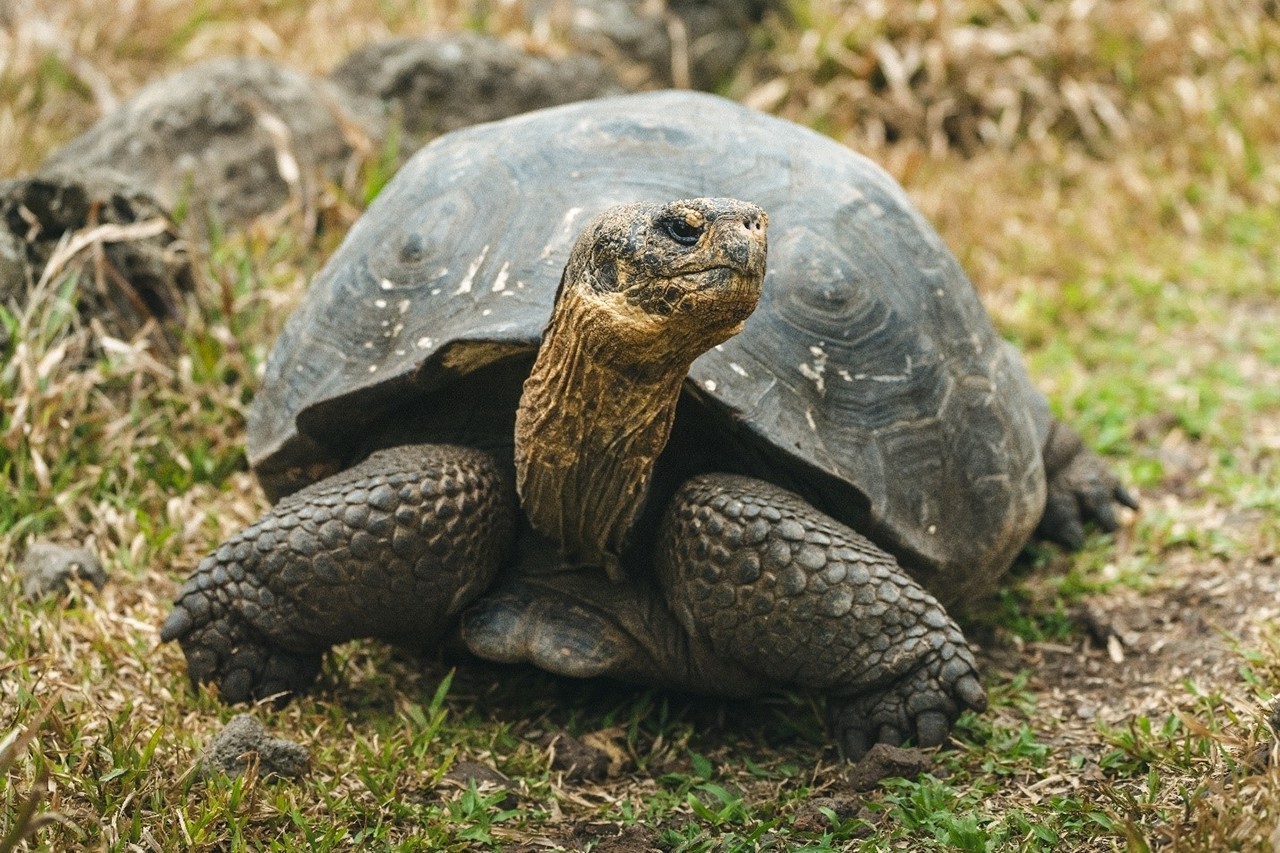
The tortoise release is part of the larger Floreana Ecological Restoration Project, which aims to remove invasive species like rats and feral cats and eventually return 12 native animal species to the island, with tortoises serving as the keystone for rebuilding the ecosystem.
This Landsat 8 image of Floreana Island from October 6, 2020, shows dry coastal lowlands surrounding greener, higher-elevation vegetation toward the island’s center.Wanmei Liang/NASA Earth ObservatoryThe Galápagos Conservancy is also using NASA satellite data and the decision tool developed to help guide tortoise releases on other Galápagos islands and to plan future reintroductions across the archipelago.
If successful, Floreana Island could once again support a large tortoise population, helping restore relationships between animals, plants, and the landscape that shaped the island for thousands of years.
“For those of us who live and work in Galápagos, this [release] is deeply meaningful,” Sevilla said. “It demonstrates that large-scale ecological restoration is possible and that, with science and long-term commitment, we can recover an essential part of the archipelago’s natural heritage.”
About the Author
Emily DeMarco
Writer/Editor (IV)Share
Details
Last Updated Feb 20, 2026Related Terms
- Earth
- Global Precipitation Measurement (GPM)
- Goddard Space Flight Center
- Human Dimensions
- Landsat
- Life on Earth
- Terra
- Vegetation
- Wildlife
Explore More
3 min readWinds Whip Up Fires and Dust on the Southern Plains
Dry, gusty conditions spurred fast-growing fires in Oklahoma and Kansas, along with dangerous dust storms…
Article 16 hours ago 3 min readNorthern Glow Spans Iceland and Canada
A vivid display of the aurora lit up skies over the Denmark Strait and eastern…
Article 2 days ago 1 min readCommodity Classic 2026 Hyperwall Schedule
Article 2 days ago Keep ExploringDiscover More Topics From NASA
Earth
Your home. Our Mission. And the one planet that NASA studies more than any other.
Earth Observatory
NASA's Earth Observatory brings you the Earth, every day: images, stories, and discoveries about the environment, Earth systems, and climate.
Explore Earth Science
Earth Science in Action
NASA's unique vantage point helps us inform solutions to enhance decision-making, improve livelihoods, and protect our planet.