Downloads
NASA’S Juno Misson Captures Jupiter Moon Thebe
JPEG (152.30 KB)
Description
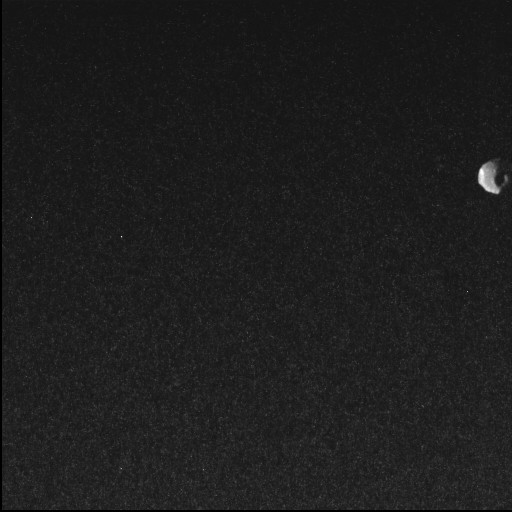
NASA’s Juno spacecraft captured this view of Thebe, the second largest of Jupiter’s inner moons, during a close pass on May 1, 2026. The spacecraft’s Stellar Reference Unit (SRU) captured this image from a distance of approximately 3,100 miles (5,000 kilometers) at a resolution of about 1.9 miles (3 kilometers) per pixel.
Thebe resides at the outer edge of Jupiter’s faint ring system and is believed to play a role in the formation of the planet’s “gossamer” ring through the shedding of dust.
While the SRU’s primary function is to image star fields for navigation, its high sensitivity in low-light conditions makes it a powerful secondary science instrument. The SRU has previously been used to discover “shallow lightning” in Jupiter’s atmosphere and to image the planet’s ring system.
A division of Caltech in Pasadena, California, JPL manages the Juno mission for the principal investigator, Scott J. Bolton, of the Southwest Research Institute in San Antonio. Juno is part of NASA’s New Frontiers Program, which is managed at NASA’s Marshall Space Flight Center in Huntsville, Alabama, for the agency’s Science Mission Directorate in Washington.
For more information about Juno, visit: https://www.nasa.gov/juno
Keep ExploringDiscover More Topics From Photojournal
Photojournal
Search Photojournal
Photojournal’s Latest Content
Feedback