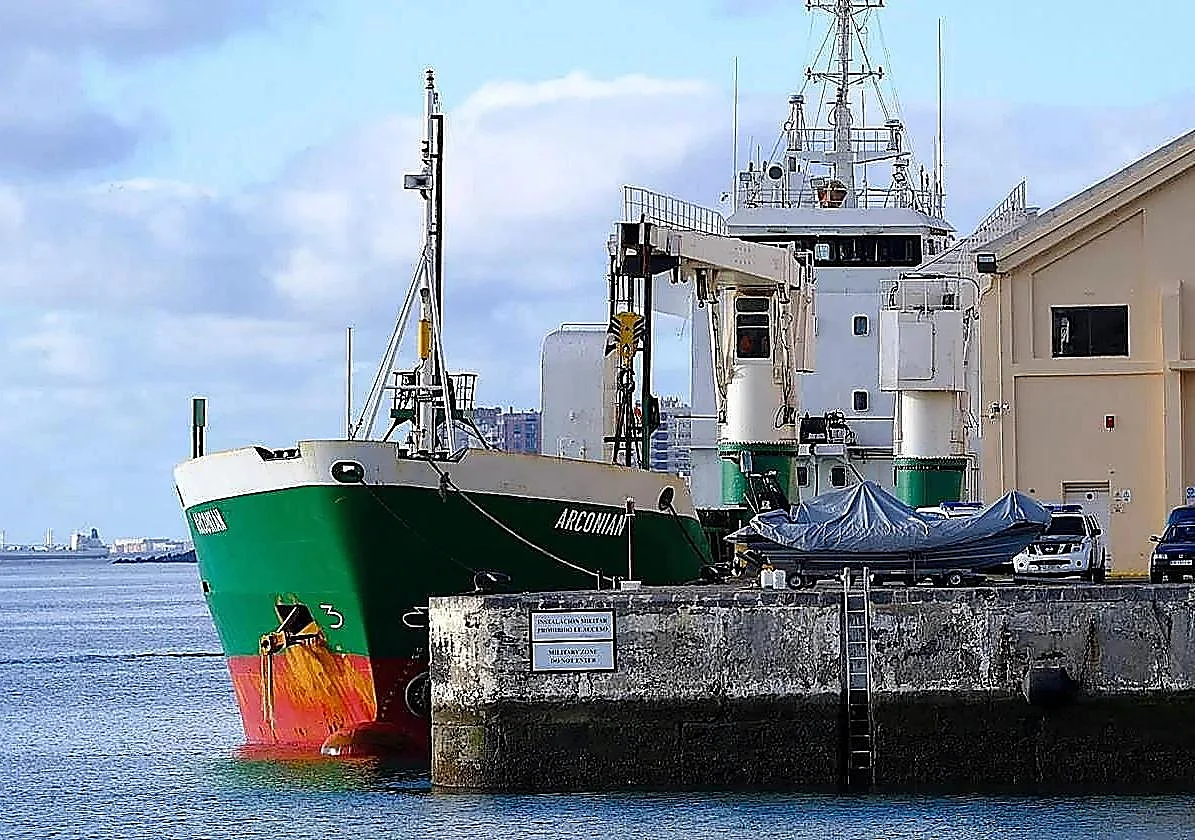
The Guardia Civil escorted the cargo ship Arconian to the Port of Las Palmas, it is estimated that between 30 and 45 tonnes of cocaine was seized
The ship Arconian, from Sierra Leone, in the Port of Las Palmas on Monday. (Juan Carlos Alonso)C. S.
04/05/2026 a las 15:56h.The Guardia Civil intercepted a merchant ship in the Atlantic loaded with a large consignment of cocaine, which could rank among the largest seizures to ... date in Spain. The cargo ship, named Arconian and flying the Comoros flag, arrived at the port of Las Palmas de Gran Canaria on Sunday afternoon, escorted by a patrol boat from the Guardia CIvil.
The 23 crew members were arrested on arrival at the port and the authorities proceeded to weigh the packages. According to preliminary reports, the haul could amount to between 30,000 and 45,000 kilos of cocaine.
The operation, which is being carried out under the supervision of the national court and remains subject to judicial secrecy which currently prevents the disclosure of specific details regarding the quantity of drugs seized. However, sources close to the investigation suggest that the shipment could even exceed the nearly ten tonnes of cocaine seized in January during another maritime operation west of the Canary Islands.
The vessel had set sail on 22 April from Freetown (Sierra Leone) with a declared destination of Benghazi (Libya), although its journey was intercepted as part of an international operation against drug trafficking in which Customs Surveillance officers are also reported to have taken part. Once in port, a thorough search of the vessel will be carried out.
This latest police crackdown confirms the archipelago’s strategic role in international drug trafficking routes. In the first few months of 2026, the security forces have stepped up their activities with dozens of operations and tonnes of drugs seized, particularly cocaine and hashish, against a backdrop of a global rise in the production and consumption of narcotics.
Drug trafficking on the rise
Higher production, lower prices and increased consumption are keeping drug trafficking at record levels, an upward trend that police are attempting to curb. This saw a thousand investigations in 2025, 1,893 arrests and over 130 tonnes of narcotics seized, with hashish leading the way at 70.5 tonnes – triple the amount from the previous year.
Following close behind, the 60 tonnes of cocaine seized by the national police last year continues the rise in seizures of this drug, whilst heroin seizures have also risen, totalling 66 kilos. In a single operation in December, 8 kilos of heroin in tablet form were seized – a quantity similar to the total seized in 2024.
Seizures of cannabis, like those of hashish, remain at record levels, particularly the removal of plants, which rose from 7,400 to over 35,000 last year, whilst more than 1,700 kilos were confiscated, slightly more than in the previous year. The data is taken from the statistics of the central criminal intelligence unit relating to police activity carried out in 2025 by the Central Unit for the fight against drugs and oganised crime (Udyco) and its central narcotics brigade.
With the first four months of 2026 now complete, the police crackdown on drug trafficking shows no sign of letting up. From January to April alone, more than thirty operations were carried out, resulting in 187 arrests. The drugs seized, almost 60 tonnes, are divided equally between cocaine (25.3) and hashish (25.5), with half a dozen large hauls.
Notable among these are the largest cocaine seizure by sea in Europe since 1999, nearly 10 tonnes carried by a vessel intercepted 535 kilometres from the Canary Islands, as well as the 17.5 tonnes of hashish seized in various operations that uncovered the latest drug tunnel in Ceuta.
Investigators suspect that large quantities of hashish have been smuggled through its tunnels from Morocco in recent years; they have not ruled out the possibility of further tunnels, according to Canarias7.
With the figures on the table and having only just returned from the presentation of the 5,000-kilo cocaine haul seized off the coast of Huelva, the commissioner in charge of the Central Narcotics Brigade, Alberto Morales, points out that since he joined the brigade in 2001, he has “never seen such a run of drug seizures”.
“The figures are a good indicator, but they do not mean that officers work more or less hard to seize more or less drugs,” he warns, before emphasising that if the analysis of ‘statistics’ is of any value at all ( and it is of great value) it is to open up new avenues of investigation and improve police effectiveness.