Zoom
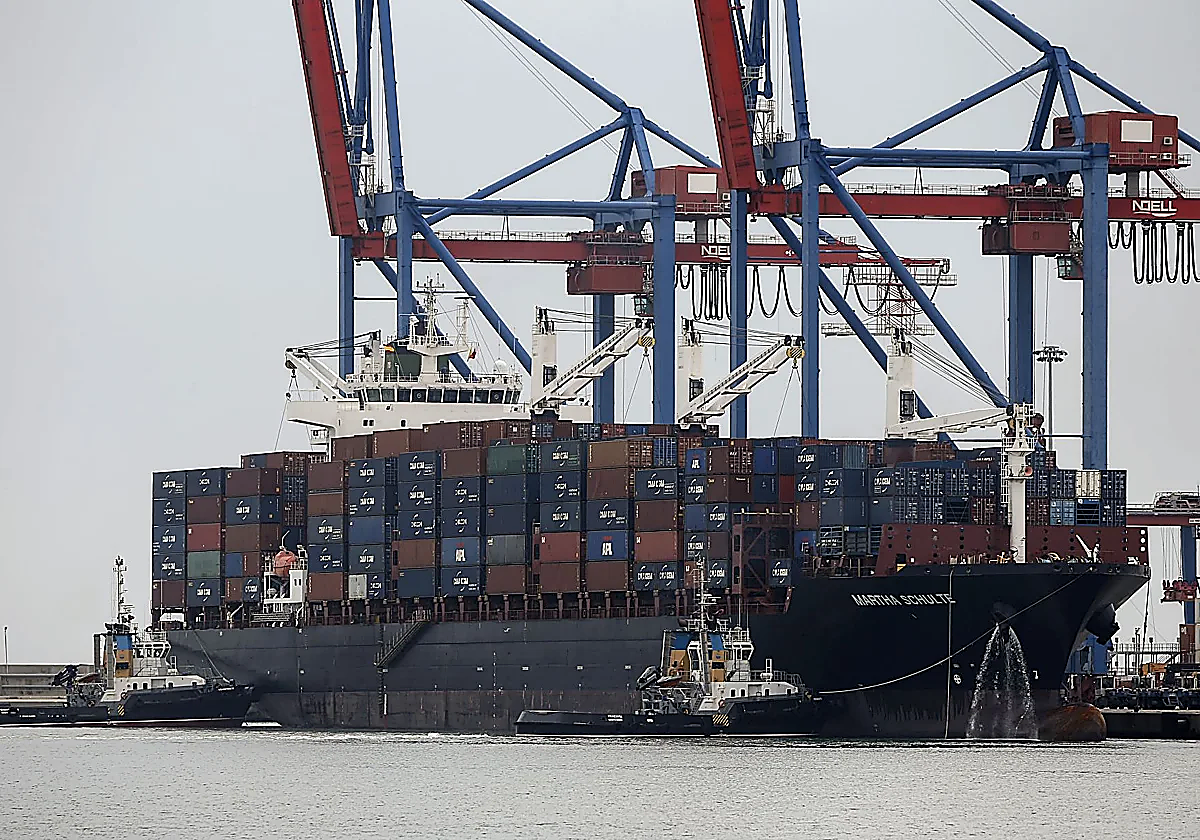
A container ship docked at Malaga Port. Ñito Salas Geopolitics Malaga Port records surge in container traffic amid Persian Gulf crisisImports and exports at the Costa del Sol capital's docks skyrocketed in Q1 2026, with export growth rates exceeding 300%
Ignacio Lillo
Malaga
Wednesday, 22 April 2026, 13:30
The ongoing conflict in the Persian Gulf and the subsequent blockade of the Strait of Hormuz have triggered a record-breaking boom at the Port of Malaga. Strategically positioned near the Strait of Gibraltar, the port has become a vital alternative for international freight as global shipping companies reroute to avoid high-risk zones.
From January to March 2026, container traffic in Malaga has quadrupled in several categories compared to the first quarter of 2025. According to the Malaga Port Authority, the export of full TEUs (Twenty-foot Equivalent Units) has surged by over 300% in both volume and tonnage. Historically a transit point for empty units, the port has successfully transitioned into a primary hub for full-load cargo.
The second area where this growth is clearly evident is the import of full containers. In this case, the increase ranges from 58% to 75%, depending on whether the number of containers or the tonnage handled is taken as the benchmark. The volume of full containers transported by sea has also risen, by up to 40%. In conclusion, across all market segments, almost 94,000 containers have been moved in three months, with a combined weight of 1.2 million tonnes.
"The underlying trend is the consolidation of the Port of Malaga, which has seen three consecutive years of growth, although the war in Iran and the blockade of the Strait of Hormuz are providing an additional boost, which is occasionally leading to excess demand," head of the Port Authority Carlos Rubio said.
The next meeting of the Port Authority will urgently address the lease agreement with infrastructure company Adif for part of the Los Prados logistics platform, in order to begin its occupancy imminently. "We need to relocate containers because there is no more space at the docks. We are looking for space outside for the less urgent containers," Rubio said.
What's happening in Malaga?
Rubio also highlighted the change in model, since Malaga previously specialised in empty containers in transit, whereas now it mainly handles full containers. "We now have greater interaction with the hinterland, particularly for exports but also for imports."
The products Malaga sells abroad via shipping containers are mainly meat and meat products; bottled olive oil; table olives; industrial goods; and textiles. Conversely, the goods arriving via this route are mostly fresh fruit from South America.
Rubio is optimistic about the future. "Traffic will continue growing. The war in the Persian Gulf is merely an additional strain, but even without this factor we would still be achieving record figures," he said.
Other goods
Total freight traffic, which also includes solid and liquid bulk cargo, supplies, roll-on/roll-off cargo (by lorries) and the import of new vehicles, shows equally positive results. In the first quarter of the year, Malaga Port handled almost 1.7 million tonnes, representing a 29% increase compared to the same period last year (1,289,420 tonnes).
At this point, there are significant differences depending on the product. For example, solid bulk cargo decreased by almost 12% compared to the same period last year (262,635 tonnes), although cement and clinker saw a slight increase. Liquid bulk cargo activity also declined. During the first quarter, 28,746 tonnes were handled, a 16% decrease. However, this variation is attributable to the fact that olive oil cargo increased (up 15%, to 28,746 tonnes). In other words, this product accounted for 100% of the liquid bulk cargo traffic during the first quarter, as diesel fuel saw no activity.
In the provisioning sector, fuel service to ships stands out, having increased by 261% (24,994 tonnes). Ro-ro traffic (roll-on/roll-off cargo) also grew by 7.5% (116,915 tonnes). Finally, imports of new vehicles decreased by 16%, with 22,262 units between January and March 2026.
Related story