Zoom
María Dolores Chando has decided to break into the world of professional fishing. M. J. A International Women's Day Motril port celebrates the 'hidden' women keeping the fishing industry afloatMore than 70 professionals gathered at the Costa Tropical town's port on International Women's Day to make the role of women in a historically male sector visible
MJ Arrebola
Granada
Tuesday, 10 March 2026, 17:15
The Port of Motril became a sea of change this International Women’s Day as over 70 female professionals gathered to shine a light on their vital - and often invisible - roles in the maritime industry.
From stevedores and customs officers to truck drivers and boat owners, the meeting at the Real Club Náutico de Motril proved that the "boys' club" of professional fishing is finally being dismantled.
At a glance: Motril’s female maritime pioneers
The Gathering: 70+ women from the Civil Guard Maritime Service, customs, haulage, and port management.
The Trailblazer: María Dolores Chando, currently the only woman among 20 students training to become a professional boat skipper.
The Skills: Training involves mastering engine mechanics, electronic navigation, and chart reading in the wheelhouse.
The Law: New regulations now force all companies with over 50 workers to implement specific, local equality plans.
The 'Invisible' Jobs: Recognition for net-menders (rederas), administrative staff, and fish market managers.
The president of Motril's port authority, José García Fuentes, welcomed the women and highlighted the port's commitment to equality. He said that the port authority has recently approved its first equality plan, a document which sets out the roadmap to ensure that men and women can develop their profession under the same conditions and without barriers.
García Fuentes went on to say that "more and more women are occupying positions of responsibility or carrying out jobs traditionally associated with the male sphere. Much remains to be done, but this is the way forward: to work together to achieve effective equality between men and women."
Belén Sánchez, the port authority's manager of the human resources, organisation and equality department, explained that meetings such as this one are part of a plan which came into being after the entry into force of the regulations which oblige companies with more than 50 workers to have their own equality plan.
Until then, the port was governed by a common plan for the whole of the Spanish port system, but the new legislation allowed the measures to be adapted to the specific needs of Motril's port.
A long way to go
Also present at the meeting was the manager of Motril's fish producers' organisation and technical advisor of the Andalusian association of women in the fishing sector, Inmaculada Carrasco, who highlighted the work of the women's associations in the sector. "Thanks to them, today many have a voice in decision-making related to fishing". The association has more than 300 members, which demonstrates the contribution of women to the fishing sector.
Carrasco recalled that, despite all the progress that has been made, many jobs remain unseen. The work of many women is carried out on land, in administrative, organisational or management tasks, and others are in charge of fixing nets while the men remain on board. The presence of women on board is still small, although "encouraging" examples are beginning to appear.
The only female skipper on the course
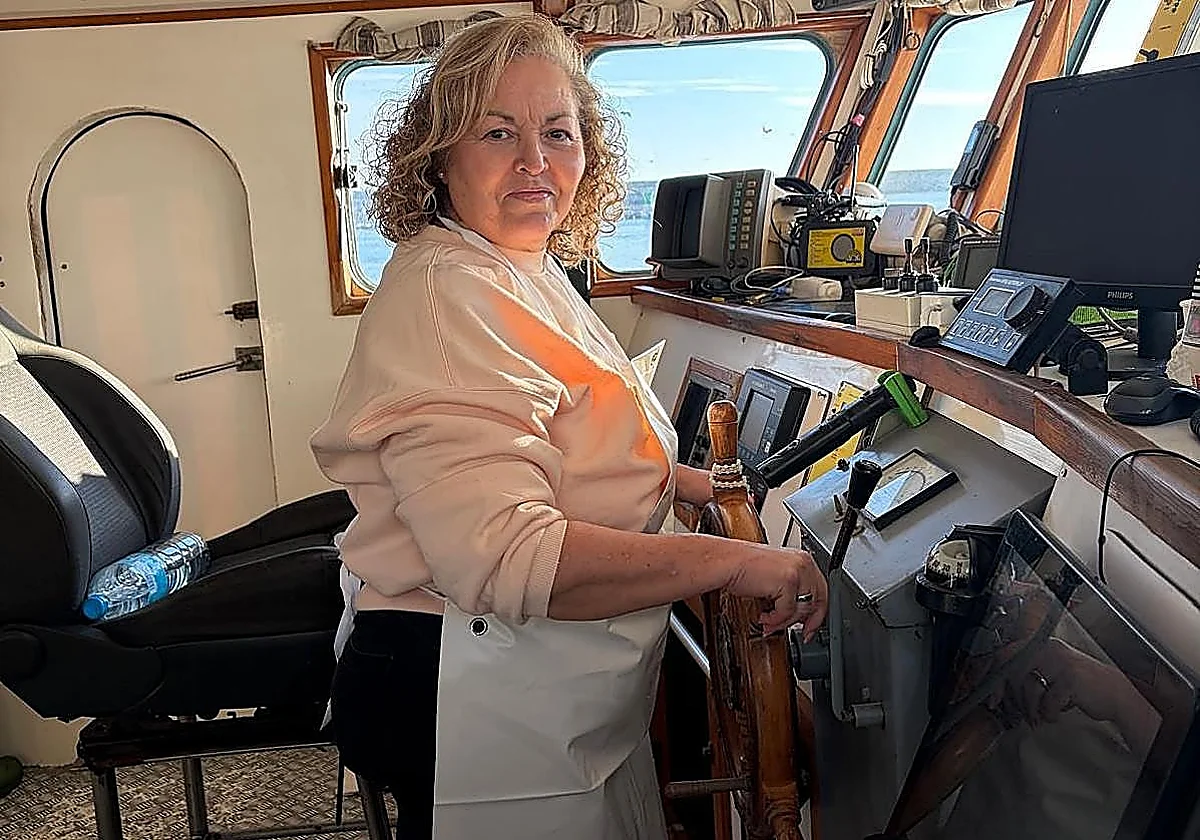
In a sector in which men have traditionally worked, María Dolores Chando has decided to break into the world of professional fishing. For the past few months, she has been training to become a boat skipper, a further step in her daily work as a trawler owner. Chando is currently doing coastal skipper training, a process that combines technical knowledge with a lot of practice.
The programme is divided into two parts: the first, which focuses on the engine room and boat mechanics, was completed last year. She is now in the second phase, where he is learning on the wheelhouse, where key aspects of navigation are studied, such as the use of equipment, reading charts and route planning. After completing the course, he will have to accumulate embarkation days in order to obtain the official qualification that will allow him to work as a skipper.
María Dolores says that out of 20 students on the course, "I am the only woman in the boat skipper course". Far from feeling uncomfortable, she says she feels fully integrated. "Everyone is doing their job and I am doing mine. And when necessary, we give each other a hand," she explains.
It was her husband who instilled her passion for the sea: "After many years together, you get the bug. You get to know things, you get excited and in the end you realise that you love everything to do with fishing and fish," she says.
This interest led her to train and take another step forward in a "very hard" profession, but one that she is passionate about. For María Dolores, learning is never too late, a philosophy she inherited from her family, specifically from her father. "As my father used to say, there is never a time or place to learn: there is always time".